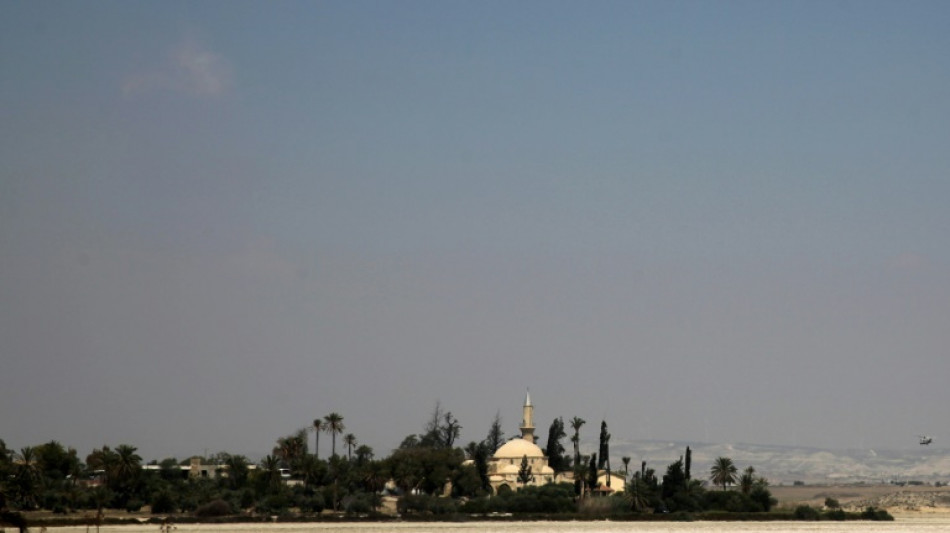
Cyprus dig reveals key trading hub in antiquity / Photo: Yiannis Kourtoglou - AFP

 NASA scan discovers new, 'once in a century' Moon crater

 Most stocks rise as Fed hikes and indicates drive to curb inflation

 UK-Sudanese author pens book to give children 'African history of Africa'

 US Congress passes sweeping Russia sanctions bill

 US stocks fall, dollar gains after Fed lifts interest rates

 US Fed raises rates to tackle 'too high' inflation in move sure to rile Trump

 US Fed raises rates to battle inflation in move likely to rile Trump

 US House faces test on sweeping Russia sanctions bill

 British PM says to make 'difficult decisions' as inflation rises

 Global fuel price demos: a round-up

 Leverate Launches MCP for Traders to Connect AI Assistants With Trading Platforms

 MEXC Launches $1M "Discover Your Wall Street DNA" Campaign to Help Traders Find Their Market Fit

 Stocks edge higher ahead of US Fed rate call

 BASIS.pro Expands On-Chain Infrastructure with XDC Network Partnership and Zypher DAO as Auto Earn Goes Live

 Pickle-flavoured tart? AI inspires Japan's convenience stores

 EU chief hosts Canada's Carney in push to 'deepen' alliance

 Meta chief pushes back on AI slowdown calls

 US Fed to deliver rate decision with markets betting on hike

 i-payout Expands U.S. Money Transmitter Licensing Footprint and Advances European EMI Strategy

 US Senate crypto bill collapses amid partisan deadlock

 OpenAI, Anthropic and Google are working to create an AI standards body

 Protesting shepherds, farmers clash with Romanian police

 Foundation Lets Ledger Users Switch to Open Source Without Starting Over

 EU to propose curbing social media, online games for under 15s

 FX Junction Reaches 40,600 Members and 26 Million Trades

A Swedish-led excavation on Cyprus has unearthed a wealth of artefacts suggesting an ancient port city in Larnaca on the south coast was the region's key Bronze Age trading post, an official said Wednesday.
"The city's wealth seems to have been based on the production of copper and trade with near and distant cultures," said Giorgos Georgiou, acting director of Cyprus' Antiquities Department.
"Judging by the rich burial gifts, the tombs belonged to families of the city's ruling class, which must have been involved in the export of copper and intercultural trade," he added in a written response to AFP.
He said the excavation site at Dromolaxia-Vyzakia was a Late Bronze Age harbour settlement, estimated by some authorities to be at least 25 hectares (60 acres) in size.
The settlement, which flourished from 1600 to 1100 BC, lies along the shores of the Larnaca salt lake at Hala Sultan Tekke.
Last month, the University of Gothenburg said it recently discovered tombs outside the Bronze Age trading metropolis.
It said they rank among the richest ever found in the Mediterranean region, and the precious tomb artefacts indicate their occupants ruled the city, which was a centre for the copper trade in 1500–1300 BC.
"Considering the richness of the grave goods, it is a reasonable assumption that these were royal tombs,"said Peter Fischer, an archaeology professor and leader of the expedition.
The tombs consist of underground chambers accessed via a narrow passage from the surface. The chambers vary in size, measuring up to 4 x 5 metres (yards).
The Swedish expedition, excavating around Hala Sultan Tekke since 2010, has previously found chamber tombs.
"We found more than 500 complete artefacts distributed among two tombs," it said.
"Many of the artefacts consist of precious metals, gems, ivory and high-quality ceramics," said Fischer on the university's website.
He said about half of the artefacts were imported from neighbouring cultures.
Gold and ivory came from Egypt.
Precious stones, such as blue lapis lazuli, dark red carnelian and blue-green turquoise, were imported from Afghanistan, India, and the Sinai, respectively.
The tombs also contain amber objects from the Baltic region.
- 'From cultures east and north' -
The tombs were discovered using magnetometers, an instrument that can detect objects and structures up to two metres beneath the surface.
Georgiou said three chamber tombs, preliminarily dated to the 14th century BC, were exposed during the most recent excavation season.
"One had been looted, most likely in the 19th century AD. "Two nearby tombs were found undisturbed."
The tombs contained locally produced pottery and ornaments, "as well as numerous items of jewellery and other imported objects from the Aegean, Anatolia, Egypt, the Levant and cultures further east and north".
He said other metal objects included jewellery of precious metals, diadems, daggers, knives, spearheads, and a mirror of bronze.
A.Zimmermann--CPN

