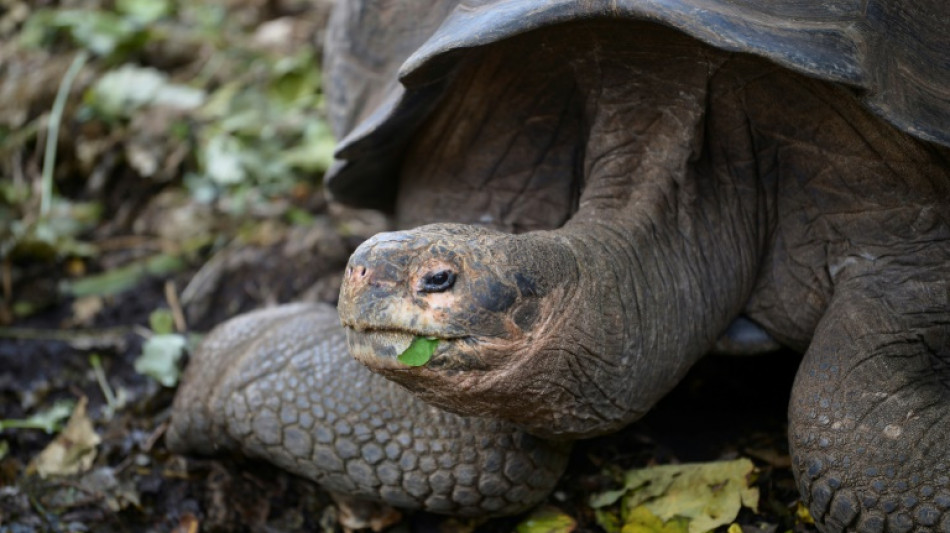
New giant tortoise species found in Galapagos after DNA study

 Wildfires push endangered Sumatran elephants to brink: Indonesian NGO

 Bank of Japan set to raise rates under pressure from inflation, US

 EU chief to unveil social media, gaming curbs for under-15s

 'Resident Evil' film brings video game's ethos to the big screen

 i-payout Expands U.S. Money Transmitter Licensing Footprint and Advances European EMI Strategy

 US Senate crypto bill collapses amid partisan deadlock

 OpenAI, Anthropic and Google are working to create an AI standards body

 Protesting shepherds, farmers clash with Romanian police

 Foundation Lets Ledger Users Switch to Open Source Without Starting Over

 EU to propose curbing social media, online games for under 15s

 FX Junction Reaches 40,600 Members and 26 Million Trades

 'We unleashed the beast': the world's fears and hopes about AI

 Hospitality leaders ask Burnham to halve VAT amid rising costs

 Worcestershire invited to nominate groups for 2027 King’s volunteer award

 Berlin's run-down public spaces at heart of election campaign

 'Widow's Bay' and 'The Pitt' win big at Emmy Awards

 Most markets drop as oil extends gains ahead of expected US rate hike

 Sri Lanka's famed beach shack battles demolition

 Vserv targets ₹1,000 crore revenue by 2030 through AI expansion

 India prohibits bank fees on UPI payments up to ₹2,000

 Brazil's Amazon defender Raoni has cancer

 Trump rejects AI slowdown concerns as UN urges coordinated controls

 Higher wages draw migrant workers to Kashmir despite attacks

 Oil supply concerns and AI warnings weigh on global markets

 'I am the hoax buster': Trump rejects AI danger warnings

A new species of giant tortoise has been discovered in the Galapagos after DNA testing found animals living on one island had not yet been recorded, Ecuador's environment ministry said.
Researchers compared the genetic material of tortoises currently living on San Cristobal with bones and shells collected in 1906 from a cave in the island's highlands and found them to be different.
The 20th-century explorers never reached the lowlands northeast of the island, where the animals live today, and as a result, almost 8,000 tortoises correspond to a different lineage to what was previously thought.
"The species of giant tortoise that inhabits San Cristobal Island, until now known scientifically as Chelonoidis chathamensis, genetically matches a different species," the ministry said Thursday on Twitter.
Galapagos Conservancy said in a newsletter that the Chelonoidis chathamensis species is "almost certainly extinct" and that the island had in fact been home to two different varieties of tortoise, one living in the highlands and another in the lowlands.
Located in the Pacific about 1,000 kilometers (600 miles) off the coast of Ecuador, the Galapagos Islands are a protected wildlife area and home to unique species of flora and fauna.
The archipelago was made famous by British geologist and naturalist Charles Darwin's observations on evolution there.
There were originally 15 species of giant tortoise on the islands, three of which became extinct centuries ago, according to the Galapagos National Park.
In 2019, a specimen of Chelonoidis phantastica was found on Fernandina Island more than 100 years after the species was considered extinct.
The study by researchers from Newcastle University in Britain, Yale in the United States, the American NGO Galapagos Conservancy and other institutions was published in the scientific journal Heredity.
They will continue to recover more DNA from the bones and shells to determine whether the tortoises living on San Cristobal, which is 557 kilometers long, should be given a new name.
pld/atm/ybl/je/cwl
Une étude ADN a révélé que les tortues géantes qui vivent sur l'île de San Cristobal, aux Galapagos, correspondent à une nouvelle espèce qui n'avait pas encore été recensée par la science, a déclaré jeudi le ministère équatorien de l'Environnement.
"L'espèce de tortue géante qui peuple l'île San Cristobal, jusqu'à présent connue scientifiquement sous le nom de Chelonoidis chathamensis, correspond génétiquement à une espèce différente", a indiqué le ministère sur Twitter.
Des chercheurs de l'université de Newcastle, de l'université de Yale, de l'ONG américaine Galapagos Conservancy et d'autres institutions ont comparé le matériel génétique de tortues vivant actuellement à San Cristobal, une île de 557 km de long, avec des os et des carapaces recueillis en 1906 par l'Académie des sciences de Californie dans une grotte située sur les hauts plateaux de l'île.
Au moment de la description de Chelonoidis chathamensis, le groupe d'expéditionnnaires qui a recueilli les ossements de la grotte n'avait jamais atteint les basses terres du nord-est de San Cristóbal, où vivent aujourd'hui les tortues.
De ce fait, "les scientifiques ont conclu que les près de huit mille tortues qui existent aujourd'hui à San Cristobal pourraient ne pas être des Chelonoidis chathamensis, mais correspondre à une toute nouvelle lignée", a expliqué le ministère de l'Environnement dans un communiqué.
Galapagos Conservancy a ajouté dans un bulletin que le groupe Chelonoidis chathamensis des hauts plateaux de San Cristobal "est presque certainement éteint" et que l'île abritait non pas une mais deux variétés différentes de tortues, l'une vivant dans les hauts plateaux et l'autre dans les basses terres.
L'étude, qui a été publiée dans la revue scientifique Heredity, se poursuivra par la récupération de davantage d'ADN sur les os et les carapaces afin de déterminer si les tortues vivantes de San Cristobal doivent recevoir un nouveau nom.
Il y a des millions d'années, San Cristobal était peut-être divisée en deux par la mer et chaque partie avait sa propre espèce de chélonien. Mais lorsque le niveau de l'eau a baissé, les deux îles ont fusionné, tout comme leurs tortues.
Les Galapagos, site du patrimoine mondial doté d'une flore et d'une faune uniques au monde, doivent leur nom aux tortues géantes. Il y avait à l'origine 15 espèces de chéloniens géants dans l'archipel, dont trois se sont éteintes il y a des siècles, selon le Parc national Galapagos (PNG).
En 2019, un spécimen de Chelonoidis phantastica a été retrouvé sur l'île Fernandina après plus de 100 ans où l'espèce était considérée comme éteinte.
A.Zimmermann--CPN