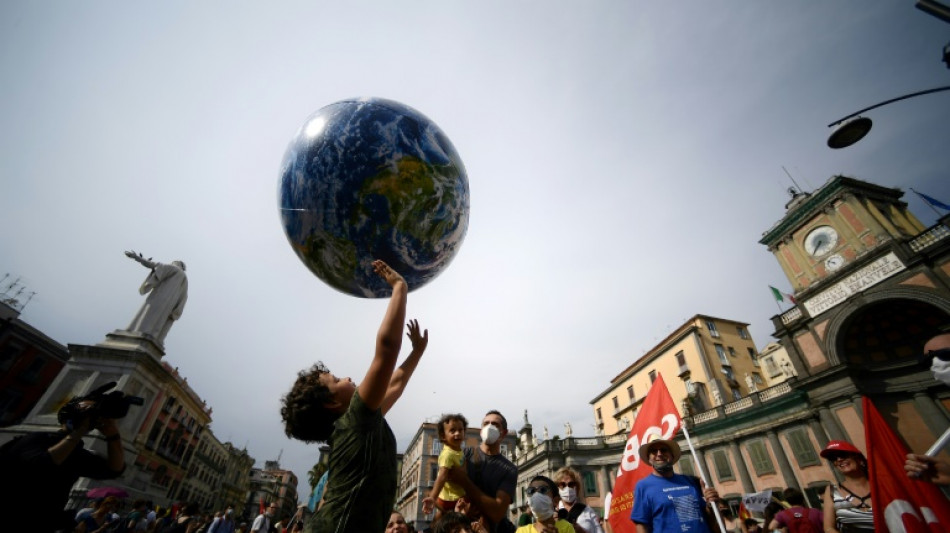
UN report to lay bare harrowing scale of climate impacts

 Wildfires push endangered Sumatran elephants to brink: Indonesian NGO

 Bank of Japan set to raise rates under pressure from inflation, US

 EU chief to unveil social media, gaming curbs for under-15s

 'Resident Evil' film brings video game's ethos to the big screen

 i-payout Expands U.S. Money Transmitter Licensing Footprint and Advances European EMI Strategy

 US Senate crypto bill collapses amid partisan deadlock

 OpenAI, Anthropic and Google are working to create an AI standards body

 Protesting shepherds, farmers clash with Romanian police

 Foundation Lets Ledger Users Switch to Open Source Without Starting Over

 EU to propose curbing social media, online games for under 15s

 FX Junction Reaches 40,600 Members and 26 Million Trades

 'We unleashed the beast': the world's fears and hopes about AI

 Hospitality leaders ask Burnham to halve VAT amid rising costs

 Worcestershire invited to nominate groups for 2027 King’s volunteer award

 Berlin's run-down public spaces at heart of election campaign
 'Widow's Bay' and 'The Pitt' win big at Emmy Awards

 Most markets drop as oil extends gains ahead of expected US rate hike

 Sri Lanka's famed beach shack battles demolition

 Vserv targets ₹1,000 crore revenue by 2030 through AI expansion

 India prohibits bank fees on UPI payments up to ₹2,000

 Brazil's Amazon defender Raoni has cancer

 Trump rejects AI slowdown concerns as UN urges coordinated controls

 Higher wages draw migrant workers to Kashmir despite attacks

 Oil supply concerns and AI warnings weigh on global markets

 'I am the hoax buster': Trump rejects AI danger warnings
The devastating scale of climate change impacts will be unveiled Monday in a landmark UN report expected to show that warming already threatens billions of people and crucial ecosystems.
Extreme weather, ecosystem collapse, mosquito-borne disease, water shortages and reduced crop yields are already measurably worse due to rising temperatures.
Just in the last year, the world has seen a cascade of unprecedented floods, heatwaves and wildfires across four continents.
But the most comprehensive assessment so far of the grave and accelerating risks of climate change from the Intergovernmental Panel on Climate Change (IPCC) is expected to show that this is just the beginning.
Released under the shadow of Russia's invasion of Ukraine, the IPCC report will include a crucial 40-page Summary for Policymakers distilling thousands of pages of scientific research.
This has been reviewed line-by-line by delegates from nearly 200 countries in sometimes fraught negotiations.
IPCC chair Hoesung Lee said the "stakes have never been higher" as the process kicked off two weeks ago.
An early draft seen by AFP in 2021 suggests that the report will lay out in relentless detail the harrowing cost of human-driven carbon pollution to interconnected natural and human-built systems.
- Urgent challenge -
Warming is affecting everything from the availability of food and water to the survival chances of many species -- and the IPCC report is likely to outline expectations of a rapid escalation of impacts in the near future.
It will also underscore the urgent need for "adaptation" -- a term that refers to preparations for devastating consequences that can no longer be avoided.
In some cases this means that adapting to intolerably hot days, flash flooding and storm surges has become a matter of life and death.
While climate change will affect the entire planet, impacts will not fall equally, the IPCC is expected to underline, with the poorest and most vulnerable often hit hardest.
Earth's surface has warmed 1.1 degrees Celsius since the 19th century.
The 2015 Paris deal calls for capping global warming at "well below" 2C, and ideally 1.5 degrees Celsius (2.7 degrees Fahrenheit).
In August 2021, another IPCC report on the physical science of human-caused climate change found that global heating is virtually certain to pass 1.5C, probably within a decade.
Edward Carr, a professor at Clark University and lead author of one of the IPCC report's chapters, stressed the urgency of action to reduce emissions and adapt to the challenges ahead.
"We've only got so many choices, there's a finite set of choices we can make that would move us in a productive way into the future," he told AFP.
"Every day we wait and delay, some of those choices either get harder or go away."
A.Levy--CPN