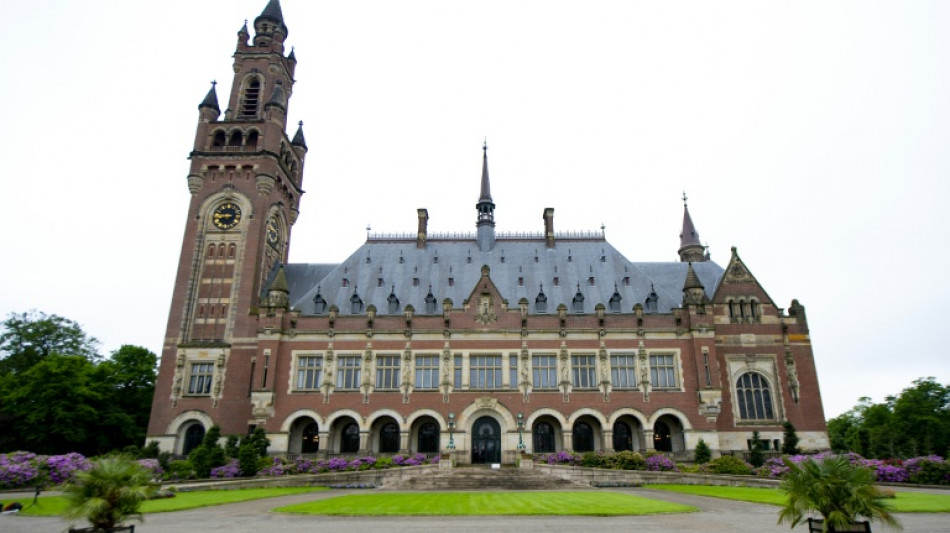
Venezuela to ICJ: Rights to oil-rich region 'inalienable' / Photo: Nick Gammon - AFP

 Wildfires push endangered Sumatran elephants to brink: Indonesian NGO

 Bank of Japan set to raise rates under pressure from inflation, US

 EU chief to unveil social media, gaming curbs for under-15s

 'Resident Evil' film brings video game's ethos to the big screen

 i-payout Expands U.S. Money Transmitter Licensing Footprint and Advances European EMI Strategy

 US Senate crypto bill collapses amid partisan deadlock

 OpenAI, Anthropic and Google are working to create an AI standards body

 Protesting shepherds, farmers clash with Romanian police

 Foundation Lets Ledger Users Switch to Open Source Without Starting Over

 EU to propose curbing social media, online games for under 15s

 FX Junction Reaches 40,600 Members and 26 Million Trades

 'We unleashed the beast': the world's fears and hopes about AI

 Hospitality leaders ask Burnham to halve VAT amid rising costs

 Worcestershire invited to nominate groups for 2027 King’s volunteer award
 Berlin's run-down public spaces at heart of election campaign
 'Widow's Bay' and 'The Pitt' win big at Emmy Awards

 Most markets drop as oil extends gains ahead of expected US rate hike

 Sri Lanka's famed beach shack battles demolition

 Vserv targets ₹1,000 crore revenue by 2030 through AI expansion

 India prohibits bank fees on UPI payments up to ₹2,000

 Brazil's Amazon defender Raoni has cancer

 Trump rejects AI slowdown concerns as UN urges coordinated controls

 Higher wages draw migrant workers to Kashmir despite attacks

 Oil supply concerns and AI warnings weigh on global markets

 'I am the hoax buster': Trump rejects AI danger warnings
Venezuela's rights to the oil-rich territory of Essequibo are "inalienable", its representative told the top UN court on Wednesday at hearings aimed at resolving a centuries-old border dispute with Guyana.
The International Court of Justice in The Hague is holding a week of hearings between the two countries over the row that has at times threatened to spill over into military action.
"Venezuela's historical rights are inalienable and Venezuela is determined to defend them peacefully," Samuel Reinaldo Moncada Acosta told the court.
The pair have been wrangling over the region since the 1800s, with the dispute intensifying after ExxonMobil discovered massive offshore oil deposits a decade ago, giving Guyana the largest crude oil reserves per capita in the world.
The Essequibo region comprises more than two thirds of Guyana, which currently administers it.
Neighbouring Venezuela, however, claims the territory, which runs roughly along the western side of an eponymous river over an area of 160,000 square kilometres (62,000 square miles).
ICJ judges have been asked to rule on the validity of the border established between the two countries in 1899 under British colonial rule.
Venezuela argues that the border should be drawn in accordance with a later document from 1966 signed before Guyana gained its independence.
It says that the Essequibo River, located much farther east than the current border, is the natural frontier, as it was in 1777 under Spanish colonial rule.
- 'Existential' case -
In testimony on Monday, Guyana's Foreign Minister Hugh Hilton Todd told judges the case had "an existential quality for Guyana" with more than 70 percent of its territory at stake.
"For the Guyanese people, it is tragic even to think about having our country dismembered by stripping from us a vast majority of our land, together with its people, its history, its traditions and customs, its resources and precious ecology," he said.
Venezuela's Acosta dismissed this argument.
"The characterisation by Guyana of an alleged threat to its territorial integrity or to its sovereign territory constitutes a flagrant misinterpretation. a deliberately misleading presentation of both facts and law," he told judges.
The ICJ, which seeks to resolve disputes between states, will hold hearings until Monday but a ruling is likely to take months if not years.
The court's decisions are binding but it has no power to ensure that they are upheld.
Acosta reiterated Venezuela's stance that the ICJ had no power to rule on the case.
"Our historical experience has taught us that delegating vital matters... to international judicial bodies has been detrimental to our sovereignty and our territorial integrity," he said.
"As a result, Venezuela has never agreed to submit this controversy to the court's jurisdiction."
X.Wong--CPN
