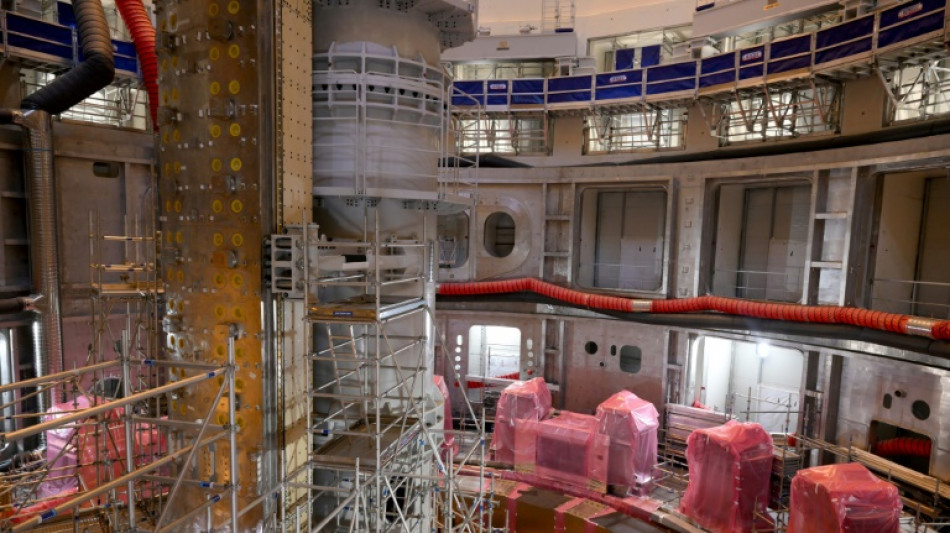
International fusion energy project faces delays, says chief / Photo: Nicolas TUCAT - AFP

 Argentine judge orders suspension of Falklands oil project

 US Fed raises rates to tackle 'too high' inflation, irking Trump

 Turkey releases 106 protesters, jails more LGBTQ activists

 Candidate for UN chief calls for AI regulation akin to nuclear weapons

 'We're losing control,' AI pioneer Yoshua Bengio tells AFP

 IR-MED and Dice Technologies Announce collaboration to Evaluate and Advance Pressure-Injury Prevention Platform in Japan

 Watts, Pitt, Cruz to light up Spain's top film festival

 Toogood Gold's Table Mountain Sits in the Shadow of a Nevada Gold Rush

 MEXC July–August Security Report: 38.66M USDT in Risk Funds Intercepted, Futures Insurance Fund Hits 792M USDT

 Emporio Armani names Dario Vitale new creative director

 EU to ban social media for under 13s, curb access until 15

 Wildfires push endangered Sumatran elephants to brink: Indonesian NGO

 Bank of Japan set to raise rates under pressure from inflation, US

 EU chief to unveil social media, gaming curbs for under-15s

 'Resident Evil' film brings video game's ethos to the big screen

 GA-ASI Mojave First UAS To Complete Battlefield Short Field Ops

 Sanders, Bannon warn of AI dangers in rare US left-right alignment

 Empty benches as schools reopen in Venezuela's quake-hit Guaira

 Tiny English village holds 'independence' vote over asylum seeker housing

 US Treasury chief says to meet Chinese counterpart at weekend

 BingX Evolves into a Multi-Asset Trading Platform, Connecting Users to Global Opportunities

 International Trading Institute Expands Professional Trader Development Beyond the Master’s in Trading

 Lake Energy Secures $80 Million for U.S. Renewable Energy Expansion

 Stocks drop, oil climbs and Treasury yields hit 19-year high

 SkySail Strategies Outperforms Wall Street's 30-Year Risk Standard With Proprietary AI Inference Model

An international project in nuclear fusion may face "years" of delays, its boss has told AFP, weeks after scientists in the United States announced a breakthrough in their own quest for the coveted goal.
The International Thermonuclear Experimental Reactor (ITER) project seeks to prove the feasibility of fusion as a large-scale and carbon-free source of energy.
Installed at a site in southern France, the decades-old initiative has a long history of technical challenges and cost overruns.
Fusion entails forcing together the nuclei of light atomic elements in a super-heated plasma, held by powerful magnetic forces in a doughnut-shaped chamber called a tokamak.
The idea is that fusing the particles together from isotopes of hydrogen -- which can be extracted from seawater -- will create a safer and almost inexhaustible form of energy compared with splitting atoms from uranium or plutonium.
ITER'S previously-stated goal was to create the plasma by 2025.
But that deadline will have to be postponed, Pietro Barabaschi -- who in September became the project's director-general -- told AFP during a visit to the facility.
The date "wasn't realistic in the first place," even before two major problems surfaced, Barabaschi said.
One problem, he said, was wrong sizes for the joints of blocks to be welded together for the installation's 19-by-11-metre (62-by-36-feet) chamber.
The second was traces of corrosion in a thermal shield designed to protect the outside world from the enormous heat created during nuclear fusion.
Fixing the problems "is not a question of weeks, but months, even years," Barabaschi said.
A new timetable is to be worked out by the end of this year, he said, including some modification to contain the expected cost overrun, and to meet the French nuclear safety agency's security requirements.
Barabaschi said he hoped ITER would be able to make up for the delays as it prepares to enter the full phase, currently scheduled for 2035.
On December 13, US researchers working separately from ITER announced an important technical breakthrough.
Scientists at the Lawrence Livermore National Laboratory (LLNL) in California said they had used the world's largest laser to create, for the first time, a fusion reaction generating more energy than it took to produce.
"Some competition is healthy in any environment," Barabaschi said about the success.
"If tomorrow somebody found another breakthrough that would make my work redundant, I would be very happy," he added.
ITER was set in motion after a 1985 summit between US president Ronald Reagan and Soviet leader Mikhail Gorbachev.
Its seven partners are China, the European Union, India, Japan, South Korea, Russia and the United States.
Russia still participates in ITER despite the start of the Ukraine conflict.
In November it dispatched one of six giant magnets needed for the top part of the tokamak.
H.Meyer--CPN