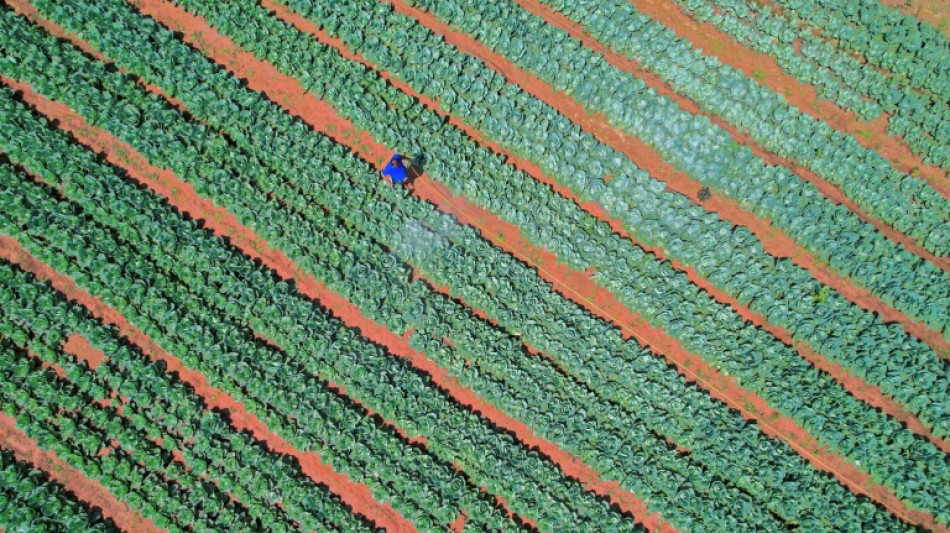
Reducing nitrogen use key to human and planetary health: study / Photo: Manjunath KIRAN - AFP

 Argentine judge orders suspension of Falklands oil project

 US Fed raises rates to tackle 'too high' inflation, irking Trump

 Turkey releases 106 protesters, jails more LGBTQ activists

 Candidate for UN chief calls for AI regulation akin to nuclear weapons

 'We're losing control,' AI pioneer Yoshua Bengio tells AFP

 IR-MED and Dice Technologies Announce collaboration to Evaluate and Advance Pressure-Injury Prevention Platform in Japan

 Watts, Pitt, Cruz to light up Spain's top film festival

 Toogood Gold's Table Mountain Sits in the Shadow of a Nevada Gold Rush

 MEXC July–August Security Report: 38.66M USDT in Risk Funds Intercepted, Futures Insurance Fund Hits 792M USDT

 Emporio Armani names Dario Vitale new creative director

 EU to ban social media for under 13s, curb access until 15

 Wildfires push endangered Sumatran elephants to brink: Indonesian NGO

 Bank of Japan set to raise rates under pressure from inflation, US

 EU chief to unveil social media, gaming curbs for under-15s

 'Resident Evil' film brings video game's ethos to the big screen

 GA-ASI Mojave First UAS To Complete Battlefield Short Field Ops

 Sanders, Bannon warn of AI dangers in rare US left-right alignment

 Empty benches as schools reopen in Venezuela's quake-hit Guaira

 Tiny English village holds 'independence' vote over asylum seeker housing

 US Treasury chief says to meet Chinese counterpart at weekend

 BingX Evolves into a Multi-Asset Trading Platform, Connecting Users to Global Opportunities

 International Trading Institute Expands Professional Trader Development Beyond the Master’s in Trading

 Lake Energy Secures $80 Million for U.S. Renewable Energy Expansion

 Stocks drop, oil climbs and Treasury yields hit 19-year high

 SkySail Strategies Outperforms Wall Street's 30-Year Risk Standard With Proprietary AI Inference Model

Better management of nitrogen-rich fertilisers through alternating crops, optimising use and other measures can yield huge environmental and health benefits, but must boost food production at the same time, researchers warned Wednesday.
Reducing nitrogen pollution from global croplands is a "grand challenge," the group of international researchers said in a study in Nature outlining a dozen urgently-needed reforms.
The intensive use of chemical fertilisers helped fuel the four-fold expansion of the human population over the last century, and will be crucial for feeding 10 billion people by 2050.
But the bumper crops of what was once called the Green Revolution have come at a terrible cost.
Today, more than half the nitrogen in fertilisers seeps into the air and water, leading to deadly pollution, soil acidification, climate change, ozone depletion and biodiversity loss.
"Given the multiple health, climate and environmental impacts of reactive nitrogen, it has to be reduced in all the mediums such as air and water," lead author Baojing Gu, a professor at Zhejiang University, told AFP.
The benefits of doing so far outstrip the costs, he added.
- Nitrogen cycle -
The world is naturally awash in nitrogen, which is critical for the survival of all life on Earth, especially plants.
Nearly 80 percent of Earth's atmosphere is nitrogen, albeit in a gaseous form (N2) of little direct use to most organisms.
It is made available to plants when microbes that live within plants or soils turn it into ammonia through biological nitrogen fixation.
This process funnels some 200 million tonnes of nitrogen into the soil and oceans every year.
Various forms of the element are eventually transformed and find their way back into the atmosphere with the help of bacteria, especially in wetlands, and after leaching into the oceans or being burned.
But this natural "nitrogen cycle" has been massively imbalanced by the use of some 120 million tonnes of chemical fertiliser each year, according to the study.
Less than half of that input is actually absorbed by plants, with the rest seeping into the environment and causing a constellation of problems.
Researchers led by Gu analysed over 1,500 field observations from croplands around the world and identified 11 key measures to decrease nitrogen losses while still enhancing crop yields.
One such method is crop rotation where a variety of crops are planted on the same plot of land, optimising the flow of nutrients in the soil.
- Benefits outweigh costs -
The benefits of slashing agricultural nitrogen pollution are some 25 times higher than the implementation costs of about $34 billion, they found.
For China and India -– whose extensive and intensive use of fertiliser make them the world's top nitrogen polluters –- that cost would be about $5 and $3 billion, respectively.
Nearly half-a-trillion dollars in avoided costs are spread across reduced premature deaths from air pollution, less damage to ecosystem services and increased crop yields.
But the proposed measure could have a negative impact on the fight against climate change.
"Basically, the impact of nitrogen management on climate change is neutral, or slightly damages the climate due to the reduction of carbon sequestration in ecosystems," Gu told AFP.
Even with outsized benefits, advanced nitrogen management has up-front costs that would be beyond the reach of many smallholder farmers without the backing of strong government policies.
A nitrogen-credit-system, for example, could subsidise farmers who adopt advanced nitrogen management techniques, drawing from the economic benefits of reduced nitrogen pollution and increased food supply.
To initiate this virtuous circle, a financial budget could be secured by taxing food consumers or enterprises that use farming for commercial food production, or by taxing polluting activities and products.
D.Avraham--CPN