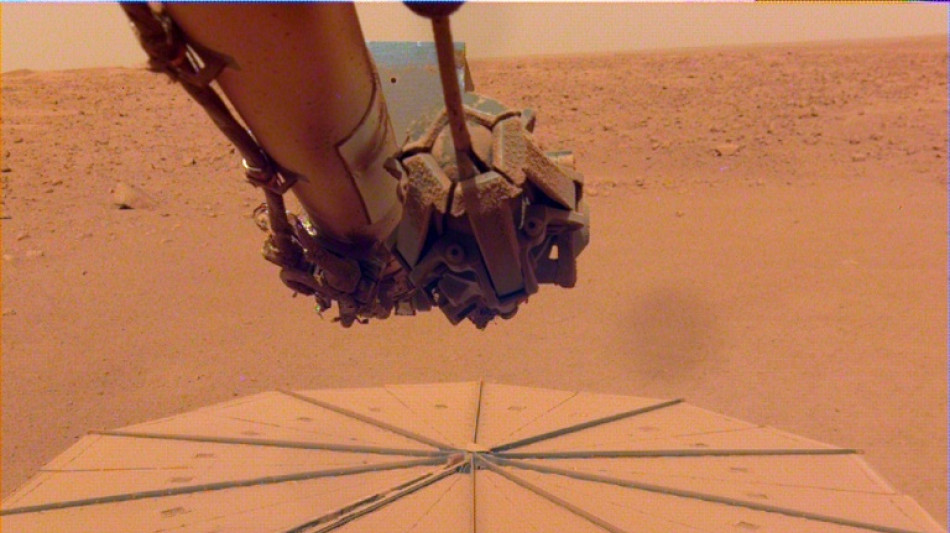
NASA retires InSight lander after four years on Mars / Photo: - - NASA/JPL-Caltech/AFP

 US Fed raises rates to tackle 'too high' inflation, irking Trump

 Turkey releases 106 protesters, jails more LGBTQ activists

 Candidate for UN chief calls for AI regulation akin to nuclear weapons

 'We're losing control,' AI pioneer Yoshua Bengio tells AFP

 IR-MED and Dice Technologies Announce collaboration to Evaluate and Advance Pressure-Injury Prevention Platform in Japan

 Watts, Pitt, Cruz to light up Spain's top film festival

 Toogood Gold's Table Mountain Sits in the Shadow of a Nevada Gold Rush

 MEXC July–August Security Report: 38.66M USDT in Risk Funds Intercepted, Futures Insurance Fund Hits 792M USDT

 Emporio Armani names Dario Vitale new creative director

 EU to ban social media for under 13s, curb access until 15

 Wildfires push endangered Sumatran elephants to brink: Indonesian NGO

 Bank of Japan set to raise rates under pressure from inflation, US

 EU chief to unveil social media, gaming curbs for under-15s

 'Resident Evil' film brings video game's ethos to the big screen

 GA-ASI Mojave First UAS To Complete Battlefield Short Field Ops

 Sanders, Bannon warn of AI dangers in rare US left-right alignment

 Empty benches as schools reopen in Venezuela's quake-hit Guaira

 Tiny English village holds 'independence' vote over asylum seeker housing

 US Treasury chief says to meet Chinese counterpart at weekend

 BingX Evolves into a Multi-Asset Trading Platform, Connecting Users to Global Opportunities

 International Trading Institute Expands Professional Trader Development Beyond the Master’s in Trading

 Lake Energy Secures $80 Million for U.S. Renewable Energy Expansion

 Stocks drop, oil climbs and Treasury yields hit 19-year high

 SkySail Strategies Outperforms Wall Street's 30-Year Risk Standard With Proprietary AI Inference Model

 Just add fish: Scientists pursue more rice, less disease in Senegal paddies

NASA said farewell on Wednesday to the InSight lander that spent four years probing the interior of Mars.
The US space agency said mission control had been unable to contact the spacecraft on two consecutive attempts, leading to the conclusion that its solar-powered batteries have run out of energy.
"InSight may be retiring, but its legacy -- and its findings from the deep interior of Mars -- will live on," NASA said.
The space agency said it will continue to listen for a signal from the lander, which last communicated with Earth a week ago, but it is considered unlikely after months of Martian dust accumulated on its two solar panels, sapping its power.
"We've thought of InSight as our friend and colleague on Mars for the past four years, so it's hard to say goodbye," said Bruce Banerdt, the mission's principal investigator at the Jet Propulsion Laboratory in California. "But it has earned its richly deserved retirement."
InSight was one of four missions currently on the Red Planet -- along with the US rovers Perseverance and Curiosity and China's Zhurong.
It arrived on Mars in November 2018 to study the interior of the planet and its seismometer, made in France, paved the way for great advances.
Seismic waves, varying based on the materials they pass through, offer a picture of the interior of the planet.
For example, scientists were able to confirm that the core of Mars is liquid and to determine the thickness of the Martian crust -- less dense than previously thought and likely consisting of three layers.
The lander yielded details about the weather on Mars and lots of quake activity.
Its highly sensitive seismometer detected 1,319 marsquakes, some caused by meteoroid impacts.
"With InSight, seismology was the focus of a mission beyond Earth for the first time since the Apollo missions, when astronauts brought seismometers to the Moon," said Philippe Lognonne of the Institut de Physique du Globe de Paris. "We broke new ground."
NASA managed to extended the lander's mission earlier this year by using its robotic arm and a small scoop to gently remove dust from the solar panels.
Not all of InSight's scientific operations went smoothly, however, such as when a spike nicknamed "the mole" had trouble burrowing below the surface to take the planet's temperature because of the composition of the soil where the robot landed.
The probe, provided by the German Aerospace Center, was eventually buried slightly below the surface and provided valuable data on the physical and thermal properties of Martian soil, NASA said.
A.Samuel--CPN