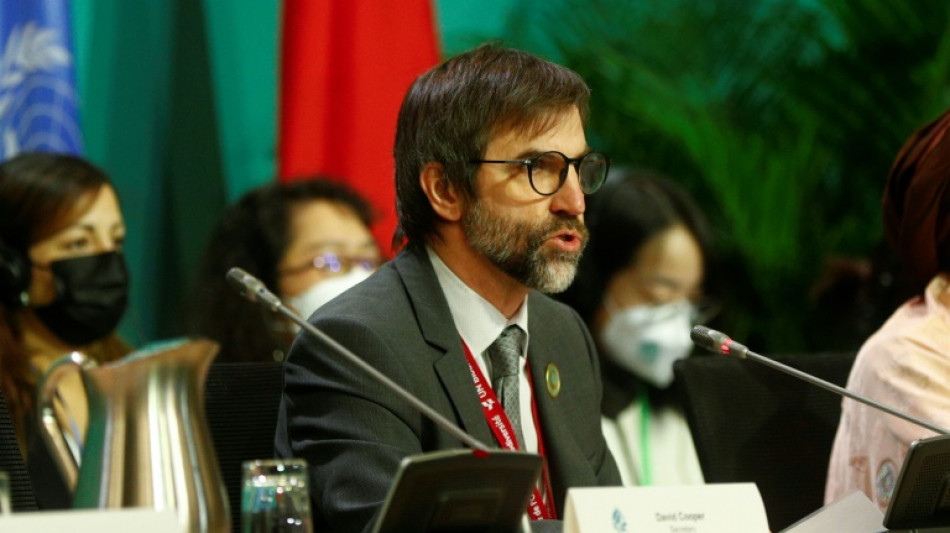
New funding announcements at high-stakes UN nature summit / Photo: Lars Hagberg - AFP

 US Fed raises rates to tackle 'too high' inflation, irking Trump

 Turkey releases 106 protesters, jails more LGBTQ activists

 Candidate for UN chief calls for AI regulation akin to nuclear weapons

 'We're losing control,' AI pioneer Yoshua Bengio tells AFP

 IR-MED and Dice Technologies Announce collaboration to Evaluate and Advance Pressure-Injury Prevention Platform in Japan

 Watts, Pitt, Cruz to light up Spain's top film festival

 Toogood Gold's Table Mountain Sits in the Shadow of a Nevada Gold Rush

 MEXC July–August Security Report: 38.66M USDT in Risk Funds Intercepted, Futures Insurance Fund Hits 792M USDT

 Emporio Armani names Dario Vitale new creative director

 EU to ban social media for under 13s, curb access until 15

 Wildfires push endangered Sumatran elephants to brink: Indonesian NGO

 Bank of Japan set to raise rates under pressure from inflation, US

 EU chief to unveil social media, gaming curbs for under-15s

 'Resident Evil' film brings video game's ethos to the big screen

 GA-ASI Mojave First UAS To Complete Battlefield Short Field Ops

 Sanders, Bannon warn of AI dangers in rare US left-right alignment

 Empty benches as schools reopen in Venezuela's quake-hit Guaira

 Tiny English village holds 'independence' vote over asylum seeker housing

 US Treasury chief says to meet Chinese counterpart at weekend

 BingX Evolves into a Multi-Asset Trading Platform, Connecting Users to Global Opportunities

 International Trading Institute Expands Professional Trader Development Beyond the Master’s in Trading

 Lake Energy Secures $80 Million for U.S. Renewable Energy Expansion

 Stocks drop, oil climbs and Treasury yields hit 19-year high

 SkySail Strategies Outperforms Wall Street's 30-Year Risk Standard With Proprietary AI Inference Model

 Just add fish: Scientists pursue more rice, less disease in Senegal paddies
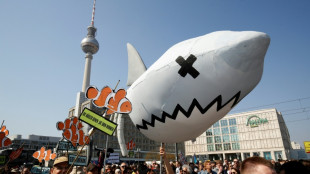
The world's environment ministers began the final phase of crunch talks at a UN summit in Montreal on Thursday aimed at sealing a historic "peace pact with nature."
New international funding commitments from some wealthy donor countries could help lift the mood after negotiations appeared to be in trouble, though significant work is still needed to drag the deal across the finish line.
At stake is the future of the planet and whether humanity can roll back habitat destruction, pollution and the climate crisis, which are threatening an estimated million plant and animal species with extinction.
The thorny issue of how much money the rich nations will pay lower income countries to preserve their ecosystems is perhaps the biggest sticking point.
But the matter received a boost Thursday after Australia, Japan, the Netherlands, Norway, Spain and the United States all announced increased pledges, joining Germany, France, the EU, the United Kingdom and Canada who previously revised upward their commitments.
"This step forward is extremely important," European Commissioner for the Environment Virginijus Sinkevicius told AFP.
"These new announcements and reminder of existing commitments are a good signal of the much-needed political will in Montreal," said Claire Blanchard, head of global advocacy at WWF International.
- Long way to go -
But it isn't clear the new promises will be enough to satisfy countries of the Global South, home to most of the world's remaining biodiversity.
Dozens of nations, including Brazil, India, Indonesia and many African countries are seeking much more ambitious funding of $100 billion yearly, or one percent of global GDP, until 2030 -- compared to the current figure of around $10 billion.
Developing countries also want a new global biodiversity fund (GBF) to help them meet their goals, for example by setting up protected areas.
But rich countries are opposed -- and propose instead making existing financial mechanisms more accessible. The disagreement triggered a temporary walkout earlier.
"Funding proposals put forth by developing countries to generate new and additional funding dedicated specifically to biodiversity-related initiatives need to be taken seriously," Jorge Viana, representing Brazilian president-elect Luiz Inacio Lula da Silva, wrote in a letter.
He added the impasse could yet tank a possible deal.
"The idea, which is quite condescending, is the Global North thinking that they are doing the Global South a favor by providing money," Joseph Onoja of the Nigerian Conservation Foundation told AFP.
- 30 by 30 -
Other draft targets include a cornerstone pledge to protect 30 percent of the world's land and seas by 2030, reducing environmentally destructive subsidies, and how poor countries should be compensated for the exploitation of their natural resources, whose genetic information is stored in digital libraries.
"We must work together to promote harmonious coexistence between man and nature," Chinese President Xi Jinping said in a video message that opened the high-level segment involving 200 ministerial-level delegates.
China is chairing the summit, known as COP15, but is not hosting because of its strict Covid rules, leaving Canada to step in and hold the meeting in Montreal, one of North America's coldest cities, in deep winter.
"A brilliant Canadian artist, Joni Mitchell, sent us a message in a song -- that we have 'Paved paradise and put up a parking lot,'" said Canada's environment minister, Steven Guilbeault, who was nicknamed "Green Jesus" during his days as an activist.
"We listened to her music and sang along but didn't really understand her message. We must live in harmony with nature, not try and dominate it," he added.
Beyond the moral implications, there is the question of self-interest: $44 trillion of economic value generation -- more than half the world's total GDP -- is dependent on nature and its services.
Ng.A.Adebayo--CPN