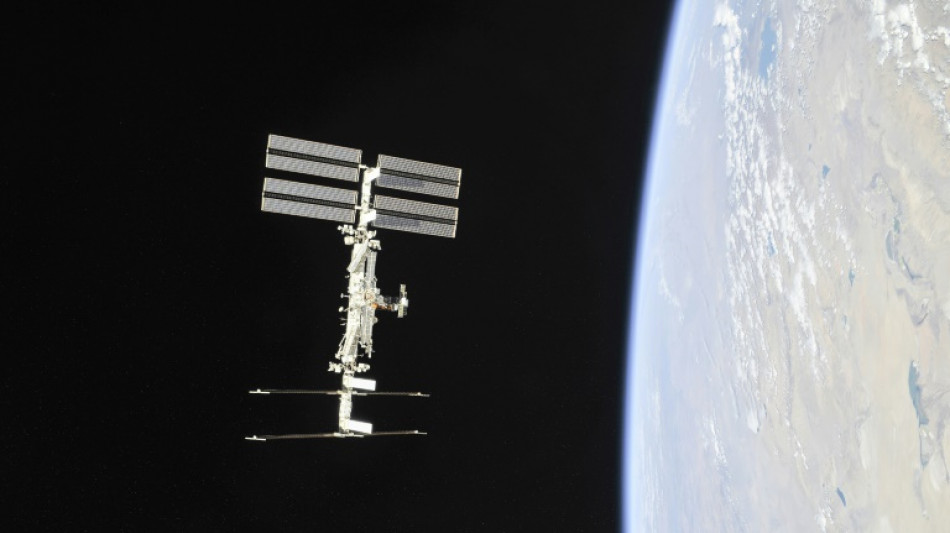
Tiny meteorite may have caused coolant leak from Soyuz capsule / Photo: HO - NASA/AFP

 US Fed raises rates to tackle 'too high' inflation, irking Trump

 Turkey releases 106 protesters, jails more LGBTQ activists

 Candidate for UN chief calls for AI regulation akin to nuclear weapons

 'We're losing control,' AI pioneer Yoshua Bengio tells AFP

 IR-MED and Dice Technologies Announce collaboration to Evaluate and Advance Pressure-Injury Prevention Platform in Japan

 Watts, Pitt, Cruz to light up Spain's top film festival

 Toogood Gold's Table Mountain Sits in the Shadow of a Nevada Gold Rush

 MEXC July–August Security Report: 38.66M USDT in Risk Funds Intercepted, Futures Insurance Fund Hits 792M USDT

 Emporio Armani names Dario Vitale new creative director

 EU to ban social media for under 13s, curb access until 15

 Wildfires push endangered Sumatran elephants to brink: Indonesian NGO

 Bank of Japan set to raise rates under pressure from inflation, US

 EU chief to unveil social media, gaming curbs for under-15s

 'Resident Evil' film brings video game's ethos to the big screen

 GA-ASI Mojave First UAS To Complete Battlefield Short Field Ops

 Sanders, Bannon warn of AI dangers in rare US left-right alignment

 Empty benches as schools reopen in Venezuela's quake-hit Guaira

 Tiny English village holds 'independence' vote over asylum seeker housing

 US Treasury chief says to meet Chinese counterpart at weekend

 BingX Evolves into a Multi-Asset Trading Platform, Connecting Users to Global Opportunities

 International Trading Institute Expands Professional Trader Development Beyond the Master’s in Trading

 Lake Energy Secures $80 Million for U.S. Renewable Energy Expansion

 Stocks drop, oil climbs and Treasury yields hit 19-year high

 SkySail Strategies Outperforms Wall Street's 30-Year Risk Standard With Proprietary AI Inference Model

 Just add fish: Scientists pursue more rice, less disease in Senegal paddies

Russian and NASA engineers were assessing a coolant leak on Thursday from a Soyuz crew capsule docked with the International Space Station (ISS) that may have been caused by a micrometeorite strike.
The coolant leak forced the last-minute cancellation of a spacewalk by two Russian cosmonauts on Wednesday and could potentially impact a return flight to Earth by three crew members.
Russia's space corporation Roscosmos and the US space agency said the leak on the Soyuz MS-22 spacecraft did not pose any danger to the astronauts and cosmonauts aboard the ISS.
"The crew members aboard the space station are safe, and were not in any danger during the leak," NASA said.
It said ground teams were evaluating "the fluid and potential impacts to the integrity of the Soyuz spacecraft."
"NASA and Roscosmos will continue to work together to determine the next course of action following the ongoing analysis," NASA said.
The TASS news agency quoted Sergei Krikalev, a former cosmonaut who heads the crewed space flight program for Roscosmos, as saying that the leak may have been caused by a micrometeorite striking Soyuz MS-22.
"The cause of the leak may be a micrometeorite entering the radiator," TASS quoted Krikalev as saying. "Possible consequences are changes in the temperature regime."
"No other changes in the telemetric parameters of either the Soyuz spacecraft or the (ISS) station on the Russian or American segments have been detected," Krikalev said.
Soyuz MS-22 flew Russian cosmonauts Sergei Prokopyev and Dmitry Petelin and NASA astronaut Frank Rubio to the ISS in September.
It is scheduled to bring them back to Earth in March and another vessel would have to be sent to the ISS if Soyuz MS-22 is unavailable.
Prokopyev and Petelin had been making preparations for a spacewalk on Wednesday when the leak was discovered.
"The crew reported the warning device of the ship's diagnostic system went off, indicating a pressure drop in the cooling system," Roscosmos said. "At the moment, all systems of the ISS and the ship are operating normally, the crew is safe."
- White particles -
NASA said the leak had occurred on the "aft end" of Soyuz MS-22, which is secured to the ISS.
Dramatic NASA TV images showed white particles resembling snowflakes streaming out of the rear of the vessel for hours.
There are currently four other astronauts and cosmonauts aboard the space station in addition to Rubio, Prokopyev and Petelin.
NASA astronauts Josh Cassada and Nicole Mann, Japanese astronaut Koichi Wakata and Russian cosmonaut Anna Kikina were flown to the ISS in October aboard a SpaceX spacecraft.
Space has been a rare avenue of cooperation between Moscow and Washington since the start of Moscow's assault on Ukraine in February, and ensuing Western sanctions on Russia that shredded ties between the two countries.
The ISS was launched in 1998 at a time of increased US-Russia cooperation following their Space Race competition during the Cold War.
X.Cheung--CPN