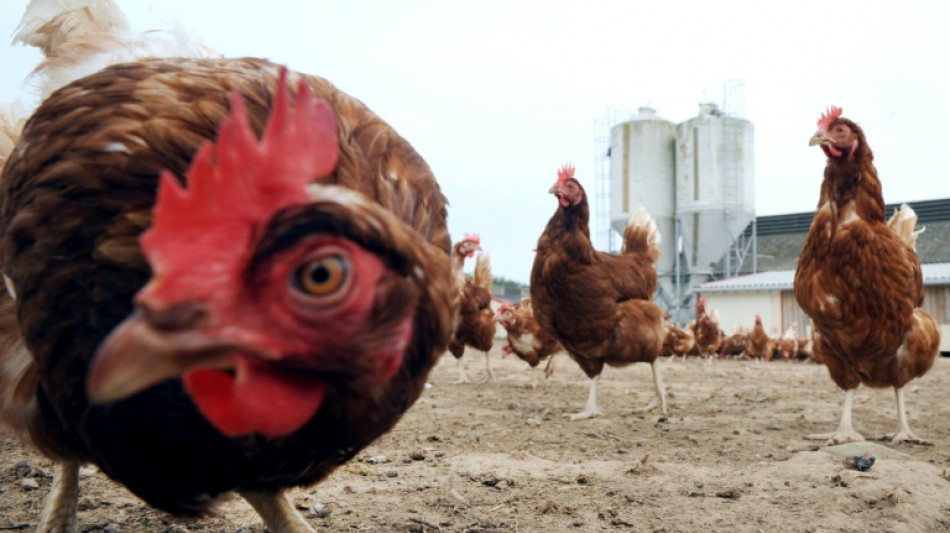
Israeli technology aims to curb male chick culling / Photo: FRED TANNEAU - AFP/File

 US Fed raises rates to tackle 'too high' inflation, irking Trump

 Turkey releases 106 protesters, jails more LGBTQ activists

 Candidate for UN chief calls for AI regulation akin to nuclear weapons

 'We're losing control,' AI pioneer Yoshua Bengio tells AFP

 IR-MED and Dice Technologies Announce collaboration to Evaluate and Advance Pressure-Injury Prevention Platform in Japan

 Watts, Pitt, Cruz to light up Spain's top film festival

 Toogood Gold's Table Mountain Sits in the Shadow of a Nevada Gold Rush

 MEXC July–August Security Report: 38.66M USDT in Risk Funds Intercepted, Futures Insurance Fund Hits 792M USDT

 Emporio Armani names Dario Vitale new creative director

 EU to ban social media for under 13s, curb access until 15

 Wildfires push endangered Sumatran elephants to brink: Indonesian NGO

 Bank of Japan set to raise rates under pressure from inflation, US

 EU chief to unveil social media, gaming curbs for under-15s

 'Resident Evil' film brings video game's ethos to the big screen

 GA-ASI Mojave First UAS To Complete Battlefield Short Field Ops

 Sanders, Bannon warn of AI dangers in rare US left-right alignment

 Empty benches as schools reopen in Venezuela's quake-hit Guaira

 Tiny English village holds 'independence' vote over asylum seeker housing

 US Treasury chief says to meet Chinese counterpart at weekend

 BingX Evolves into a Multi-Asset Trading Platform, Connecting Users to Global Opportunities

 International Trading Institute Expands Professional Trader Development Beyond the Master’s in Trading

 Lake Energy Secures $80 Million for U.S. Renewable Energy Expansion

 Stocks drop, oil climbs and Treasury yields hit 19-year high

 SkySail Strategies Outperforms Wall Street's 30-Year Risk Standard With Proprietary AI Inference Model

 Just add fish: Scientists pursue more rice, less disease in Senegal paddies

Israeli scientists have created a species of egg-laying hens that only produce females, a breakthrough that could help end the annual culling of around seven billion male chicks globally.
The chicks, born from egg-laying, are destroyed en masse by suffocation or crushing because they are not suitable for meat production and do not lay eggs.
Animal rights activists have denounced the practice as barbaric, and it has been banned in several European states.
A German prohibition on male chick culling came into effect this year. French farmers have until year's end to comply with new restrictions.
A team at the Israeli Agricultural Research Organization-Volcani Center has used gene editing to develop a new species of hens that only gives birth to females. They say this is the only option to substantially curb mass male chick culling around the world.
"This is a world first and the only solution that is easy for industry players to implement," team leader Yuval Cinnamon, a Volcani Center embryologist, told AFP.
He said technologies that seek to identify whether an egg is carrying a male or female embryo are not reliable.
The Volcani Center, based in the Tel Aviv suburbs, developed the species following seven years of research in partnership with the American-Israeli firm Huminn, which in part specialises in commercially viable sustainable food production.
- 'Most serious problem' -
The technology involves genetically modifying egg-laying hens so that, when carrying male embryos, those do not progress and hatch.
"After fertilisation the male embryos do not develop, and the female embryos develop normally without being genetically modified and hatch normally," Cinnamon explained.
"This will provide a real answer to what is probably the most serious animal welfare problem in the world today," he added.
Beyond the animal rights benefits, the technology could offer poultry producers huge savings in terms of the space and energy required to operate incubators while reducing the significant culling costs.
"It costs a dollar to cull each male chick, so that's seven billion in savings a year," Cinnamon said.
Huminn has forecast that commercial benefits from the technology could emerge within two years.
At a meeting in October, European Union agriculture ministers said they would consider a bloc-wide ban on culling male chicks from egg-laying hens, pending the results of an impact assessment.
M.Davis--CPN