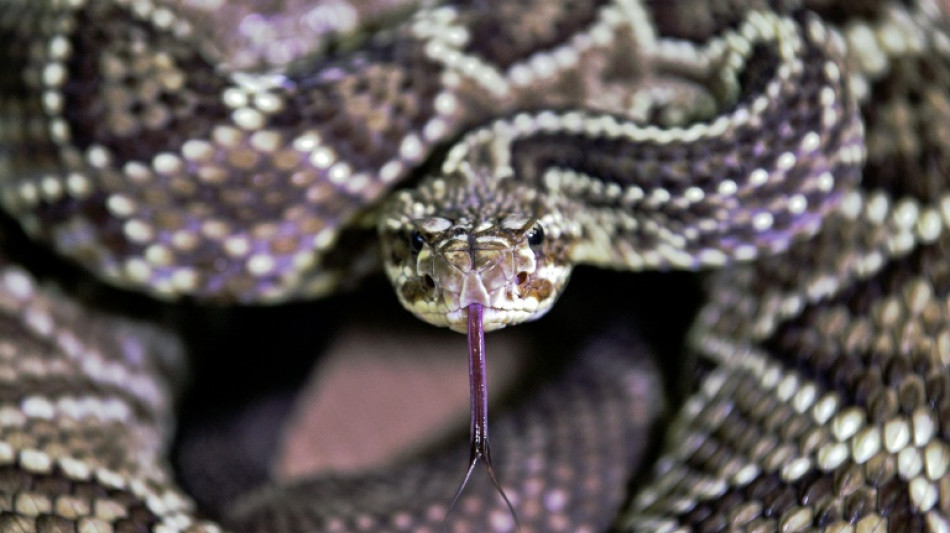
Snakes have clitorises, scientists say, slamming research 'taboo' / Photo: CARL DE SOUZA - AFP/File

 US Fed raises rates to tackle 'too high' inflation, irking Trump

 Turkey releases 106 protesters, jails more LGBTQ activists

 Candidate for UN chief calls for AI regulation akin to nuclear weapons

 'We're losing control,' AI pioneer Yoshua Bengio tells AFP

 IR-MED and Dice Technologies Announce collaboration to Evaluate and Advance Pressure-Injury Prevention Platform in Japan

 Watts, Pitt, Cruz to light up Spain's top film festival

 Toogood Gold's Table Mountain Sits in the Shadow of a Nevada Gold Rush

 MEXC July–August Security Report: 38.66M USDT in Risk Funds Intercepted, Futures Insurance Fund Hits 792M USDT

 Emporio Armani names Dario Vitale new creative director

 EU to ban social media for under 13s, curb access until 15

 Wildfires push endangered Sumatran elephants to brink: Indonesian NGO

 Bank of Japan set to raise rates under pressure from inflation, US

 EU chief to unveil social media, gaming curbs for under-15s

 'Resident Evil' film brings video game's ethos to the big screen

 GA-ASI Mojave First UAS To Complete Battlefield Short Field Ops

 Sanders, Bannon warn of AI dangers in rare US left-right alignment

 Empty benches as schools reopen in Venezuela's quake-hit Guaira

 Tiny English village holds 'independence' vote over asylum seeker housing

 US Treasury chief says to meet Chinese counterpart at weekend

 BingX Evolves into a Multi-Asset Trading Platform, Connecting Users to Global Opportunities

 International Trading Institute Expands Professional Trader Development Beyond the Master’s in Trading

 Lake Energy Secures $80 Million for U.S. Renewable Energy Expansion

 Stocks drop, oil climbs and Treasury yields hit 19-year high

 SkySail Strategies Outperforms Wall Street's 30-Year Risk Standard With Proprietary AI Inference Model

 Just add fish: Scientists pursue more rice, less disease in Senegal paddies

Female snakes have clitorises, according to the first detailed study on the subject Wednesday, in which the scientists lashed out at how little female sex organs have been researched compared to males across species.
Previous research had hypothesised that the organs on female snakes were scent glands, under-developed versions of penises, or were even there to stimulate males, rather than the other way around.
But the new study said it has "definitively" ruled out such theories, offering the first complete description of snake clitorises.
The findings suggest that clitorises may be common across squamates, the largest order of reptiles which includes snakes, and could play an essential role in how they reproduce.
However comparatively little research on the subject has been carried out, as in the case for the clitorises of pretty much all animals -- including humans.
"Female genitalia are conspicuously overlooked in comparison to their male counterparts, limiting our understanding of sexual reproduction across vertebrate lineages," wrote the authors of the study published in the journal Proceedings of the Royal Society B.
Since the 1800s it has been known that male squamates have a dual sex organ called a hemipenis.
However it was not until 1995 that German herpetologist Wolfgang Boehme, who was researching monitor lizards, first described the female sexual organ, the hemiclitores.
Megan Folwell, a PhD candidate at the University of Adelaide in Australia and the new study's lead author, told AFP she started off by analysing the hemiclitores of a common death adder.
The team of Australian and American researchers went on to dissect 10 snakes from nine different species, including the carpet python, puff adder and Mexican moccasin.
They found that snakes have two individual clitorises -- hemiclitores -- separated by tissue and hidden by skin on the underside of the tail.
For the death adder, the organ forms a triangle shape "like a heart", Folwell said.
Some are quite thin while others take up almost all the area around the cloaca, the tiny opening for the digestive, urinary and reproductive tract. Sizes ranged from less than a millimetre to seven millimetres.
The organs have erectile tissue that likely swells with blood as well as nerve bundles which "may be indicative of tactile sensitivity, similar to the mammalian clitoris," the study said.
- 'Taboo subject' -
"Snakes are very tactile animals," Folwell said, "so there's quite a high chance that they would get quite a lot of sensation even through the skin."
If the snakes' hemiclitores are stimulated during sex, it likely prompts longer and more frequent mating, resulting in a greater chance of reproductive success.
"Pleasure is such an important part of reproduction," Folwell said.
It could lead to lubrication to prevent damage from the "very spiny hemipenis" of male snakes, she said, adding that "we don't know".
So why did it take so long for scientists to get here?
"It's quite a taboo subject, female genitalia is not the easiest topic to bring up and be respected," Folwell said.
"There's also the fact that it is not the easiest structure to find," she said. "Especially if you don't know what you're looking for or where."
The study comes after a research abstract presented in the United States earlier this year said that the human clitoris has between 9,850-1,100 nerve fibres -- around 20 percent more than the previously widely cited number of 8,000, which reportedly came from research carried out on cows.
A.Samuel--CPN