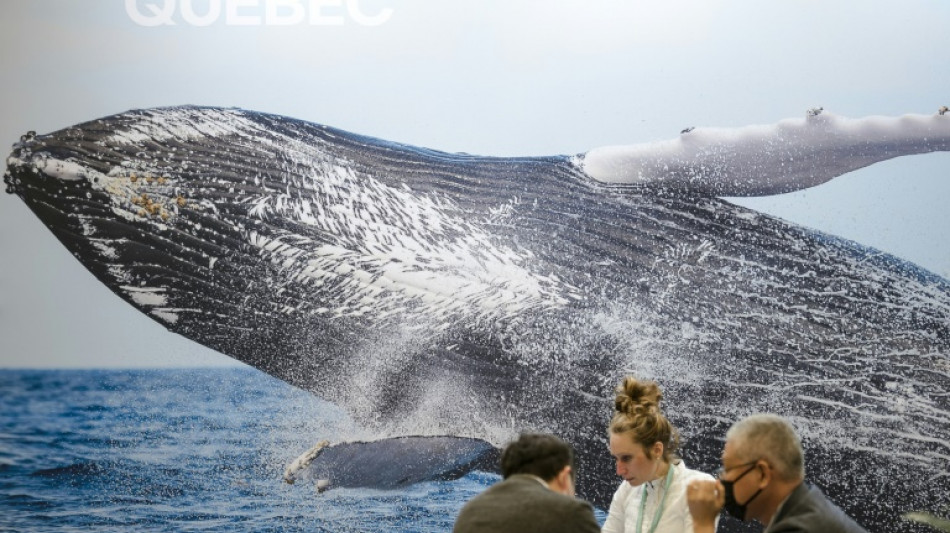
Rich nations oppose new biodiversity fund / Photo: ANDREJ IVANOV - AFP

 US Fed raises rates to tackle 'too high' inflation, irking Trump

 Turkey releases 106 protesters, jails more LGBTQ activists

 Candidate for UN chief calls for AI regulation akin to nuclear weapons

 'We're losing control,' AI pioneer Yoshua Bengio tells AFP

 IR-MED and Dice Technologies Announce collaboration to Evaluate and Advance Pressure-Injury Prevention Platform in Japan

 Watts, Pitt, Cruz to light up Spain's top film festival

 Toogood Gold's Table Mountain Sits in the Shadow of a Nevada Gold Rush

 MEXC July–August Security Report: 38.66M USDT in Risk Funds Intercepted, Futures Insurance Fund Hits 792M USDT

 Emporio Armani names Dario Vitale new creative director

 EU to ban social media for under 13s, curb access until 15

 Wildfires push endangered Sumatran elephants to brink: Indonesian NGO

 Bank of Japan set to raise rates under pressure from inflation, US

 EU chief to unveil social media, gaming curbs for under-15s

 'Resident Evil' film brings video game's ethos to the big screen

 GA-ASI Mojave First UAS To Complete Battlefield Short Field Ops

 Sanders, Bannon warn of AI dangers in rare US left-right alignment

 Empty benches as schools reopen in Venezuela's quake-hit Guaira

 Tiny English village holds 'independence' vote over asylum seeker housing

 US Treasury chief says to meet Chinese counterpart at weekend

 BingX Evolves into a Multi-Asset Trading Platform, Connecting Users to Global Opportunities

 International Trading Institute Expands Professional Trader Development Beyond the Master’s in Trading

 Lake Energy Secures $80 Million for U.S. Renewable Energy Expansion

 Stocks drop, oil climbs and Treasury yields hit 19-year high

 SkySail Strategies Outperforms Wall Street's 30-Year Risk Standard With Proprietary AI Inference Model

 Just add fish: Scientists pursue more rice, less disease in Senegal paddies

Creating a new global fund for biodiversity -- a core demand of developing countries at UN talks in Montreal -- "would take years" and be less effective than reforming existing financial mechanisms, Canada's environment minister said Tuesday.
Ottawa's position reflects the consensus among developed nations on the thorny issue, which has emerged as a key sticking point in negotiations to hammer out a new global pact for nature at the meeting, known as COP15.
Delegates from around the world have gathered for the December 7-19 summit aiming to secure a new deal: a 10-year framework aimed at saving Earth's forests, oceans and species before it's too late.
Draft targets include a cornerstone pledge to protect 30 percent of the world's land and seas by 2030, eliminating harmful fishing and agriculture subsidies and tackling invasive species and reducing pesticides.
Dozens of countries, led by Brazil, India, Indonesia and African nations, are demanding financial subsidies of at least $100 billion a year until 2030, or one percent of global GDP, to protect ecosystems. The current figure is around $10 billion annually.
"The countries of the North understand that ambition must be accompanied by financial resources," Canadian Minister of Environment and Climate Change Steven Guilbeault said at a press conference held halfway through the talks.
But "my concern is that the creation of new funding could take years, and during those years, countries in the South wouldn't be receiving any money from that fund," he added.
He recalled the Global Environment Facility, currently the main multilateral mechanism for biodiversity, took seven years to create. Donors have pledged $5.3 billion to this fund for its current cycle, 2022-2026.
"So I think it would be better to use existing funds" while pursuing reforms that would make money more accessible, he said.
"On the other hand, we have to agree on the fact that it cannot only be public money," said Guilbeault, stressing that private and philanthropic contributions must come into play, as well as multilateral lenders such as the World Bank and IMF.
"We all need to push harder this week," he concluded, after the first week of talks ended in stalemate.
- Yawning funding gap -
The divide between developed and developing nations on the issue of creating a new biodiversity fund mirrors a similar debate during recent UN climate talks in Egypt on creating a "loss and damages" fund for the most climate-vulnerable nations -- though that demand was eventually met.
Given this precedent, Basile van Havre, co-chair of one of COP15's working groups, did not rule out a similar decision for biodiversity.
"The landscape or the context now is a lot more favorable," he told AFP, acknowledging growing political momentum for such a move.
Whatever the final mechanism, the gap in expectations over resource mobilization that would allow lower income nations to hold up their side of the biodiversity deal remains a sore spot.
"The EU says it hears the needs of the Global South and the Africa Group, and recognizes that current finances are not enough. So what is the hold up?" said Greenpeace policy advisory Anna Ogniewska.
M.Mendoza--CPN