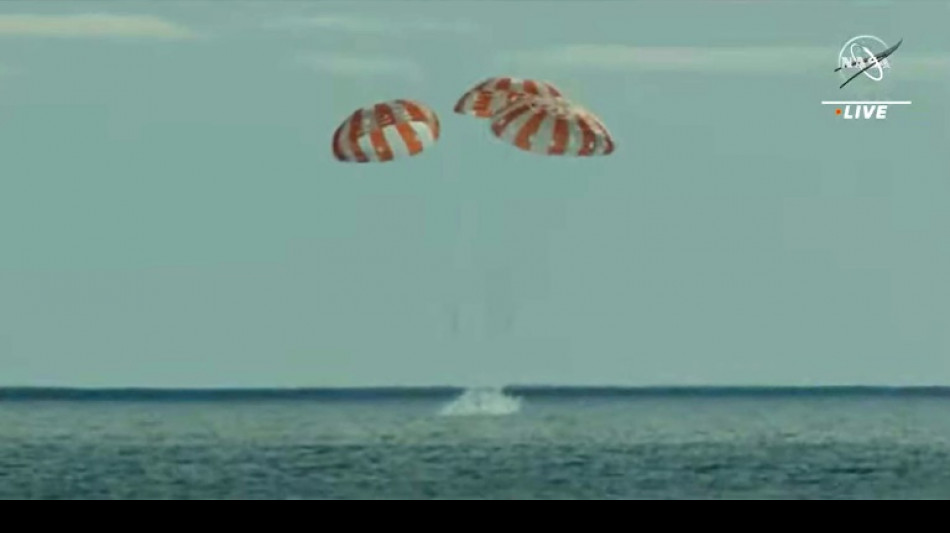
NASA capsule Orion splashes down after record-setting lunar voyage / Photo: Jose ROMERO - NASA TV/AFP

 US Fed raises rates to tackle 'too high' inflation, irking Trump

 Turkey releases 106 protesters, jails more LGBTQ activists

 Candidate for UN chief calls for AI regulation akin to nuclear weapons

 'We're losing control,' AI pioneer Yoshua Bengio tells AFP

 IR-MED and Dice Technologies Announce collaboration to Evaluate and Advance Pressure-Injury Prevention Platform in Japan

 Watts, Pitt, Cruz to light up Spain's top film festival

 Toogood Gold's Table Mountain Sits in the Shadow of a Nevada Gold Rush

 MEXC July–August Security Report: 38.66M USDT in Risk Funds Intercepted, Futures Insurance Fund Hits 792M USDT

 Emporio Armani names Dario Vitale new creative director

 EU to ban social media for under 13s, curb access until 15

 Wildfires push endangered Sumatran elephants to brink: Indonesian NGO

 Bank of Japan set to raise rates under pressure from inflation, US

 EU chief to unveil social media, gaming curbs for under-15s

 'Resident Evil' film brings video game's ethos to the big screen

 GA-ASI Mojave First UAS To Complete Battlefield Short Field Ops

 Sanders, Bannon warn of AI dangers in rare US left-right alignment

 Empty benches as schools reopen in Venezuela's quake-hit Guaira

 Tiny English village holds 'independence' vote over asylum seeker housing

 US Treasury chief says to meet Chinese counterpart at weekend

 BingX Evolves into a Multi-Asset Trading Platform, Connecting Users to Global Opportunities

 International Trading Institute Expands Professional Trader Development Beyond the Master’s in Trading

 Lake Energy Secures $80 Million for U.S. Renewable Energy Expansion

 Stocks drop, oil climbs and Treasury yields hit 19-year high

 SkySail Strategies Outperforms Wall Street's 30-Year Risk Standard With Proprietary AI Inference Model

 Just add fish: Scientists pursue more rice, less disease in Senegal paddies

NASA's Orion space capsule splashed down safely in the Pacific on Sunday, completing the Artemis 1 mission -- a more than 25-day journey around the Moon with an eye to returning humans there in just a few years.
After racing through the Earth's atmosphere at a speed of 40,000 kilometers per hour (25,000 mph), the uncrewed capsule floated down to the sea with the help of three large red and white parachutes, as seen on NASA TV.
After a few hours of tests, the vessel will be recovered by a US Navy ship in waters off the coast of Mexico's Baja California.
The capsule shaped like a gumdrop had to withstand a temperature 2,800 degrees Centigrade (5,000 Fahrenheit) -- about half that of the surface of the sun -- as it entered the Earth's atmosphere.
The main goal of this mission was to test Orion's heat shield -- for the day when it is humans and not test mannequins riding inside.
Achieving success in this mission was key for NASA, which has invested tens of billions of dollars in the Artemis program due to take people back to the Moon and prepare for an onward trip, someday, to Mars.
A first test of the capsule was carried out in 2014 but that time it stayed in Earth's orbit, coming back into the atmosphere at a slower speed of around 20,000 miles per hour.
- Choppers, divers and boats -
The USS Portland was positioned to recover the Orion capsule in an exercise NASA has been rehearsing for years. Helicopters and inflatable boats were also deployed for this task.
The falling spacecraft eased to a speed of 20 miles (30 kilometers) per hour as it finally hit the blue waters of the Pacific.
NASA will now let Orion float for two hours -- a lot longer than if astronauts were inside -- so as to collect data.
"We'll see how the heat soaks back into the crew module and how that affects the temperature inside," Jim Geffre, NASA's Orion vehicle integration manager, said last week.
Divers will then attach cables to hoist Orion onto the USS Portland, which is an amphibious transport dock vessel, the rear of which will be partly submerged. This water will be pumped out slowly so the spacecraft can rest on a platform designed to hold it.
This should all take about four to six hours after splashdown.
The Navy ship will then head for San Diego, California where the spacecraft will be unloaded a few days later.
Upon returning to Earth, the spacecraft has traveled 1.4 million miles since it took off November 16 with the help of a monstrous rocket called SLS.
At its nearest point to the Moon it flew less than 80 miles (130 kilometers) from the surface. And it broke the distance record for a habitable capsule, venturing 268,000 miles (432,000 kilometers) from our planet.
- Artemis 2 and 3 -
Recovering the spacecraft will allow NASA to gather data that is crucial for future missions.
This includes information on the condition of the vessel after its flight, data from monitors that measure acceleration and vibration, and the performance of a special vest put on a mannequin in the capsule to test how to protect people from radiation while flying through space.
Some capsule components should be good for reuse in the Artemis 2 mission, already in advanced stages of planning.
This next mission planned for 2024 will take a crew toward the Moon but still without landing on it. NASA is expected to name the astronauts selected soon.
Artemis 3, scheduled for 2025, will see a spacecraft land for the first time on the south pole of the Moon, which features water in the form of ice.
Only 12 people -- all of them white men -- have set foot on the Moon. They did this during the Apollo missions, the last of which was in 1972.
Artemis is scheduled to send a woman and a person of color to the Moon for the first time.
NASA's goal is to establish a lasting human presence on the Moon, through a base on its surface and a space station circling around it. Having people learn to live on the Moon should help engineers develop technologies for a years-long trip to Mars, maybe in the late 2030s.
A.Levy--CPN