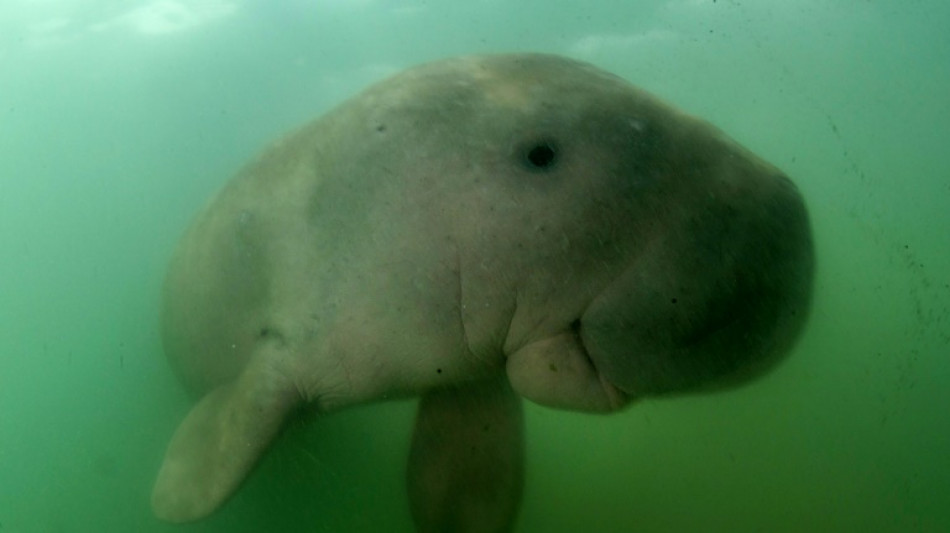
Sea cows threatened with extinction / Photo: Sirachai ARUNRUGSTICHAI - AFP/File

 US Fed raises rates to tackle 'too high' inflation, irking Trump

 Turkey releases 106 protesters, jails more LGBTQ activists

 Candidate for UN chief calls for AI regulation akin to nuclear weapons

 'We're losing control,' AI pioneer Yoshua Bengio tells AFP

 IR-MED and Dice Technologies Announce collaboration to Evaluate and Advance Pressure-Injury Prevention Platform in Japan

 Watts, Pitt, Cruz to light up Spain's top film festival

 Toogood Gold's Table Mountain Sits in the Shadow of a Nevada Gold Rush

 MEXC July–August Security Report: 38.66M USDT in Risk Funds Intercepted, Futures Insurance Fund Hits 792M USDT

 Emporio Armani names Dario Vitale new creative director

 EU to ban social media for under 13s, curb access until 15

 Wildfires push endangered Sumatran elephants to brink: Indonesian NGO

 Bank of Japan set to raise rates under pressure from inflation, US

 EU chief to unveil social media, gaming curbs for under-15s

 'Resident Evil' film brings video game's ethos to the big screen

 GA-ASI Mojave First UAS To Complete Battlefield Short Field Ops

 Sanders, Bannon warn of AI dangers in rare US left-right alignment

 Empty benches as schools reopen in Venezuela's quake-hit Guaira

 Tiny English village holds 'independence' vote over asylum seeker housing

 US Treasury chief says to meet Chinese counterpart at weekend

 BingX Evolves into a Multi-Asset Trading Platform, Connecting Users to Global Opportunities

 International Trading Institute Expands Professional Trader Development Beyond the Master’s in Trading

 Lake Energy Secures $80 Million for U.S. Renewable Energy Expansion

 Stocks drop, oil climbs and Treasury yields hit 19-year high

 SkySail Strategies Outperforms Wall Street's 30-Year Risk Standard With Proprietary AI Inference Model

 Just add fish: Scientists pursue more rice, less disease in Senegal paddies

Dugongs -- large herbivorous marine mammals commonly known as "sea cows" -- are now threatened with extinction, according to an official list updated Friday.
These gentle cousins of the manatee graze on seagrass in shallow coastal waters -- but their populations in East Africa and New Caledonia have now entered the IUCN (International Union for Conservation of Nature) Red List as "critically endangered" and "endangered," respectively.
Globally, the species remains classified as "vulnerable."
Their primary threats are unintentional capture in fishing gear in East Africa and poaching in New Caledonia, as well as boat injuries in both locations.
In East Africa, fossil fuel exploration and production, pollution and unauthorized development are also degrading their seagrass food source, while in New Caledonia seagrass is being damaged by agricultural run-off and pollution from nickel mining, among other sources.
Habitat degradation is compounded by climate change throughout the dugongs' range.
"Today's IUCN Red List update reveals a perfect storm of unsustainable human activity decimating marine life around the globe," said Bruno Oberle, IUCN Director General.
The updated list comes as delegates from across the world meet in Montreal for a UN biodiversity conference to finalize a new framework for "a peace pact with nature," with key goals to preserve Earth's forests, oceans and species.
In other updates to the IUCN list, 44 percent of all abalone shellfish are now threatened with extinction, while pillar coral has moved to "critically endangered."
Abalone species are considered gastronomic delicacies, leading to unsustainable extraction and poaching by international organized crime networks, for example in South Africa.
They are also deeply susceptible to climate change, with a marine heatwave killing 99 percent of Roe's abalones off Western Australia in 2011.
Agricultural and pollution run-off also cause harmful algal blooms, which have eliminated the Omani abalone, a commercial species found in the Arabian Peninsula, across half of its former range.
Twenty of the world's 54 abalone species are now threatened with extinction.
"Abalones reflect humanity's disastrous guardianship of our oceans in microcosm: overfishing, pollution, disease, habitat loss, algal blooms, warming and acidification, to name but a few threats," said Howard Peters of the University of York who led the assessment.
"They really are the canary in the coal mine."
Pillar coral, which are found throughout the Caribbean, moved from "vulnerable" to "critically endangered" after its population shrunk by over 80 percent across most of its range since 1990.
Bleaching caused by sea surface temperature rise -- as well as antibiotics, fertilizers and sewage running into the oceans -- have left them deeply susceptible to Stony coral tissue soss disease, which has ravaged their numbers over the past four years.
Overfishing around coral reefs has piled on more pressure by depleting the number of grazing fish, allowing algae to dominate.
D.Avraham--CPN