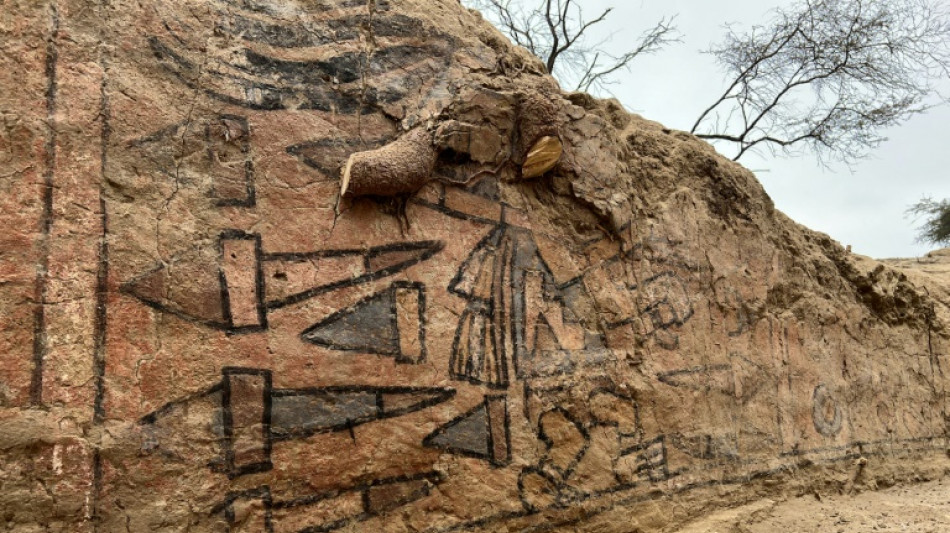
Archeologists find ancient Peruvian fresco, lost for a century / Photo: Sam Ghavami - AFP

 US Fed raises rates to tackle 'too high' inflation, irking Trump

 Turkey releases 106 protesters, jails more LGBTQ activists

 Candidate for UN chief calls for AI regulation akin to nuclear weapons

 'We're losing control,' AI pioneer Yoshua Bengio tells AFP

 IR-MED and Dice Technologies Announce collaboration to Evaluate and Advance Pressure-Injury Prevention Platform in Japan

 Watts, Pitt, Cruz to light up Spain's top film festival

 Toogood Gold's Table Mountain Sits in the Shadow of a Nevada Gold Rush

 MEXC July–August Security Report: 38.66M USDT in Risk Funds Intercepted, Futures Insurance Fund Hits 792M USDT

 Emporio Armani names Dario Vitale new creative director

 EU to ban social media for under 13s, curb access until 15

 Wildfires push endangered Sumatran elephants to brink: Indonesian NGO

 Bank of Japan set to raise rates under pressure from inflation, US

 EU chief to unveil social media, gaming curbs for under-15s

 'Resident Evil' film brings video game's ethos to the big screen

 GA-ASI Mojave First UAS To Complete Battlefield Short Field Ops

 Sanders, Bannon warn of AI dangers in rare US left-right alignment

 Empty benches as schools reopen in Venezuela's quake-hit Guaira

 Tiny English village holds 'independence' vote over asylum seeker housing

 US Treasury chief says to meet Chinese counterpart at weekend

 BingX Evolves into a Multi-Asset Trading Platform, Connecting Users to Global Opportunities

 International Trading Institute Expands Professional Trader Development Beyond the Master’s in Trading

 Lake Energy Secures $80 Million for U.S. Renewable Energy Expansion

 Stocks drop, oil climbs and Treasury yields hit 19-year high

 SkySail Strategies Outperforms Wall Street's 30-Year Risk Standard With Proprietary AI Inference Model

 Just add fish: Scientists pursue more rice, less disease in Senegal paddies

Archeologists have rediscovered a pre-Hispanic fresco depicting mythological scenes in northern Peru that they had only seen in black and white photographs that were more than a century old.
"It's an exceptional discovery, first of all, because it is rare to unearth wall paintings of such quality in pre-Colombian archeology," said Sam Ghavami, the Swiss archeologist who led excavations that uncovered the mural in October.
Ghavami spent four years looking for the rock painting, which he believes could be around 1,000 years old, with a team of Peruvian students.
"The composition of this painting is unique in the history of mural art in pre-Hispanic Peru," added the archaeologist, who trained at the University of Freiburg in Germany.
The fresco forms part of the Huaca Pintada temple, which belonged to the Moche civilization that flourished between the 1st and 8th centuries, and venerated the Moon, the rain, iguanas, and spiders.
The uncovered mural is about 30 meters (98 feet) long, and its images in blue, brown, red, white, and mustard yellow paint remain extremely well preserved.
In one section, a procession of warriors can be seen heading toward a birdlike deity.
The painted images "appear to be inspired by the idea of a sacred hierarchy built around a cult of ancestors and their intimate links with the forces of nature," said Ghavami.
He told AFP that deciphering the mural's message would form part of his research, but he believes it "could be interpreted as a metaphorical image of the political and religious order of the region's ancient inhabitants."
The discovery is also unusual as it shows a mixture of styles and elements of two pre-Incan cultures: the Moche and the Lambayeque, who lived on Peru's north coast between 900 and 1350 AD.
The mural's existence was only known via black and white photos taken in 1916 by the German ethnologist Hans Heinrich Bruning, who was living in Peru when he heard of the site after treasure hunters tried to loot it, but found nothing of value.
As the years went on, thick foliage took over, and no one had tried to look for the paintings until it piqued Ghavami's interest and he went in search of the long-lost fresco.
However, first he had a long battle to obtain permission from the family who own the land where the mural was found.
D.Goldberg--CPN