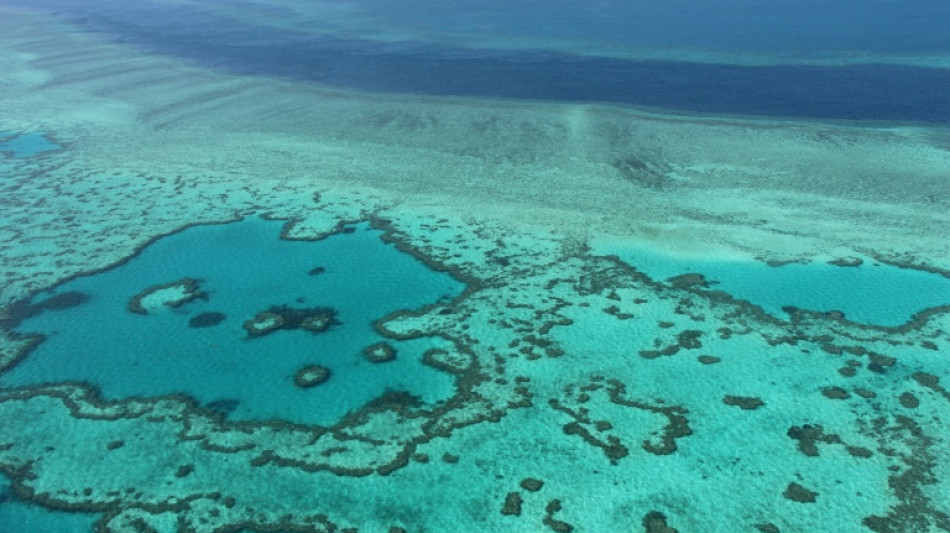
Australia falls short in Great Barrier Reef efforts: experts / Photo: SARAH LAI, SARAH LAI - AFP/File

 US Fed raises rates to tackle 'too high' inflation, irking Trump

 Turkey releases 106 protesters, jails more LGBTQ activists

 Candidate for UN chief calls for AI regulation akin to nuclear weapons

 'We're losing control,' AI pioneer Yoshua Bengio tells AFP

 IR-MED and Dice Technologies Announce collaboration to Evaluate and Advance Pressure-Injury Prevention Platform in Japan

 Watts, Pitt, Cruz to light up Spain's top film festival

 Toogood Gold's Table Mountain Sits in the Shadow of a Nevada Gold Rush

 MEXC July–August Security Report: 38.66M USDT in Risk Funds Intercepted, Futures Insurance Fund Hits 792M USDT

 Emporio Armani names Dario Vitale new creative director

 EU to ban social media for under 13s, curb access until 15

 Wildfires push endangered Sumatran elephants to brink: Indonesian NGO

 Bank of Japan set to raise rates under pressure from inflation, US

 EU chief to unveil social media, gaming curbs for under-15s

 'Resident Evil' film brings video game's ethos to the big screen

 GA-ASI Mojave First UAS To Complete Battlefield Short Field Ops

 Sanders, Bannon warn of AI dangers in rare US left-right alignment

 Empty benches as schools reopen in Venezuela's quake-hit Guaira

 Tiny English village holds 'independence' vote over asylum seeker housing

 US Treasury chief says to meet Chinese counterpart at weekend

 BingX Evolves into a Multi-Asset Trading Platform, Connecting Users to Global Opportunities

 International Trading Institute Expands Professional Trader Development Beyond the Master’s in Trading

 Lake Energy Secures $80 Million for U.S. Renewable Energy Expansion

 Stocks drop, oil climbs and Treasury yields hit 19-year high

 SkySail Strategies Outperforms Wall Street's 30-Year Risk Standard With Proprietary AI Inference Model

 Just add fish: Scientists pursue more rice, less disease in Senegal paddies

Despite warnings, Australia's efforts to save the Great Barrier Reef still fall short of protecting the world's largest coral reef system from pollution and climate change, experts said Monday.
Australia had taken unprecedented steps towards the protection of the Great Barrier Reef, which the United Nations has designated a world heritage site, but more was needed to avoid the site being declared "in danger" by UNESCO, the UN agency which compiles and manages a list of heritage sites.
Such a designation puts a government on notice that a site could be removed from the World Heritage list altogether, a very rare event.
"Despite the unparalleled science and management efforts" made by Australia over recent years, the Great Barrier Reef is "significantly impacted by climate change factors", Eleanor Carter at the International Union for Conservation of Nature (IUCN) and UNESCO representative Hans Thulstrup said in a report based on a mission to the Reef.
"The resilience of the property to recover from climate change impacts is substantially compromised," they said.
Carter and Thulstrup recommended that the reef should be added to the "World Heritage in Danger" list.
The Australian government in January announced a billion-dollar package to protect the reef, seven years after its "Reef 2050" plan, already a response to a UN downgrade threat.
The Climate Council pressure group said this latest package of funding was like putting "a Band-Aid on a broken leg".
Monday's report echoed that assessment, saying the reef's ability to recover from climate change impacts was "substantially compromised".
In particular, Australian strategies were "lacking clear climate change targets", while some measures were not fully implemented, especially concerning "water quality and fisheries activities", it said.
Australia reported in May that 91 percent of the reef's coral had been damaged by bleaching after a prolonged summer heatwave, a process that increases the mortality rates of the affected corals.
After intense lobbying, Australia narrowly avoided the Reef being placed on UNESCO's "in danger" list in the summer of 2021.
The then-government of conservative prime minister Scott Morrison was voted out this year in favour of a centre-left government under Anthony Albanese who has promised greener policies.
A UNESCO spokesperson told AFP that "a constructive dialogue is ongoing with the current government".
A source close to the matter called Monday's report "a roadmap submitted to the Australian government which should say what it intends to do with it and produce results".
The source added: "The path to saving the Great Barrier Reef is narrow, but it exists. Strong and rapid action can produce results.".
To be included on UNESCO's world heritage list, a site must have "outstanding universal value".
An spot on the list usually means boosted tourism, and improved access to funds and to scientific expertise.
Those benefits are threatened when a site is declared "in danger" -- which is currently the case of about 50 sites worldwide.
Only three sites have ever been dropped from the heritage list completely.
M.Mendoza--CPN