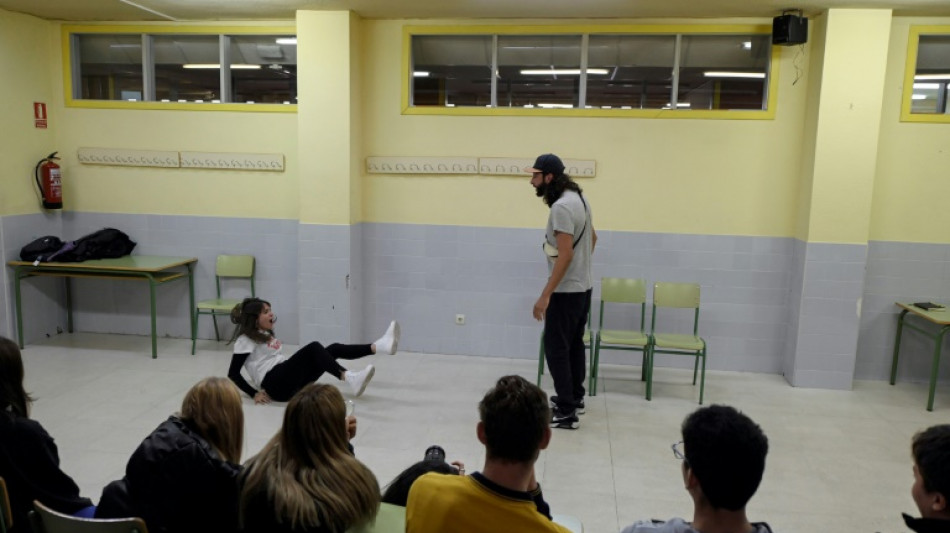
Interactive play gives Spain teens insight into gender violence / Photo: OSCAR DEL POZO - AFP

 Lights out in Laos as electricity exports surge

 Steven Strogatz weighs AI mathematics advances and their consequences for researchers

 Anthropic boss calls for AI slowdown, Altman and Musk agree

 French IT giant Capgemini sells subsidiary after row over ICE links

 Quebec Brokerage Qubit Insurance Announces New Data on Coverage Shortfalls as Rebuilding Costs Rise

 Lady Gaga welcomes first child with fiance: US media

 Bhutan business bets on hazelnuts for farming future

 'Widow's Bay' and 'The Pitt' are favorites for Emmys night

 Coastal erosion forces cancellation of California music festival

 Argentina's Dirty War rears its head in Venice film

 UK lawmakers throw out bill to legalise assisted dying

 US inflation steady in August, fueling Fed rate hike expectations

 New York marks 25th anniversary of 9/11 attacks

 Nepal flood reconstruction bill to be $4.78 bn: foreign ministry

 JUMO and Standard Bank launch Social Finance Framework to scale inclusive finance in Africa

 Doomsday tech: could AI really kill us all?

 French comedy show 'Call my agent' makes film comeback

 It's all coming back: Celine Dion fans gear up for Paris return

 Researchers eye AI revolution in natural disaster forecasts

 US braces for inflation report that may push Fed to hike rates

 Musk threatens legal action over documentary

 Latin America fact-check group asks Meta not to replace verification practice

 AI Risks to Enter 60–80% of Liability and Cyber Insurance Underwriting by 2028, ScienceSoft Predicts

 Tribal Launches Campfire, Letting Business and Technical Teams Build on Salesforce Together

 Stocks fall as fresh oil surge fans inflation fears

The row started with something minor: 'Edu' was laughing at something on his phone but refused to show it to his girlfriend 'Ali'. She got upset and they started arguing.
Angry words turned into shouting and insults and suddenly a furious 'Edu' grabs her phone and hurls it to the classroom floor where it shatters, the violent gesture shocking the group of watching teenagers.
The confrontation between the two characters, played by actors, is part of a play by Teatro Que Cura (The Healing Theatre) visiting a high school in the town of Parla near Madrid to raise awareness about domestic violence.
November 25 is International Day for the Elimination of Violence Against Women and in Spain, which passed Europe's first law against it in 2004, experts agree education is key to reducing the problem.
In May, official figures showed gender violence was growing fastest among the under-18s, with the number of female victims up nearly 30 percent from 514 in 2020 to 661 in 2021.
It was unclear if this was due to an increase in violence or a rise in the number of incidents reported.
The play at El Olivo high school starts with the couple getting ready for their first date, Edu wining over the 15- and 16-year-olds with a humorous monologue worrying over his looks, what to wear and his chances of getting laid.
But the laughter dies as their relationship develops -- and the teenagers are encouraged to reflect on their arguments and what they would do differently.
"The aim is to help adolescents build relationships based on equality and prevent domestic violence," says Susana Martin Cuezva, a therapist who directs Teatro que Cura and moderates the discussions.
"The idea is that the students experience a situation of tension or conflict in the here and now and that they resolve it in a different way to how the actors are approaching it, which is always through violence."
- 'Pretty realistic' -
"It's good to show it like this. If you see it in the street, it's just a couple fighting. But seeing it in this context you realise it is actually violence and that you can do something about it," says 15-year-old Patricia Garcia.
As the plot develops, the audience is invited to voice their thoughts directly to Edu or Ali, with each actor improvising a response.
"I lost my head, I'm not really like that," Edu explains to a student after the phone-smashing incident.
"Yeah right. First, give me some space and don't try to intimidate me," she says calmly. As he starts arguing, she walks off -- to cheers and applause from the students.
What affected Mario Carmona, 16, most was the insults and the pushing and shoving.
"Unfortunately, it was pretty realistic, and it happens more often than you'd expect," he told AFP.
"It's not easy to understand what's happening even though these arguments are pretty normal. But it's good to have someone to support you, who can give you a wake-up call if things get a bit out of hand."
Set up in 2017, Teatro que Cura uses interactive theatre to immerse teens in dramatised scenarios of inequality and violence to raise awareness about conflict and gender-based violence.
Over the past five years, they have worked with some 9,000 teenagers aged 14-19, mostly in the Madrid region.
Studies show education is crucial, with a 2021 Spanish government report finding sex education classes focused on equality and violence "reduce the risk of resorting to gender-based violence in boys, and of suffering it in girls".
- 'Detecting cases of risk' -
"Adolescents who are taught about gender-based violence are at less risk," educational psychologist Maria Jose Diaz-Aguado told El Pais newspaper.
"If you get this sort of education at school, you can become aware of such things much earlier," agreed 16-year-old Maryam Calderon.
Silvia Serrano Martin, El Olivo's school psychologist, said the sessions were very effective.
"It's really helped raise awareness about domestic violence because seeing it in such an experiential way reaches them more directly," she told AFP.
"This is a useful prevention tool but it's also good for detecting cases of risk."
Sometimes students come forward to privately share their experiences, which in some cases has involved situations of "real urgency," Susana Martin Cuezva says.
"Once a boy came to talk to the actor and said he identified with Edu, that he was starting to be violent with his partner. He was in tears and told us he needed help and didn't want to repeat what was happening at home," she said.
The case was immediately referred to a regional gender violence unit.
"I've learned I need to put myself first," 15-year-old Garcia told AFP when asked what she had taken from the session.
"If a relationship is starting to become aggressive, you have to walk away for your own good."
M.Anderson--CPN