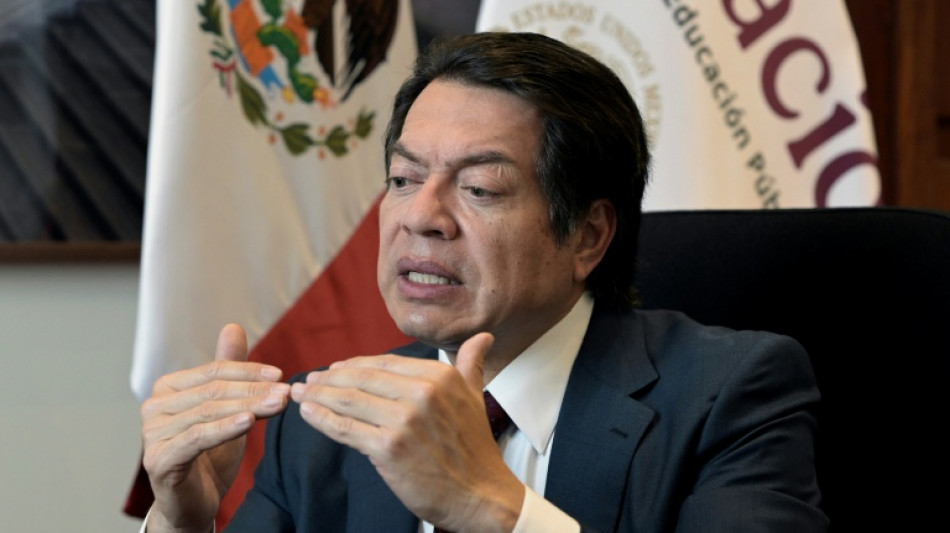
Mexico considering social media restriction for minors: minister to AFP / Photo: Alfredo ESTRELLA - AFP

 Lights out in Laos as electricity exports surge

 Steven Strogatz weighs AI mathematics advances and their consequences for researchers

 Anthropic boss calls for AI slowdown, Altman and Musk agree

 French IT giant Capgemini sells subsidiary after row over ICE links

 Quebec Brokerage Qubit Insurance Announces New Data on Coverage Shortfalls as Rebuilding Costs Rise

 Lady Gaga welcomes first child with fiance: US media

 Bhutan business bets on hazelnuts for farming future

 'Widow's Bay' and 'The Pitt' are favorites for Emmys night

 Coastal erosion forces cancellation of California music festival

 Argentina's Dirty War rears its head in Venice film

 UK lawmakers throw out bill to legalise assisted dying

 US inflation steady in August, fueling Fed rate hike expectations

 New York marks 25th anniversary of 9/11 attacks

 Nepal flood reconstruction bill to be $4.78 bn: foreign ministry

 JUMO and Standard Bank launch Social Finance Framework to scale inclusive finance in Africa

 Doomsday tech: could AI really kill us all?

 French comedy show 'Call my agent' makes film comeback

 It's all coming back: Celine Dion fans gear up for Paris return

 Researchers eye AI revolution in natural disaster forecasts

 US braces for inflation report that may push Fed to hike rates

 Musk threatens legal action over documentary

 Latin America fact-check group asks Meta not to replace verification practice

 AI Risks to Enter 60–80% of Liability and Cyber Insurance Underwriting by 2028, ScienceSoft Predicts

 Tribal Launches Campfire, Letting Business and Technical Teams Build on Salesforce Together

 Stocks fall as fresh oil surge fans inflation fears

Mexico is considering implementing an Australia-style social media restriction for minors, Public Education Secretary Mario Delgado told AFP.
Several nations are toughening up age restrictions on social media platforms as concerns grow over excessive screen time for children and their exposure to harmful content online.
Delgado said the government had launched consultations with a range of civil society groups, including teachers and parents' representatives, with a view to developing regulatory proposals by June.
Australia has since December required TikTok, YouTube, Snapchat and other top social media services to remove accounts held by under-16s, or face heavy fines.
French lawmakers in January approved a social media ban for under-15s, although it still needs to be ratified by the Senate.
Britain, Spain, Denmark, India, Indonesia and Portugal are studying similar restrictions.
"The state has the responsibility for the guardianship and education of minors. And that's where we should think about setting certain limits," Delgado told AFP.
“What Meta, Facebook and TikTok are interested in is having followers, and there are no filters on content that could affect children’s emotional health,” he said, citing their exposure to violent or pornographic content and cyberbullying.
Delgado insisted, however, that any ban needed to come "from the grassroots, from the lived experiences of parents, different communities, and teachers."
"We want them to tell us what these limits should be and how to regulate them,” he stressed.
He added that tech companies would be given a voice in the debate, which aims to promote a "responsible, critical, and conscious" digital culture, rather than prohibit.
Australian officials say that country's ban has already reduced cyberbullying and increased student concentration in schools.
"I personally like the Australian model," Delgado said, while adding that, as the father of a teenager, he understood the challenges of curbing children's social media use.
He added that, for now, Latin America's second-most populous country after Brazil was not considering banning mobile devices in public schools.
Brazil and Chile last year joined a growing number of nations that have banned non-emergency smartphone use by children in schools.
P.Schmidt--CPN