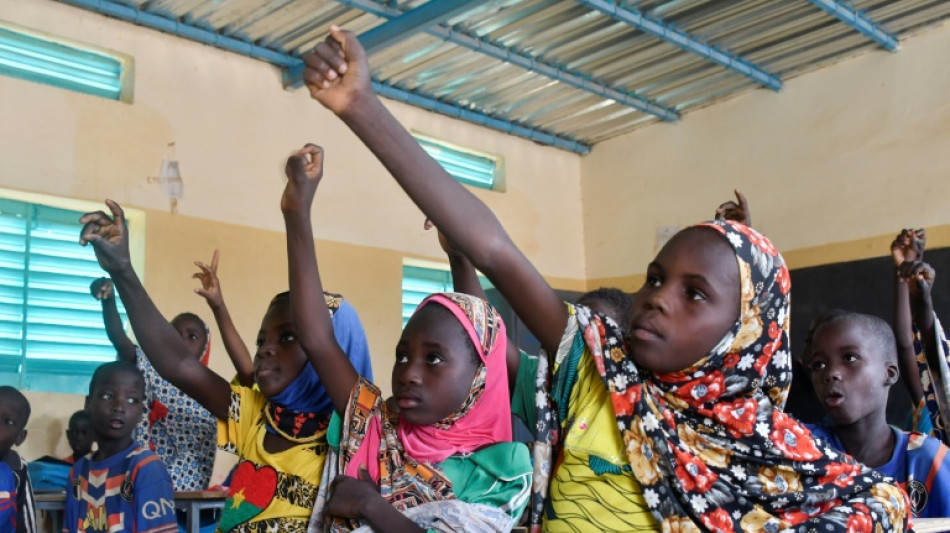
Fleeing jihadist violence, Niger pupils return to school / Photo: BOUREIMA HAMA - AFP

 Lights out in Laos as electricity exports surge

 Steven Strogatz weighs AI mathematics advances and their consequences for researchers

 Anthropic boss calls for AI slowdown, Altman and Musk agree

 French IT giant Capgemini sells subsidiary after row over ICE links

 Quebec Brokerage Qubit Insurance Announces New Data on Coverage Shortfalls as Rebuilding Costs Rise

 Lady Gaga welcomes first child with fiance: US media

 Bhutan business bets on hazelnuts for farming future

 'Widow's Bay' and 'The Pitt' are favorites for Emmys night

 Coastal erosion forces cancellation of California music festival

 Argentina's Dirty War rears its head in Venice film

 UK lawmakers throw out bill to legalise assisted dying

 US inflation steady in August, fueling Fed rate hike expectations

 New York marks 25th anniversary of 9/11 attacks

 Nepal flood reconstruction bill to be $4.78 bn: foreign ministry

 JUMO and Standard Bank launch Social Finance Framework to scale inclusive finance in Africa

 Doomsday tech: could AI really kill us all?

 French comedy show 'Call my agent' makes film comeback

 It's all coming back: Celine Dion fans gear up for Paris return

 Researchers eye AI revolution in natural disaster forecasts

 US braces for inflation report that may push Fed to hike rates

 Musk threatens legal action over documentary

 Latin America fact-check group asks Meta not to replace verification practice

 AI Risks to Enter 60–80% of Liability and Cyber Insurance Underwriting by 2028, ScienceSoft Predicts

 Tribal Launches Campfire, Letting Business and Technical Teams Build on Salesforce Together

 Stocks fall as fresh oil surge fans inflation fears

With blue schoolbags bouncing off their backs, hundreds of schoolchildren hurtle down small sand dunes eager to attend class again.
But these boys and girls are survivors of suffering and trauma that few children of their age could conceive.
Their new school is in the town of Ouallam in southwestern Niger, a region that for five years has been plagued by attacks unleashed by groups linked with Al-Qaeda and the Islamic State group.
The pupils come from 18 villages near Mali whose inhabitants fled to the relative safety of Ouallam in 2021 after jihadist killings that also forced the closure of schools.
The UN children's agency UNICEF says 817 schools with 72,421 pupils -- including 34,464 girls -- have closed in Niger, mostly in the Tillaberi, the border region where Ouallam is located.
In Ouallam alone, around one hundred schools have had to shut their doors.
The chronic insecurity has prompted the authorities to create dedicated educational centres where displaced children can resume their schooling, Mahamadou Illo Abarchi, an education official in Ouallam, told AFP.
Some 17,000 pupils have already re-entered the school system and another 55,300 are set to follow suit, enrolling in around 20 centres for displaced children across southwestern Niger, the government says.
- 'Killed by the bandits' -
In Ouallam, almost 1,600 schoolchildren -- some of whom had not attended class for three years -- are registered with three centres built near a site for displaced people.
The sites offer free canteens, a vital resource for families who have escaped violence in a nation that, by the UN's human development index, is the poorest in the world.
Lessons take place in shelters or classrooms equipped with tables and benches provided by NGOs. But in others, the pupils must learn on the floor.
Fatima and Aissa, two young girls from Ngaba, a settlement near Mali, expressed their delight at returning to school as they clutched their slate boards.
But the euphoria of returning to school cannot wipe out the painful memories.
"My uncle was a village chief, he was killed by the bandits in front of our eyes," said Mariama, who also lived in Ngaba. "There was a lot of blood."
Nassirou, Malick, Hasane, Abdou and their parents fled their village of Adabdab on foot after a series of jihadist attacks, the last of which on October 22 claimed the lives of 11 civilians.
"It was the bandits who chased us away, they killed many men," Nassirou said quietly in the playground.
Moussa, who hails from a hamlet in the same area, said: "I'm not afraid anymore, I no longer hide when I hear the sound of motorcycles" often used by jihadists to attack villages.
- 'Encouraging results' -
When they first arrived at the new centres, many children showed "signs of distress and trauma, others were very aggressive", said education official Morou Chaibou.
He spoke of how some pupils recounted harrowing memories -- including seeing their parents being shot.
Adamou Dari, the regional director of the centres, said they also offered the children psychological and social support to give them some stability after their traumatic experience.
"Now they concentrate in class and the results are encouraging," said a teacher as she played in the courtyard with some of her pupils.
Absenteeism is minor but a source of worry, Dari said, explaining that some pupils played truant to work in the town and feed their families.
Harlem Desir of the International Rescue Committee, who recently visited the site for displaced people in Ouallam, said impoverished families often put their children to work or marry their daughters at a young age.
In 2021, Amnesty International warned that boys aged between 15 and 17 were filling the ranks of armed groups, especially the Al-Qaeda-affiliated GSIM, in the Torodi region near Burkina Faso -- with the blessing of their parents.
M.Davis--CPN