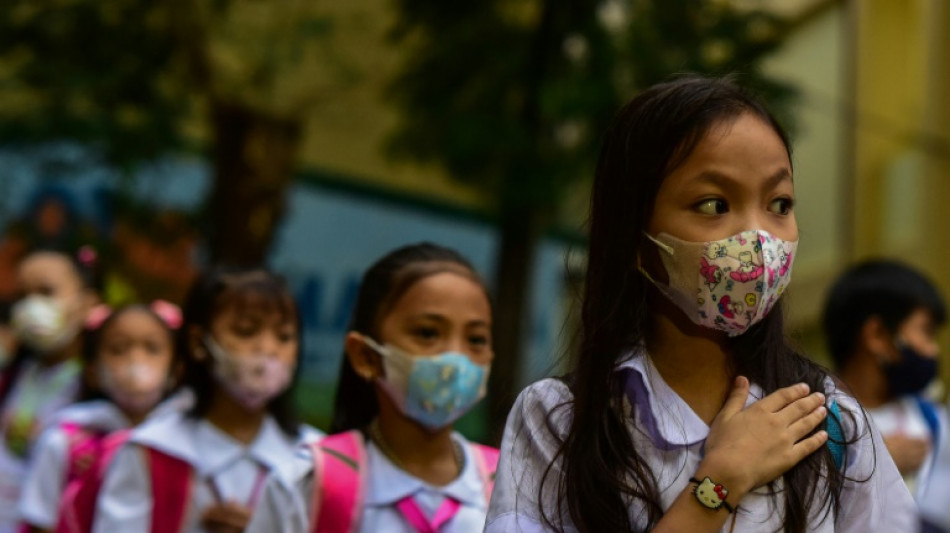
Philippine classrooms reopen after more than two years / Photo: Maria Tan - AFP

 Lights out in Laos as electricity exports surge

 Steven Strogatz weighs AI mathematics advances and their consequences for researchers

 Anthropic boss calls for AI slowdown, Altman and Musk agree

 French IT giant Capgemini sells subsidiary after row over ICE links

 Quebec Brokerage Qubit Insurance Announces New Data on Coverage Shortfalls as Rebuilding Costs Rise

 Lady Gaga welcomes first child with fiance: US media

 Bhutan business bets on hazelnuts for farming future

 'Widow's Bay' and 'The Pitt' are favorites for Emmys night

 Coastal erosion forces cancellation of California music festival

 Argentina's Dirty War rears its head in Venice film

 UK lawmakers throw out bill to legalise assisted dying

 US inflation steady in August, fueling Fed rate hike expectations

 New York marks 25th anniversary of 9/11 attacks

 Nepal flood reconstruction bill to be $4.78 bn: foreign ministry

 JUMO and Standard Bank launch Social Finance Framework to scale inclusive finance in Africa

 Doomsday tech: could AI really kill us all?

 French comedy show 'Call my agent' makes film comeback

 It's all coming back: Celine Dion fans gear up for Paris return

 Researchers eye AI revolution in natural disaster forecasts

 US braces for inflation report that may push Fed to hike rates

 Musk threatens legal action over documentary

 Latin America fact-check group asks Meta not to replace verification practice

 AI Risks to Enter 60–80% of Liability and Cyber Insurance Underwriting by 2028, ScienceSoft Predicts

 Tribal Launches Campfire, Letting Business and Technical Teams Build on Salesforce Together

 Stocks fall as fresh oil surge fans inflation fears

Millions of children in the Philippines returned to school as the academic year started on Monday, with many taking their seats in classrooms for the first time since the Covid-19 pandemic hit.
The Philippines is one of the last countries in the world to resume full-time, in-person lessons -- sparking warnings that the prolonged closure of classrooms had worsened an education crisis in the country.
Children in masks and uniforms lined up for a temperature check and squirt of hand sanitiser at Pedro Guevara Elementary School in Manila, which had shut classrooms since March 2020.
The school has adopted a hybrid system of in-person and remote learning as it transitions its nearly 6,000 students back to face-to-face classes by November -- a deadline set by President Ferdinand Marcos Jr soon after he took office two months ago.
Grade six student Sophia Macahilig said she was "excited" to meet her classmates and teachers after two years of Zoom lessons.
"We used to have fun and now I can have fun again," 11-year-old Macahilig told AFP.
But many students have a lot of catching up to do.
Even before the pandemic, nine out of 10 Filipino children could "not read a simple text with comprehension" by age 10, the World Bank and other agencies said in a recent report.
Only 10 countries were worse off, including Afghanistan, Laos, Chad and Yemen.
- Lagging behind -
After Philippine schools closed, a "blended learning" programme involving online classes, printed materials and lessons broadcast on television and social media was introduced.
As face-to-face classes resume, old problems persist: large class sizes, outdated teaching methods, poverty, and lack of basic infrastructure -- such as toilets -- have been blamed for contributing to the education crisis.
Pedro Guevara science teacher Ethel Tumanan, 32, said she was worried that students had missed out on valuable learning over the past two years.
"As a teacher, we really prefer face-to-face, at least we are the ones who can gauge and assess where our pupils are at."
In the lead-up to the reopening of classrooms, the government has been ramping up a vaccination drive and will provide students with free public transport until the end of the calendar year.
On Saturday, the government began handing out cash aid to students and parents struggling to cover expenses, leading to chaotic scenes outside distribution centres.
In the city of Zamboanga, 29 people were injured when several thousand tried to push through the gate of a high school.
Y.Ibrahim--CPN