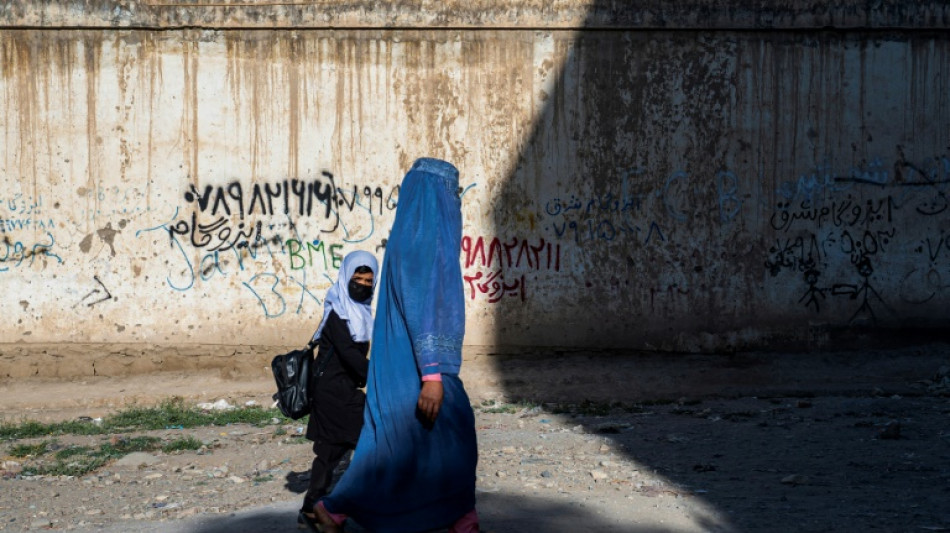
Taliban torn over reforms one year after seizing power / Photo: Wakil KOHSAR - AFP

 Lights out in Laos as electricity exports surge

 Steven Strogatz weighs AI mathematics advances and their consequences for researchers

 Anthropic boss calls for AI slowdown, Altman and Musk agree

 French IT giant Capgemini sells subsidiary after row over ICE links

 Quebec Brokerage Qubit Insurance Announces New Data on Coverage Shortfalls as Rebuilding Costs Rise

 Lady Gaga welcomes first child with fiance: US media

 Bhutan business bets on hazelnuts for farming future

 'Widow's Bay' and 'The Pitt' are favorites for Emmys night

 Coastal erosion forces cancellation of California music festival

 Argentina's Dirty War rears its head in Venice film

 UK lawmakers throw out bill to legalise assisted dying

 US inflation steady in August, fueling Fed rate hike expectations

 New York marks 25th anniversary of 9/11 attacks

 Nepal flood reconstruction bill to be $4.78 bn: foreign ministry

 JUMO and Standard Bank launch Social Finance Framework to scale inclusive finance in Africa

 Doomsday tech: could AI really kill us all?

 French comedy show 'Call my agent' makes film comeback

 It's all coming back: Celine Dion fans gear up for Paris return

 Researchers eye AI revolution in natural disaster forecasts

 US braces for inflation report that may push Fed to hike rates

 Musk threatens legal action over documentary

 Latin America fact-check group asks Meta not to replace verification practice

 AI Risks to Enter 60–80% of Liability and Cyber Insurance Underwriting by 2028, ScienceSoft Predicts

 Tribal Launches Campfire, Letting Business and Technical Teams Build on Salesforce Together

 Stocks fall as fresh oil surge fans inflation fears

One year on from the Taliban's return to power in Afghanistan, some cracks are opening within their ranks over the crucial question of just how much reform their leaders can tolerate.
Infamous during their first reign for their brutal crackdowns on rights and freedoms, the Islamists vowed to rule differently this time.
On a superficial level at least, they appear to have changed in some respects.
Officials in Kabul have embraced technology, while cricket matches are cheered in full stadiums.
Televisions were banned under the Taliban government's first incarnation, while Afghans now have access to the internet and social media.
Girls are allowed to attend primary school and women journalists are interviewing government officials -- unthinkable during the Taliban's first stint in power in the 1990s.
The group's hardline core, composed of battle-hardened veteran fighters, is against any significant ideological change that could be viewed as a sign of capitulation to their enemies in the West.
"You have one (Taliban) camp, which is pushing ahead with what they're seeing as reforms, and another camp that seems to think even these meagre reforms are too much," said Ibraheem Bahiss, an Afghanistan analyst with International Crisis Group.
The United States and its allies -- which had bankrolled Afghanistan for 20 years -- have locked the country out of the global banking system and billions in frozen assets abroad, as they hold out for reforms from the Taliban.
Without significant progress, it is the Afghan people who suffer as the country reels under a massive economic crisis that has seen some families choose between selling their organs or their infant daughters.
- 'Retrograde dogmatic views' -
On whether the Taliban are even capable of reform, analysts are wary that recent policy changes amount to little more than "tokenism".
"There are some cases where we could point to an evolution in policy, but let's be very clear... We're still looking at an organisation that has refused to move beyond very retrograde, dogmatic views," said Michael Kugelman, an Afghanistan specialist with the Washington-based Wilson Center think tank.
Most secondary schools for girls remain closed. Many women have been forced out of government work, while many fear venturing out and being chastised by the Taliban.
Simple joys such as music, shisha and card games are strictly controlled in the most conservative areas, while protests have been crushed and journalists regularly threatened or detained.
Demands from the West for an inclusive government were ignored, and the assassination of Al-Qaeda's leader in Kabul last week underlined the Taliban's ongoing ties with jihadist groups.
- Reform as capitulation -
It is from the Taliban's power base of southern Kandahar that the secretive supreme leader Hibatullah Akhundzada gathers his powerful inner circle of veteran fighters and religious clerics to impose a harsh interpretation of sharia.
And for them, ideological concerns outweigh any political or economic drivers to effect change.
"The needs of the Afghans remain the same as 20 years ago," Mohammad Omar Khitabi, a member of a council of clerics who advise Akhundzada in Kandahar, told AFP.
His thoughts are echoed by Kandahar's Vice and Virtue Director Abdul Rahman Tayabi, another close aide of the supreme leader.
"Our people do not have too many demands, like people in other countries might have," he told AFP.
Afghan families were left stunned in March when Akhundzada overturned the education ministry's decision to reopen secondary schools for girls.
Some analysts believe he felt uneasy over what could be seen by hardliners as an act of surrender to the West on girls' rights.
Hopes of restoring international money flows were shattered -- to the dismay of many Taliban officials in Kabul, some of whom spoke out against the decision.
Relations with Western diplomats -- who meet regularly with Taliban ministers but have no access to Akhundzada -- suffered a major setback.
A slew of directives that harked back to the first reign of the Taliban quickly followed.
"The decisions that (Akhundzada) has made so far are all based on the opinions of religious scholars," said Abdul Hadi Hammad, the head of a madrassa and member of the supreme leader's advisory council.
Akhundzada has stressed the need for unity in the movement as he carefully seeks to balance several factions -- including competing groups that claim the credit for the 2021 victory over US-led forces.
While advisers to Akhundzada claim the Taliban can survive without foreign income, unlocking billions of dollars in frozen assets abroad would be a crucial lifeline.
"We know the Taliban can be transactional, but they cannot appear to be transactional," a Western diplomat told AFP on condition of anonymity.
- Economic pressure -
Within the movement, no one dares openly challenge Akhundzada's power, but discontent is quietly growing among the lower ranks.
"Taliban guards are getting their salaries late, and their salaries are low too. They are unhappy," said one mid-level Taliban official based in northwestern Pakistan, who asked not to be named.
Many have returned to their villages or travelled to Pakistan to take up different work, another Taliban member added.
Attempts by the movement to shore up revenue through lucrative coal mining have sparked infighting in the north, exacerbated by ethnic divisions and religious sectarianism.
With winter only a few months away, food security and freezing temperatures will put even more pressure on the leaders of one of the world's poorest countries.
These mounting stresses have the potential to worsen divisions, Kugelman said, though likely not enough to force any dramatic shift in policy.
"If the Taliban leadership start to feel very real threats to their political survival, then could they change?" he asked.
"Given that they are ideologically focused, that may not be the case."
L.K.Baumgartner--CPN