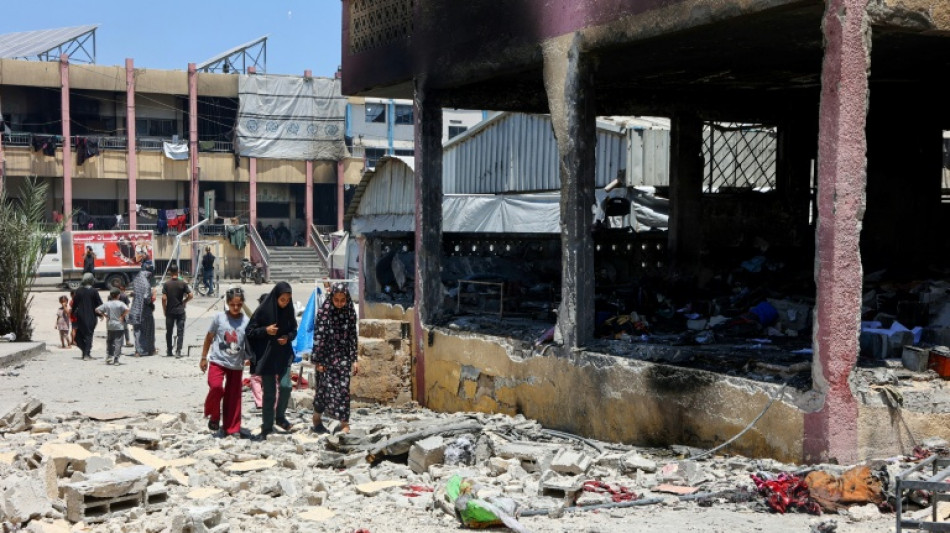
Gaza risks 'lost generation' due to ruined schools: UN official / Photo: Omar AL-QATTAA - AFP

 Lights out in Laos as electricity exports surge

 Steven Strogatz weighs AI mathematics advances and their consequences for researchers

 Anthropic boss calls for AI slowdown, Altman and Musk agree

 French IT giant Capgemini sells subsidiary after row over ICE links

 Quebec Brokerage Qubit Insurance Announces New Data on Coverage Shortfalls as Rebuilding Costs Rise

 Lady Gaga welcomes first child with fiance: US media

 Bhutan business bets on hazelnuts for farming future

 'Widow's Bay' and 'The Pitt' are favorites for Emmys night

 Coastal erosion forces cancellation of California music festival

 Argentina's Dirty War rears its head in Venice film

 UK lawmakers throw out bill to legalise assisted dying

 US inflation steady in August, fueling Fed rate hike expectations

 New York marks 25th anniversary of 9/11 attacks

 Nepal flood reconstruction bill to be $4.78 bn: foreign ministry

 JUMO and Standard Bank launch Social Finance Framework to scale inclusive finance in Africa

 Doomsday tech: could AI really kill us all?

 French comedy show 'Call my agent' makes film comeback

 It's all coming back: Celine Dion fans gear up for Paris return

 Researchers eye AI revolution in natural disaster forecasts

 US braces for inflation report that may push Fed to hike rates

 Musk threatens legal action over documentary

 Latin America fact-check group asks Meta not to replace verification practice

 AI Risks to Enter 60–80% of Liability and Cyber Insurance Underwriting by 2028, ScienceSoft Predicts

 Tribal Launches Campfire, Letting Business and Technical Teams Build on Salesforce Together

 Stocks fall as fresh oil surge fans inflation fears

With Gaza's education system shattered by two years of gruelling war, UNICEF's regional director says he fears for a "lost generation" of children wandering ruined streets with nothing to do.
"This is the third year that there has been no school," Edouard Beigbeder, the UN agency's regional director for the Middle East and North Africa, told AFP in Jerusalem on Thursday after returning from the Palestinian territory.
"If we don't start a real transition for all children in February, we will enter a fourth year. And then we can talk about a lost generation."
The devastating conflict between Israel and Hamas reduced swathes of Gaza to rubble, displaced the vast majority of its population at least once and crippled public services.
The destruction "is almost omnipresent wherever you go," Beigbeder said.
"It is impossible to imagine 80 percent of a territory that is completely flattened out or destroyed," he added.
A US-brokered ceasefire which came into effect earlier in October has allowed UNICEF and other education partners to get about one-sixth of children who should be in school into temporary "learning centres," Beigbeder told AFP.
"They have three days of learning in reading, mathematics and writing, but this is far from a formal education as we know it," he added.
Beigbeder said that such learning centres, often located in schools or near displacement camps, consisted of metal structures covered with plastic sheeting or of tents.
He said there were sometimes chairs, cardboard boxes or wooden planks serving as tables, and that children would write on salvaged slates or plastic boards.
"I've never seen everyone sitting properly," he added, describing children on mats or carpets.
- 'Inaccessible' -
Despite the ceasefire, Beigbeder said the situation for Gaza's education system was catastrophic, with 85 percent of schools destroyed or unusable.
Of the buildings still standing, many are being used as shelters for displaced people, he said, with the situation compounded by the fact that many children and teachers are also on the move and looking to provide for their own families.
Gaza's school system was already overcrowded before the conflict, with half the pre-war population under the age of 18.
Of the schools managed by the West Bank-based Palestinian Authority alone, Beigbeder said that some 80 out of 300 were in need of renovation.
He said 142 had been completely destroyed, while 38 were "completely inaccessible" because they were located in the area to which Israeli troops have withdrawn under the ceasefire.
The UN agency for Palestinian refugees (UNRWA) said on October 18 that it was launching a "new e-learning school year" with the aim of reaching 290,000 pupils.
On Friday, US Secretary of State Marco Rubio accused UNRWA of being a "subsidiary of Hamas" and said it would play no role in post-war Gaza.
Hamas's unprecedented attack on Israel on October 7, 2023 sparked the war in the Palestinian territory.
- 'Lost generation' -
Beigbeder said it was vital to put education "at the top of the agenda" and rebuild a sense of social cohesion for Gaza's children, almost all of whom are traumatised and in need of psychological support.
UNICEF said one of the priorities was getting permission at border crossings to bring in materials to set up semi-permanent schools, as well as school supplies which have been blocked as they're considered non-essential.
Israel repeatedly cut off supplies into the Gaza Strip during the war, exacerbating dire humanitarian conditions, with the UN saying it caused a famine in parts of the Palestinian territory.
The World Health Organization said Thursday there had been little improvement in the amount of aid going into Gaza since the ceasefire took hold -- and no observable reduction in hunger.
"How can you rehabilitate classrooms if you don't have cement? And above all, we need notebooks and books ... blackboards, the bare minimum," said Beigbeder.
"Food is survival. Education is hope".
M.García--CPN