Finnish phone ban brings focus, and chatter, back to school / Photo: Alessandro RAMPAZZO - AFP

 Lights out in Laos as electricity exports surge

 Steven Strogatz weighs AI mathematics advances and their consequences for researchers

 Anthropic boss calls for AI slowdown, Altman and Musk agree

 French IT giant Capgemini sells subsidiary after row over ICE links

 Quebec Brokerage Qubit Insurance Announces New Data on Coverage Shortfalls as Rebuilding Costs Rise

 Lady Gaga welcomes first child with fiance: US media

 Bhutan business bets on hazelnuts for farming future

 'Widow's Bay' and 'The Pitt' are favorites for Emmys night

 Coastal erosion forces cancellation of California music festival

 Argentina's Dirty War rears its head in Venice film

 UK lawmakers throw out bill to legalise assisted dying

 US inflation steady in August, fueling Fed rate hike expectations

 New York marks 25th anniversary of 9/11 attacks

 Nepal flood reconstruction bill to be $4.78 bn: foreign ministry

 JUMO and Standard Bank launch Social Finance Framework to scale inclusive finance in Africa

 Doomsday tech: could AI really kill us all?

 French comedy show 'Call my agent' makes film comeback

 It's all coming back: Celine Dion fans gear up for Paris return

 Researchers eye AI revolution in natural disaster forecasts

 US braces for inflation report that may push Fed to hike rates

 Musk threatens legal action over documentary

 Latin America fact-check group asks Meta not to replace verification practice

 AI Risks to Enter 60–80% of Liability and Cyber Insurance Underwriting by 2028, ScienceSoft Predicts

 Tribal Launches Campfire, Letting Business and Technical Teams Build on Salesforce Together

 Stocks fall as fresh oil surge fans inflation fears

Students huddle together in the corridor, chatter filling the air on a break between classes at a school in Finland, where mobile phones have been banned since school resumed in August.
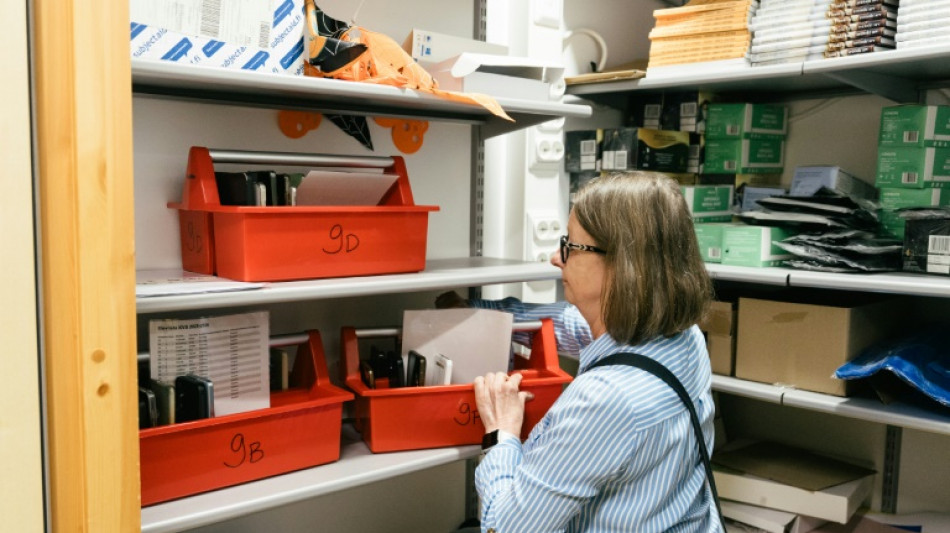
At Kungsvagens Skola for students aged 13 to 15 in Sipoo, northeast of Helsinki, teachers collect students' phones in the morning and lock them in a storage room until the end of the school day.
Principal Maria Tallberg said the transition to a phone-free school had "exceeded expectations".
"Of course, they (students) grumbled a bit in the beginning, especially since they can't use them during breaks, but they also understand why, deep down," Tallberg told AFP during a recent visit.
"Many have also said they were not aware they were so addicted to their phones."
The new law banning phones during class-time came into force on August 1 across Finland, a country long known for its high-quality education.
Several municipalities and individual schools have now chosen to extend the ban to breaks as well.
Previously, the Finnish National Agency for Education had recommended that schools restrict the use of mobile phones in classrooms.
The ban comes amidst a global debate on how smartphone use affects not only mental and overall health, but also learning and education.
Reports, including one from UNESCO in 2023, have warned that phones in the classroom can hamper learning by causing distraction.
Several countries have adopted similar restrictions, including South Korea, Italy, the Netherlands and France.
- 'Very different' -
Annika Railila, a chemistry teacher at Kungsvagens Skola, said classrooms were now calmer and students less distracted.
"Before, we had to remind them almost every lesson that the phone stays in their bag and you don't use it during the lessons."
Students also socialise more during breaks now, she said.
"You actually get to see their eyes and faces, which is a lot nicer than to say hello to someone who's looking at the screen," she added.
15-year-old Kie Lindfors described the school environment as "very different".
"I talk more with people and there is a room in the school where there are board games and stuff so that's been lots of fun on recess, going there to play," he said.
His classmate Lotta Knapas felt the school had become "a lot more noisy" and "wild".
"I understand that we can't use them in lessons but I think it is kind of dumb they take them away from us for the whole day," she said.
Meanwhile, Oscar Ingman, 14, feared some students might feel more lonely.
"I see more people being more sociable, more people talking and so on. But I also do see occasionally some people just sitting alone in a corridor," he said.
The school aimed to organise activities to prevent kids from having nothing to do, the principal said, noting that internet bullying at the school had already decreased.
"Students used to take pictures and film both during lessons and a lot on breaks, and we often had to investigate when video clips were shared everywhere," said Tallberg.
- Reverse the trend -
Finland's new law was adopted after education scores plunged, Finnish Education Minister Anders Adlercreutz told AFP.
"We have noticed in Finland, as in many other countries, that our reading and mathematic skills have deteriorated and the Finnish approach is to think about how we can create more space for learning and teaching," Adlercreutz said.
"Removing disturbing elements from the classroom helps."
The latest results from the OECD's Programme for International Student Assessment (PISA) from 2022 showed Finnish 15-year-olds' skills in mathematics, reading comprehension, and science had declined.
Finland nonetheless still ranked above the OECD average for all subjects among the 38 member countries.
The phone ban did not mean schools were exiting the digital world, Adlercreutz insisted.
"It is important for children to have physical books, but they also need to be digitally literate," he said.
"But in a world that is moving so fast, perhaps the role of schools is also to teach slowness, to be a place where you have to force yourself to read longer texts, focus on one thing, and work purposefully toward a long-term goal."
M.P.Jacobs--CPN