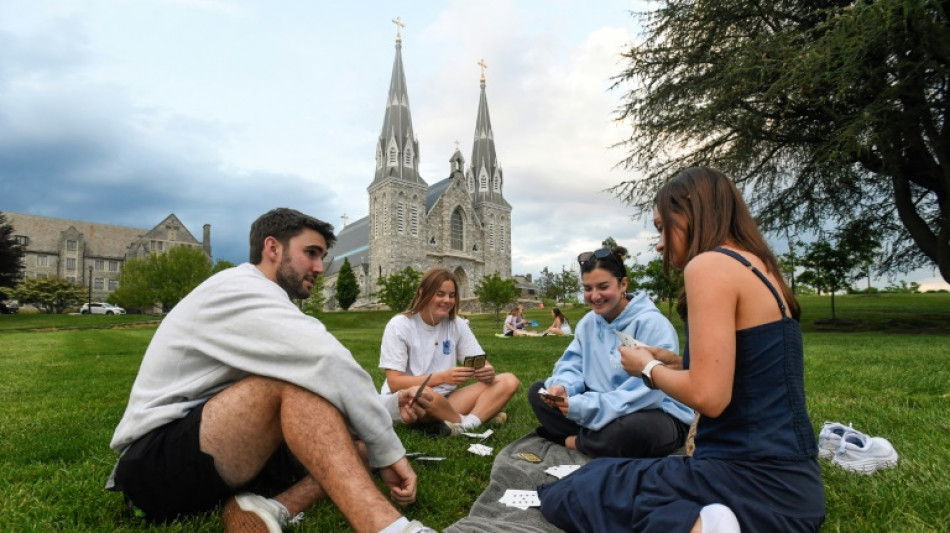
'Into a void': Young US college graduates face employment crisis / Photo: Matthew Hatcher - AFP

 Lights out in Laos as electricity exports surge

 Steven Strogatz weighs AI mathematics advances and their consequences for researchers
 Anthropic boss calls for AI slowdown, Altman and Musk agree

 French IT giant Capgemini sells subsidiary after row over ICE links

 Quebec Brokerage Qubit Insurance Announces New Data on Coverage Shortfalls as Rebuilding Costs Rise

 Lady Gaga welcomes first child with fiance: US media

 Bhutan business bets on hazelnuts for farming future

 'Widow's Bay' and 'The Pitt' are favorites for Emmys night

 Coastal erosion forces cancellation of California music festival

 Argentina's Dirty War rears its head in Venice film

 UK lawmakers throw out bill to legalise assisted dying

 US inflation steady in August, fueling Fed rate hike expectations

 New York marks 25th anniversary of 9/11 attacks

 Nepal flood reconstruction bill to be $4.78 bn: foreign ministry

 JUMO and Standard Bank launch Social Finance Framework to scale inclusive finance in Africa

 Doomsday tech: could AI really kill us all?

 French comedy show 'Call my agent' makes film comeback

 It's all coming back: Celine Dion fans gear up for Paris return

 Researchers eye AI revolution in natural disaster forecasts

 US braces for inflation report that may push Fed to hike rates

 Musk threatens legal action over documentary

 Latin America fact-check group asks Meta not to replace verification practice

 AI Risks to Enter 60–80% of Liability and Cyber Insurance Underwriting by 2028, ScienceSoft Predicts

 Tribal Launches Campfire, Letting Business and Technical Teams Build on Salesforce Together

 Stocks fall as fresh oil surge fans inflation fears

Over two years, Rebecca Atkins filed more than 250 job applications, and felt like every one was going into a gaping chasm -- one opened by the highest unemployment rate for recent college graduates in the United States in more than a decade.
"It was extremely dispiriting," said the 25-year-old, who graduated in 2022 with a degree in law and justice from a university in the US capital Washington. "I was convinced that I was a terrible person, and terrible at working."
At 5.8 percent, unemployment for young, recent graduates from US universities is higher than it has been since November 2013, excluding 15 months in the Covid pandemic, according to official data.
Moreover, it has also remained stubbornly higher than overall unemployment -- an extremely unusual situation, analysts say.
And while overall US unemployment has stabilized between around 3.5 and 4 percent post-pandemic, unemployment for recent college graduates is only trending higher.
The labor market for new grads has weakened consistently since 2022, with new hiring down 16 percent in 2025, year-over-year, according to payroll firm Gusto.
Analysts say the trend is likely a result of cyclical post-pandemic hiring slowdowns -- particularly in new-grad-heavy sectors like technology, finance, and business information -- and overall economic uncertainty in the tumultuous early days of the Trump administration.
That is scant consolation to the droves of young people -- often saddled with huge amounts of student debt -- on the hunt for their first full-time job.
"All of the jobs that I wanted, I didn't have the requirements for -- often entry-level jobs would require you to have four or five years of experience," said Atkins, who bounced between part-time roles and working in restaurants for years.
- 'Extremely high uncertainty' -
"It is definitely an outlier," said Matthew Martin, senior US economist at Oxford Economics. "You'd expect that the white collar positions would not be as exposed to cyclical downturns (as other jobs)."
Job openings for professional and business services have declined by more than 40 percent since 2021, according to research authored by Martin, with tech sector jobs disproportionately impacted.
"Part of that is a slower pace of hiring as they right-size after they hired at very high rates in 2022, but at the same time the sheer volume of decline also points to the impact of AI," he told AFP, signaling the potential of artificial intelligence technology to eliminate some entry-level roles.
Gregory Daco, chief economist at EY-Parthenon, said slowing tech sector hiring as companies focus on holding on to their talent "disproportionately" affects recent graduates.
The hiring slowdown is also a result of US President Donald Trump's far-reaching policy swings since taking office in January, said Daco.
"The experience of extremely high uncertainty when it comes to the administration's trade, tax or other policies has caused many firms to potentially slow down or freeze their hiring."
He cautioned, however, against jumping to the conclusion that AI had already begun to eliminate entry-level roles, pointing to a so-far limited uptake of the technology by most sectors.
"The reality is that a lot of firms are still in the early stages of adoption of these new technologies, and I think it would be a bit premature to assume that we've reached a level of use... that would have a visible macro impact."
- 'Constantly working' -
The United States is perhaps the most expensive country in the world for a university education, with an average cost of $27,673 per year for an undergraduate degree, according to official data.
In 2020, 36.3 percent of US undergraduates took on federal student loans to help meet those spiraling costs, the data shows, with the Education Data Initiative putting average student loan debt for graduating students at $29,550.
Even without student loan debt, however, the weakening job market can leave some recent graduates feeling like they are stretched thin.
Katie Bremer, 25, graduated from American University with a dual-degree in Environmental Science and Public Health in 2021.
It took her more than a year to find a full-time job -- one not in her field -- and even then, she had to supplement her income by babysitting.
"I felt like I was constantly working," she told AFP.
"It seems overwhelming, looking at the costs, to try and make your salary stretch all the way to cover all the milestones you're supposed to reach in young adulthood."
There is little hope on the immediate horizon, with analysts warning that it will likely take some time for the labor market to resolve itself, with part of that adjustment likely seeing students picking different majors.
"It's likely to get worse before it gets better," said Martin.
Looking at her peers, many of whom are saddled with huge debt and struggled to find work, Bremer says she worries for their collective long-term future.
"There have been times where I've thought 'how is my generation going to make this work?'"
P.Kolisnyk--CPN