Millions sit China's high-stakes university entrance exam / Photo: Adek BERRY - AFP

 Lights out in Laos as electricity exports surge

 Steven Strogatz weighs AI mathematics advances and their consequences for researchers

 Anthropic boss calls for AI slowdown, Altman and Musk agree

 French IT giant Capgemini sells subsidiary after row over ICE links

 Quebec Brokerage Qubit Insurance Announces New Data on Coverage Shortfalls as Rebuilding Costs Rise

 Lady Gaga welcomes first child with fiance: US media

 Bhutan business bets on hazelnuts for farming future

 'Widow's Bay' and 'The Pitt' are favorites for Emmys night

 Coastal erosion forces cancellation of California music festival

 Argentina's Dirty War rears its head in Venice film

 UK lawmakers throw out bill to legalise assisted dying

 US inflation steady in August, fueling Fed rate hike expectations

 New York marks 25th anniversary of 9/11 attacks

 Nepal flood reconstruction bill to be $4.78 bn: foreign ministry

 JUMO and Standard Bank launch Social Finance Framework to scale inclusive finance in Africa

 Doomsday tech: could AI really kill us all?

 French comedy show 'Call my agent' makes film comeback

 It's all coming back: Celine Dion fans gear up for Paris return

 Researchers eye AI revolution in natural disaster forecasts

 US braces for inflation report that may push Fed to hike rates

 Musk threatens legal action over documentary

 Latin America fact-check group asks Meta not to replace verification practice

 AI Risks to Enter 60–80% of Liability and Cyber Insurance Underwriting by 2028, ScienceSoft Predicts

 Tribal Launches Campfire, Letting Business and Technical Teams Build on Salesforce Together

 Stocks fall as fresh oil surge fans inflation fears

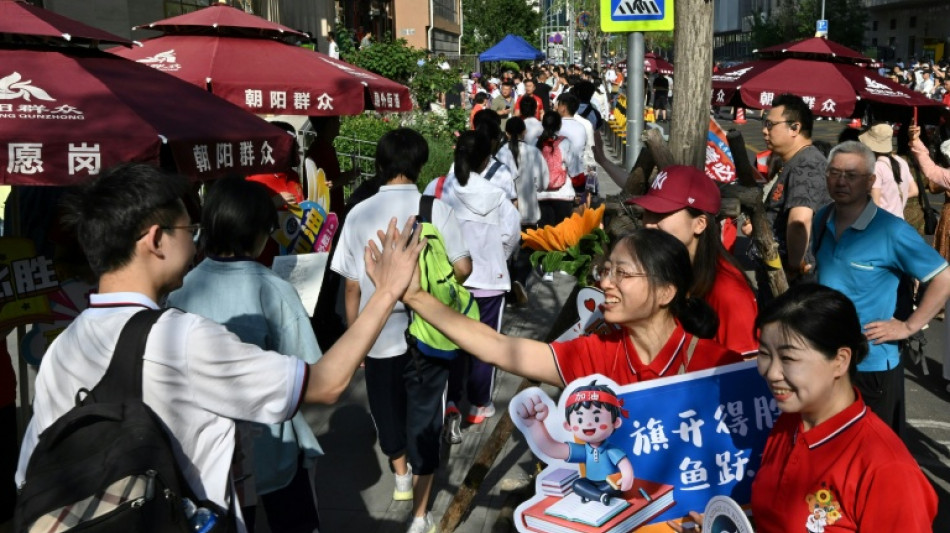
Hopeful parents accompanied their teenage children to the gates of a busy Beijing test centre on Saturday, among millions of high school students across China sitting their first day of the highly competitive university entrance exam.
Nationwide, 13.35 million students have registered for the multi-subject "gaokao" series this year, according to the Ministry of Education, down from last year's record-high 13.42 million test takers.
Outside the central Beijing secondary school, a proud parent who gave her name as Chen said "12 years of hard work have finally led to this moment" -- as she waved a fan in front of her daughter while the student reviewed her notes one last time before the test.
"We know our kids have endured so much hardship," Chen told AFP, adding that she was not nervous.
"I'm actually quite excited. I think my child is excellent, and I'm sure she will get the best score," she said.
China's gaokao requires students to use all their knowledge acquired to this point, testing them on subjects including Chinese, English, mathematics, science and humanities.
The exam results are critical for gaining admission to university -- and determining whether they will attend a prestigious or more modest institution.
While teachers and staff offered students their support, holding up signs of encouragement, some test takers, dressed in school uniforms, appeared panicked, including a girl with tears in her eyes.
"There's no need for us parents to add pressure. The children are already under a lot of it," said a woman named Wang, whose son had just entered the exam hall.
Like many mothers, she wore a traditional Chinese qipao in hopes of bringing good luck.
"I hope my son achieves immediate success and gets his name on the (list of high-scoring candidates)," Wang said with a smile.
Higher education has expanded rapidly in China in recent decades as an economic boom pushed up living standards -- as well as parents' expectations for their children's careers.
But the job market for young graduates remains daunting.
As of April, 15.8 percent of people aged 16 to 24 living in urban areas were unemployed, according to the National Bureau of Statistics.
Due to this pressure, many Chinese students prepare for the gaokao from a young age, often with extra lessons after the regular school day.
- 'Safe gaokao' -
And every year education authorities are on guard against cheating and disruptions during the exam.
This week, China's Vice Premier Ding Xuexiang called for a "safe gaokao", stressing the importance of a rigorous campaign against cheating.
Areas around exam centres are closely guarded by police, with road lanes closed to traffic and several cities banning motorists from honking their horns so as not to disrupt the concentration of students.
In some schools, facial recognition is even used to prevent fraud.
While the university admission rate for gaokao test takers has exceeded 80-90 percent in recent years, many students disappointed with their results choose to repeat the exam.
As there is no age limit for the test, some have become notorious for attempting the exam dozens of times, either after failing it or not getting into their top-choice university.
One teacher at the Beijing school where parents saw off their children on Saturday estimated that only about 10 of the approximately 600 final-year students there would earn a place at one of the capital's top universities.
Jiang, a final-year high school student who only gave one name, said he dreamt of attending a Beijing university, and was remaining calm shortly before his Chinese exam.
"Even though the pressure is intense, it's actually quite fair," he told AFP.
"I feel like all the preparations that needed to be made have been made, so there's really no point in being nervous now, right?
"Whatever happens, happens. It's truly not something I can completely control."
D.Goldberg--CPN