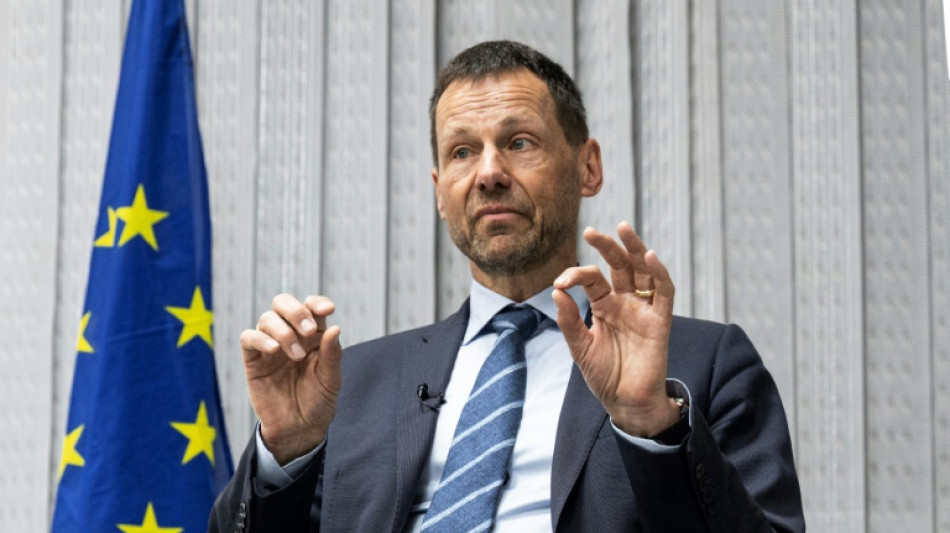
EU says Taliban 'not listening' to Afghans with girls' school ban / Photo: Wakil KOHSAR - AFP

 Lights out in Laos as electricity exports surge

 Steven Strogatz weighs AI mathematics advances and their consequences for researchers

 Anthropic boss calls for AI slowdown, Altman and Musk agree

 French IT giant Capgemini sells subsidiary after row over ICE links

 Quebec Brokerage Qubit Insurance Announces New Data on Coverage Shortfalls as Rebuilding Costs Rise

 Lady Gaga welcomes first child with fiance: US media

 Bhutan business bets on hazelnuts for farming future

 'Widow's Bay' and 'The Pitt' are favorites for Emmys night

 Coastal erosion forces cancellation of California music festival

 Argentina's Dirty War rears its head in Venice film

 UK lawmakers throw out bill to legalise assisted dying

 US inflation steady in August, fueling Fed rate hike expectations

 New York marks 25th anniversary of 9/11 attacks

 Nepal flood reconstruction bill to be $4.78 bn: foreign ministry

 JUMO and Standard Bank launch Social Finance Framework to scale inclusive finance in Africa

 Doomsday tech: could AI really kill us all?

 French comedy show 'Call my agent' makes film comeback

 It's all coming back: Celine Dion fans gear up for Paris return

 Researchers eye AI revolution in natural disaster forecasts

 US braces for inflation report that may push Fed to hike rates

 Musk threatens legal action over documentary

 Latin America fact-check group asks Meta not to replace verification practice

 AI Risks to Enter 60–80% of Liability and Cyber Insurance Underwriting by 2028, ScienceSoft Predicts

 Tribal Launches Campfire, Letting Business and Technical Teams Build on Salesforce Together

 Stocks fall as fresh oil surge fans inflation fears

The Taliban shutdown of girls' education shows the hardline Islamists' are not listening to the Afghan people and poses a major hurdle to international recognition of the new regime, a top European Union official said Thursday.
In March, Taliban authorities ordered all secondary girls' schools to shut, just hours after reopening them for the first time since seizing power in August last year.
The decision, which came from the country's supreme leader and the movement's chief Hibatullah Akhundzada, has triggered widespread outrage in the international community.
Western nations have made aid pledges to tackle Afghanistan's spiralling humanitarian crisis conditional on the Taliban's respect for human rights, particularly the rights of women to work and education.
But the EU's special envoy to Afghanistan Tomas Niklasson told AFP the Taliban veto on girls' schools "has put some doubts in our heads regarding how reliable their promises are, how reliable they may be as a partner".
"It seems to be a government that isn't really listening to its people," he said, adding that what women really wanted is the right to work, education, access to health facilities and "not instructions on how to dress".
The Taliban had repeatedly assured that they would reopen secondary schools for girls, but on March 23 they ordered them shut after tens of thousands of teenage girls flocked to attend classes.
They have yet to offer any new timetable as to when the institutions will be opened again.
"If the schools open relatively soon across the country at all levels for boys and girls, this could be a positive, positive step forward," Niklasson said as he wrapped up a five-day visit to Kabul.
He said removing the ban on girls' education would be a "dramatic shift" which -- if accompanied by guarantees for other civil liberties, minority protections and women's rights -- could help make the Taliban's case for international recognition.
However, he warned the EU currently believes Afghanistan is in the grip of "a more backward going trend".
The Taliban have rolled back several freedoms gained by women during the two decades of US-led military intervention.
They have effectively banned women from many government jobs and from travelling alone unless accompanied by an adult male relative.
Last week Akhundzada also issued a decree ordering women to cover up fully in public, including their faces.
He also commanded authorities to fire female government employees who do not follow the new dress code, and to suspend male workers if their wives and daughters fail to comply.
Some Afghan women initially pushed back against the creeping new curbs, holding small protests.
But the Taliban soon rounded up the ringleaders, holding them incommunicado while denying that they had been detained.
On Wednesday, Taliban fighters dispersed a small women's protest against the burqa dress code and even obstructed journalists from covering it.
T.Morelli--CPN