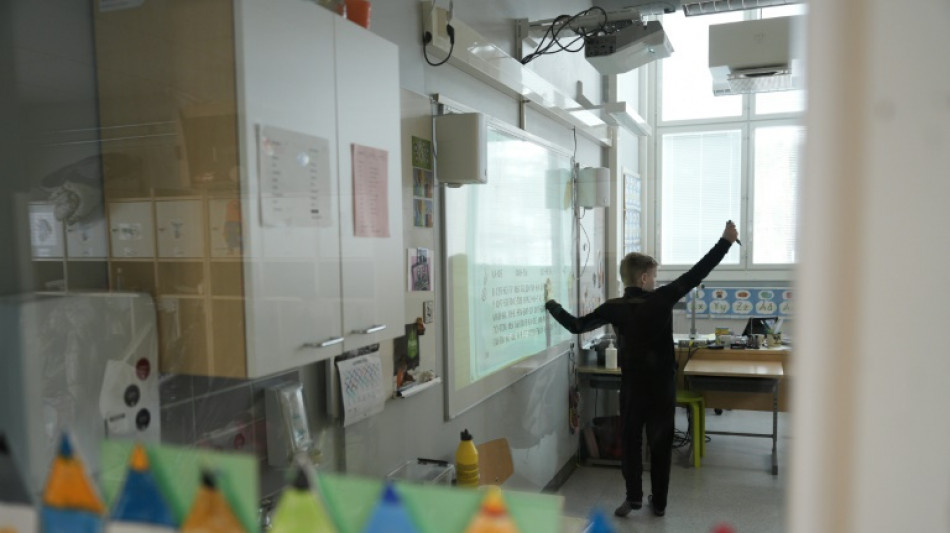
Do svidaniya! Finland's fading interest in Russian language / Photo: Alessandro RAMPAZZO - AFP

 Lights out in Laos as electricity exports surge

 Steven Strogatz weighs AI mathematics advances and their consequences for researchers

 Anthropic boss calls for AI slowdown, Altman and Musk agree

 French IT giant Capgemini sells subsidiary after row over ICE links

 Quebec Brokerage Qubit Insurance Announces New Data on Coverage Shortfalls as Rebuilding Costs Rise

 Lady Gaga welcomes first child with fiance: US media

 Bhutan business bets on hazelnuts for farming future

 'Widow's Bay' and 'The Pitt' are favorites for Emmys night

 Coastal erosion forces cancellation of California music festival

 Argentina's Dirty War rears its head in Venice film

 UK lawmakers throw out bill to legalise assisted dying

 US inflation steady in August, fueling Fed rate hike expectations

 New York marks 25th anniversary of 9/11 attacks

 Nepal flood reconstruction bill to be $4.78 bn: foreign ministry

 JUMO and Standard Bank launch Social Finance Framework to scale inclusive finance in Africa

 Doomsday tech: could AI really kill us all?

 French comedy show 'Call my agent' makes film comeback

 It's all coming back: Celine Dion fans gear up for Paris return

 Researchers eye AI revolution in natural disaster forecasts

 US braces for inflation report that may push Fed to hike rates

 Musk threatens legal action over documentary

 Latin America fact-check group asks Meta not to replace verification practice

 AI Risks to Enter 60–80% of Liability and Cyber Insurance Underwriting by 2028, ScienceSoft Predicts

 Tribal Launches Campfire, Letting Business and Technical Teams Build on Salesforce Together

 Stocks fall as fresh oil surge fans inflation fears

Two Finnish towns near the Russian border plan to close schools offering Russian language and culture classes, upsetting parents and students who say cross-cultural understanding is needed more than ever.
Finland's relations with its powerful eastern neighbour have soured since Russia's 2022 invasion.
The war prompted Helsinki to reverse its decades-long policy of military non-alignment and join NATO in April 2023, a decision that angered Moscow.
When the towns of Lappeenranta and Joensuu announced this year they would close their two schools focusing on Russian language and culture due to a lack of resources, school representatives saw it as fallout from the rise of anti-Russian sentiment in Finland since the war in Ukraine.
The headmaster of the School of Eastern Finland, Katri Anttila, said town officials were no longer keen to maintain Russian language studies after the invasion.
"This is part of the same trend, which is very sad. I am happy we have parents and students who do not link the Russian language to Russian President (Vladimir) Putin and the Russian government, because language should never be linked to politics or a certain country," Anttila said.
The School of Eastern Finland has three branches in the towns of Lappeenranta, Imatra and Joensuu, the only schools outside the capital Helsinki that offer Russian culture and language studies in addition to the Finnish curriculum.
The state-funded schools founded in 1997 have 700 students aged six to 18.
- Declining interest -
During a recent visit to the Lappeenranta school, classrooms were bustling with students chatting in Finnish and Russian, colourful posters hanging on the walls with writing in the two languages.
Located some 30 kilometres from Finland's 1,340 kilometre (832-mile) border with Russia, the first spring flowers were beginning to bloom in the schoolyard under a gloomy April sky.
Both students and teachers were upset about Lappeenranta's recent decision.
"I was shocked when I heard the school will close," Eetu Varis, an 18-year-old at the upper secondary school, told AFP.
A city official in charge of Lappeenranta educational services, Juhani Junnilainen, told AFP the closure was due to a school network reform.
"We do not have enough resources to maintain all the schools we have," he said.
In addition, "interest for the Russian language has decreased for more than a decade" while "Spanish has become more and more popular" in Lappeenranta schools.
The city of Turku also decided this year it would end a Finnish-Russian language programme offered at one public school, citing declining student enrolment.
A separate school in Helsinki offering classes in Russian told AFP it had no plans to close.
- 'Next to us' -
Before the Covid pandemic and Russia's war in Ukraine, almost two million Russian tourists crossed Finland's border to visit the Lappeenranta region annually, bringing in more than 300 million euros ($322 million).
Now, Russian licence plates are a rare sight on the streets of Lappeenranta.
In late 2022, Finland imposed entry restrictions on Russian tourists, allowing only essential travel.
"Before the ongoing situation in Ukraine you heard Russian everywhere," said student Varis, adding: "It is important in this area."
Like the majority of his classmates, Varis is a native Finnish speaker interested in learning about other languages and cultures.
Finland closed its entire eastern border with Russia in December, five months after Moscow began pushing undocumented migrants over the border in what Finnish officials labelled a "hybrid attack". Russia has denied the charge.
Tuomas Laitinen, a parent of two children at the Lappeenranta school, accused the towns of miscalculating the need for an understanding of the Russian culture and language in Finland.
"Finland has been known for decades for our knowledge of Russia, and it benefits the EU and NATO," he said.
"Geographically we are not moving anywhere. Russia is next to us, and we have to know about their culture."
Anttila meanwhile underlined that Finland must be able to "understand the language of the Russian opposition", emphasising that the school would continue to fight to keep its doors open.
M.Mendoza--CPN