Asian countries score high in key education survey / Photo: SIMIN WANG - AFP

 Lights out in Laos as electricity exports surge

 Steven Strogatz weighs AI mathematics advances and their consequences for researchers

 Anthropic boss calls for AI slowdown, Altman and Musk agree

 French IT giant Capgemini sells subsidiary after row over ICE links

 Quebec Brokerage Qubit Insurance Announces New Data on Coverage Shortfalls as Rebuilding Costs Rise

 Lady Gaga welcomes first child with fiance: US media

 Bhutan business bets on hazelnuts for farming future

 'Widow's Bay' and 'The Pitt' are favorites for Emmys night

 Coastal erosion forces cancellation of California music festival

 Argentina's Dirty War rears its head in Venice film

 UK lawmakers throw out bill to legalise assisted dying

 US inflation steady in August, fueling Fed rate hike expectations

 New York marks 25th anniversary of 9/11 attacks

 Nepal flood reconstruction bill to be $4.78 bn: foreign ministry

 JUMO and Standard Bank launch Social Finance Framework to scale inclusive finance in Africa

 Doomsday tech: could AI really kill us all?

 French comedy show 'Call my agent' makes film comeback

 It's all coming back: Celine Dion fans gear up for Paris return

 Researchers eye AI revolution in natural disaster forecasts

 US braces for inflation report that may push Fed to hike rates

 Musk threatens legal action over documentary

 Latin America fact-check group asks Meta not to replace verification practice

 AI Risks to Enter 60–80% of Liability and Cyber Insurance Underwriting by 2028, ScienceSoft Predicts

 Tribal Launches Campfire, Letting Business and Technical Teams Build on Salesforce Together

 Stocks fall as fresh oil surge fans inflation fears

Asian countries dominated the top spots in a keenly watched survey of education capabilities published Tuesday, while levels in Europe slipped at a record pace -- and not just because of Covid.
However, the report also showed that students in top performing countries were not necessarily happier.
The PISA survey is carried out every three years by the Paris-based Organisation for Economic Cooperation and Development (OECD) to assess the ability of 15-year-olds to meet real-life challenges.
"The Pisa 2022 results show a fall in student performance that is unprecedented in Pisa's history," OECD education analyst Irene Hu told reporters.
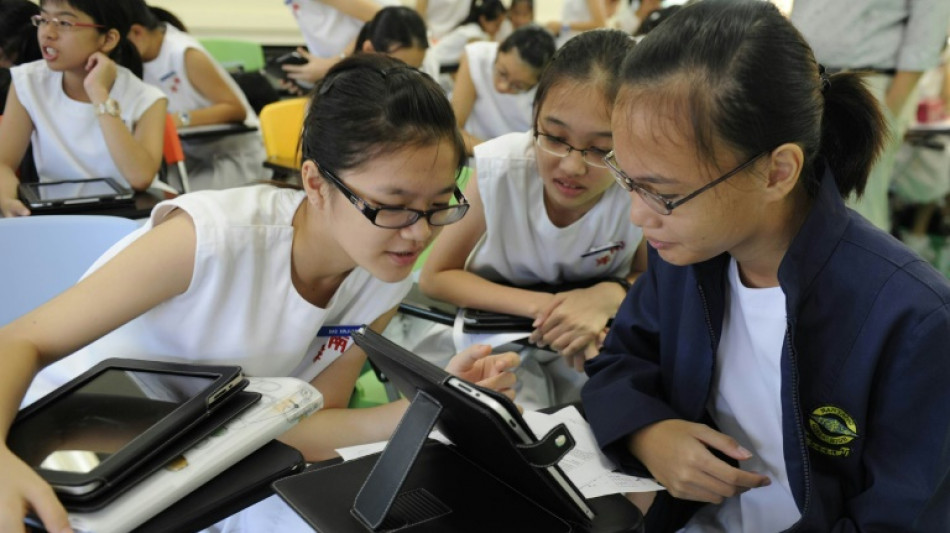
Singapore took top ranking in the latest assessment, which was carried out in 2022 and involved 690,000 students in 81 participating countries and economies.
The south-east Asian island city state scored highest in all three of the survey's areas: mathematics, reading and science.
"These results suggest that, on average, Singaporean students are the equivalent of almost three to five years of schooling ahead of their peers," the report said.
Five other Asian education systems -- in Macao, Taiwan, Hong Kong, Japan and South Korea -- came next in mathematics, and also scored near the top in reading and science.
But while Asia did well, other parts of the world declined, sparking an overall "unprecedented drop in performance", the report said.
Germany, Iceland, the Netherlands, Norway and Poland, for example, all saw notably lower achievements in mathematics, it said.
- 'Not just about Covid' -
Covid-19 shutdowns hurt education standards, the report said, but there were also other factors behind the downturn.
Students in Finland, Iceland and Sweden -- once star performers -- have been scoring lower marks for years.
"This indicates that long-term issues in education systems are also to blame for the drop in performance," it said. "It is not just about Covid."
A key factor is "the level of support pupils received from teachers and school staff", the OECD's Hu said.
Some education systems have not given sufficient resources for supporting students, said Eric Charbonnier, another OECD education analyst.
"Countries have invested in education over the past 10 years, but maybe they didn't invest efficiently, or sufficiently into the quality of teaching," he said.
"We also see less parental involvement with the progress of children compared to 2018," he added.
While there was some correlation between spending and academic performance, "history shows that countries determined to build a first-class education system can achieve this even in adverse economic circumstances", the report said.
"The world is no longer strictly divided between rich and well-educated nations and poor and badly-educated ones", it said.
In some cases, 2022's drop in skills amounted to roughly a year's worth of education.
"For example, in mathematics, in Denmark, France, Greece, Portugal and Sweden, the average 15-year-old in 2022 scored at the level expected of a 14-year-old in 2018," the report said.
The best European performer was Estonia. The EU's two biggest countries, Germany and France, ranked below Switzerland, Ireland, Belgium and Britain.
"Germany is more worrying than France," said Charbonnier, adding that Norway and Finland also declined more than France.
The US education system showed little change from the last survey, with students there weaker in mathematics, and slightly above average in reading and science.
- 'Fear of failure' -
For the first time, the OECD also examined the happiness of students, using nine aspects of their lives to measure their well-being.
They include engagement with school, material and cultural well-being, openness to diversity and psychological well-being.
This showed that in top maths performers Singapore, Macao and Taiwan, "many students reported a high fear of failure and limited engagement in extracurricular activities such as sports".
In contrast, with students in countries with lower average PISA test scores, such as Spain and Peru, researchers often found "lower levels of anxiety and a greater focus on sports".
A.Samuel--CPN