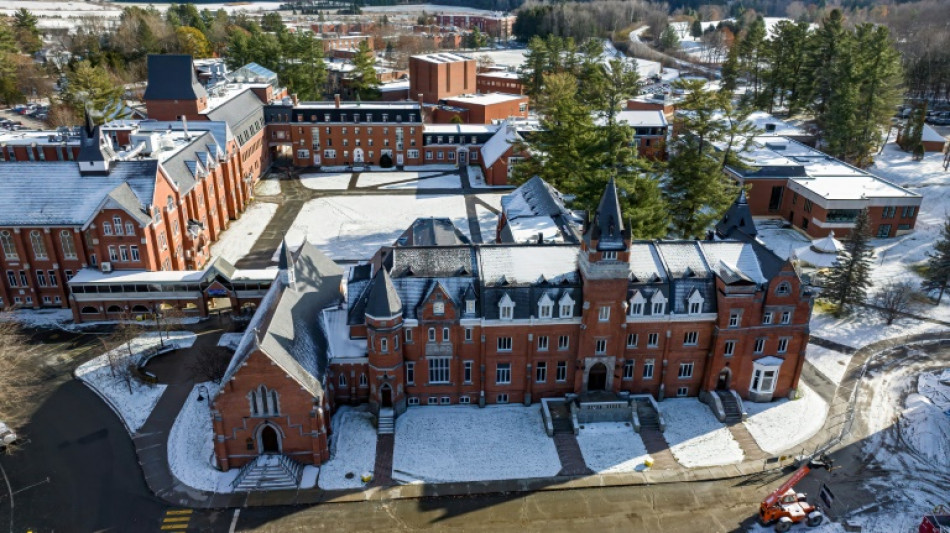
'Existential risk': Quebec's English-language universities fear massive fee hikes / Photo: Sebastien ST-JEAN - AFP

 Lights out in Laos as electricity exports surge

 Steven Strogatz weighs AI mathematics advances and their consequences for researchers

 Anthropic boss calls for AI slowdown, Altman and Musk agree

 French IT giant Capgemini sells subsidiary after row over ICE links

 Quebec Brokerage Qubit Insurance Announces New Data on Coverage Shortfalls as Rebuilding Costs Rise

 Lady Gaga welcomes first child with fiance: US media

 Bhutan business bets on hazelnuts for farming future

 'Widow's Bay' and 'The Pitt' are favorites for Emmys night

 Coastal erosion forces cancellation of California music festival

 Argentina's Dirty War rears its head in Venice film

 UK lawmakers throw out bill to legalise assisted dying

 US inflation steady in August, fueling Fed rate hike expectations

 New York marks 25th anniversary of 9/11 attacks

 Nepal flood reconstruction bill to be $4.78 bn: foreign ministry

 JUMO and Standard Bank launch Social Finance Framework to scale inclusive finance in Africa

 Doomsday tech: could AI really kill us all?

 French comedy show 'Call my agent' makes film comeback

 It's all coming back: Celine Dion fans gear up for Paris return

 Researchers eye AI revolution in natural disaster forecasts

 US braces for inflation report that may push Fed to hike rates

 Musk threatens legal action over documentary

 Latin America fact-check group asks Meta not to replace verification practice

 AI Risks to Enter 60–80% of Liability and Cyber Insurance Underwriting by 2028, ScienceSoft Predicts

 Tribal Launches Campfire, Letting Business and Technical Teams Build on Salesforce Together

 Stocks fall as fresh oil surge fans inflation fears

A chill has fallen over the three English-language universities in Canada's Quebec province, as winter arrives with students and administrators worried about plans to nearly double tuition by next school year.
Announced last month by the French-speaking province's government, the plan would raise tuition for non-Quebec residents at all three anglophone universities from around Can$9,000 (US$6,500) to Can$17,000 -- with the additional funds meant to support francophone universities and educational programs.
Bishop's University, nestled on the wooded banks of a river about two hours east of Montreal, could see a "catastrophic" outflow of students if the plan goes through, warns principal Sebastien Lebel-Grenier.
"For us, this is truly an existential crisis. It's a threat to our ability to continue as a university," he told AFP in an interview.
About 30 percent of Bishop's 2,650 students come from other provinces in Canada, while 15 percent are international.
Bryn Empey, a teaching student from Ontario in her final year at the university, said she thinks most students in Canada would choose not to study in Quebec.
"If you're paying double to come study in a province that doesn't welcome you... then I think it's really hard to justify that price increase when you can have a similar experience in Ontario," she told AFP, adding that her younger sister was already reconsidering her plans to attend Bishop's.
Quebec has had a long-running fear that its unique French-speaking identity is under threat of English intrusion -- especially in the metropolis of Montreal where the province's two other anglophone universities, McGill and Concordia, are located.
In announcing the fee hike measure, Quebec's Minister of Higher Education Pascale Dery said it was to "send out a clear signal."
"Not only are we putting an end to a policy that subsidized students at a loss if they didn't stay here, but we're also putting the brakes on the decline of French in Montreal," said the member of Quebec premier Francois Legault's CAQ party.
Empey, who helped organize a large march in Montreal to protest against the fee hike, said she doubts the money would help protect the French language.
Jonathan Cassan, a 20-year-old American in his third year of environmental studies at Bishop's, said the plan would "deter a lot of students from coming here."
- Montreal's reputation -
With a higher proportion of Canadian students than the bigger McGill and Concordia, Bishop's is more at risk, says professor Pier-Andre Bouchard St-Amant of the ENA national public administration university.
But the administrations of McGill and Concordia, both internationally renowned universities, are also warning that the measure could be disastrous for them, while arguing it could harm Montreal's reputation.
Concordia president Graham Carr expects "devastating financial implications," while his counterpart at McGill, Deep Saini, warns of serious negative effects not just at his university, but on "the higher education sector, and on the whole of Quebec society."
"Among McGill's strongest assets is its tremendous power to attract and retain the highly skilled people who contribute so significantly to Quebec's economy and society," Saini said in a statement.
And it is not just the education sector outraged by the tuition fee hike: Many businesses and organizations have also voiced their opposition and demanded a reversal.
But the damage may already have been done.
"The mere fact of announcing these measures is already having a very significant impact," Lebel-Grenier said.
"It's fallen right in the middle of our recruitment effort for next year."
T.Morelli--CPN