Long-banned Alsatian finally allowed in French schools / Photo: FREDERICK FLORIN - AFP

 Lights out in Laos as electricity exports surge

 Steven Strogatz weighs AI mathematics advances and their consequences for researchers

 Anthropic boss calls for AI slowdown, Altman and Musk agree

 French IT giant Capgemini sells subsidiary after row over ICE links

 Quebec Brokerage Qubit Insurance Announces New Data on Coverage Shortfalls as Rebuilding Costs Rise

 Lady Gaga welcomes first child with fiance: US media

 Bhutan business bets on hazelnuts for farming future

 'Widow's Bay' and 'The Pitt' are favorites for Emmys night

 Coastal erosion forces cancellation of California music festival

 Argentina's Dirty War rears its head in Venice film

 UK lawmakers throw out bill to legalise assisted dying

 US inflation steady in August, fueling Fed rate hike expectations

 New York marks 25th anniversary of 9/11 attacks

 Nepal flood reconstruction bill to be $4.78 bn: foreign ministry

 JUMO and Standard Bank launch Social Finance Framework to scale inclusive finance in Africa

 Doomsday tech: could AI really kill us all?

 French comedy show 'Call my agent' makes film comeback

 It's all coming back: Celine Dion fans gear up for Paris return

 Researchers eye AI revolution in natural disaster forecasts

 US braces for inflation report that may push Fed to hike rates

 Musk threatens legal action over documentary

 Latin America fact-check group asks Meta not to replace verification practice

 AI Risks to Enter 60–80% of Liability and Cyber Insurance Underwriting by 2028, ScienceSoft Predicts

 Tribal Launches Campfire, Letting Business and Technical Teams Build on Salesforce Together

 Stocks fall as fresh oil surge fans inflation fears

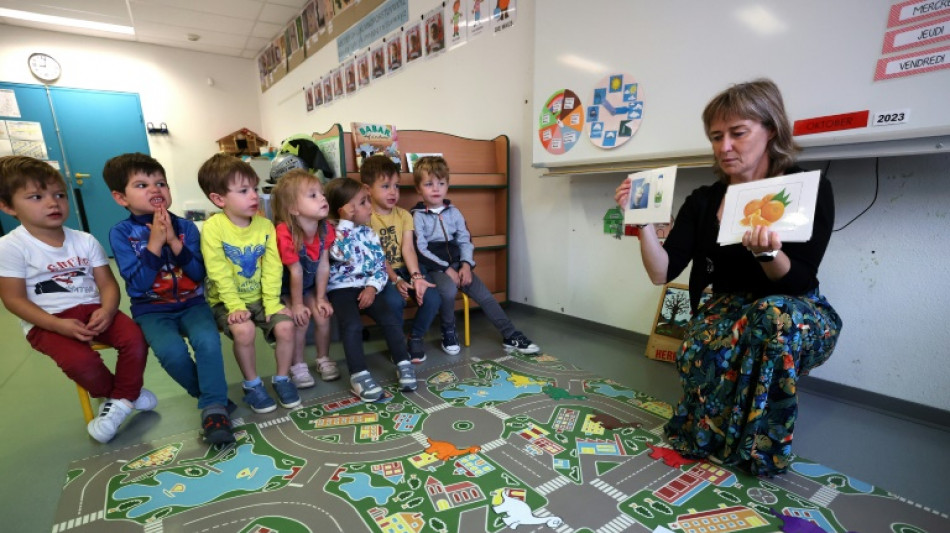
In a school in eastern France, teacher Sandra Cronimus greets her pupils every morning with a lusty "Guede morje!"
She is speaking Alsatian, the German dialect spoken widely in Alsace, a wealthy border region that France and Germany have fought over three times since 1870.
Long forbidden, the language that legendary Arsenal manager Arsene Wenger grew up speaking, is now being taught for the first time in French state schools.
"Clap your hands if you like going to school," Cronimus urged her class of three and four year olds, who responded to the roll with "Ich bin do" -- "I'm here" in Alsatian.
The 15 children at the Rainbow nursery school in Brumath, north of Strasbourg, are taught three-quarters of the time in either Alsatian or German, with the rest in French.
Three other schools near the city on the Rhine have also started teaching in Alsatian, a rarity in a country where regional languages have been pushed to the verge of extinction by a centralising state, ever-vigilant of threats to French national identity.
- 'They forbade us from speaking' -
Brumath's mayor Etienne Wolf is delighted by the change.
"When I was a child they forbade us from speaking Alsatian," said the 68-year-old.
"I want to defend Alsatian, which is falling away" particularly among young people, he added. "Often people understand it but don't speak it anymore."
Classroom assistant Corinne Husser is equally overjoyed to be able to speak her first language with the children. "It's great, it's the first time I have been able to work in Alsatian," she said.
While Alsatian is spoken by around half a million people, the dialect in Brumath is not exactly the same as the one spoken by Cronimus, who comes from a village in the northern Vosges.
And it is different again to what is spoken 150 kilometres (93 miles) to the south at the other end of the region. "In Altkirch it's completely different," said the teacher, who switches easily between German, Alsatian and French with the children.
Cronimus got extra training from language experts to take on "this new challenge".
Alsatian is already taught with German in a dozen community schools across Alsace run by the private ABCM network. Several take an immersive approach, with no French at all spoken in class.
- Rapid decline -
Pierre Klein, the president of the Alsace Bilingual Federation, said it was a pity that the state schools did not follow their lead as "they could have fully benefitted from the advantages of immersion".
Even so he welcomed the belated official "recognition of the value of being bilingual given the rapid decline in the use of the dialect... particularly among the under 50s."
However, Wolf said that the big problem with the completely immersive approach "is finding the people capable of teaching it".
Local education officials are already struggling to recruit teachers for bilingual French-German classes, in which one in five children in the Strasbourg area are taught.
Parents too were clearly worried about signing up for an experimental project.
"At the beginning only three pupils were signed up but before others were won over," said Cronimus.
Those that have signed up don't seem to be disappointed.
Celine Babin, 40, admitted that she "hesitated a little" before putting her son Paul into the class. Now, however, she is convinced it will help him with other languages. "And also, Alsatian is part of our culture," she added.
St.Ch.Baker--CPN