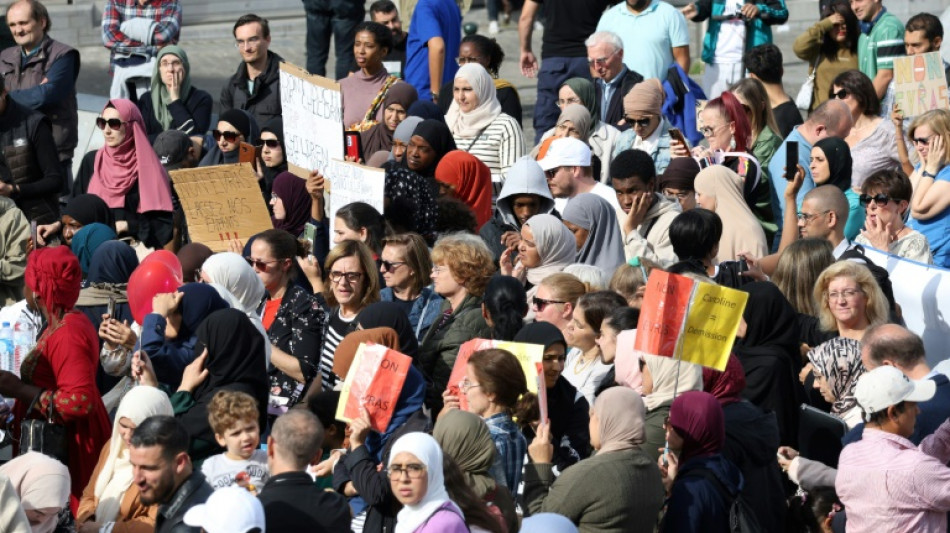
Protests against sex ed classes in Belgian schools / Photo: Simon Wohlfahrt - AFP

 Lights out in Laos as electricity exports surge

 Steven Strogatz weighs AI mathematics advances and their consequences for researchers

 Anthropic boss calls for AI slowdown, Altman and Musk agree

 French IT giant Capgemini sells subsidiary after row over ICE links

 Quebec Brokerage Qubit Insurance Announces New Data on Coverage Shortfalls as Rebuilding Costs Rise

 Lady Gaga welcomes first child with fiance: US media

 Bhutan business bets on hazelnuts for farming future

 'Widow's Bay' and 'The Pitt' are favorites for Emmys night

 Coastal erosion forces cancellation of California music festival

 Argentina's Dirty War rears its head in Venice film

 UK lawmakers throw out bill to legalise assisted dying

 US inflation steady in August, fueling Fed rate hike expectations

 New York marks 25th anniversary of 9/11 attacks

 Nepal flood reconstruction bill to be $4.78 bn: foreign ministry

 JUMO and Standard Bank launch Social Finance Framework to scale inclusive finance in Africa

 Doomsday tech: could AI really kill us all?

 French comedy show 'Call my agent' makes film comeback

 It's all coming back: Celine Dion fans gear up for Paris return

 Researchers eye AI revolution in natural disaster forecasts

 US braces for inflation report that may push Fed to hike rates

 Musk threatens legal action over documentary

 Latin America fact-check group asks Meta not to replace verification practice

 AI Risks to Enter 60–80% of Liability and Cyber Insurance Underwriting by 2028, ScienceSoft Predicts

 Tribal Launches Campfire, Letting Business and Technical Teams Build on Salesforce Together

 Stocks fall as fresh oil surge fans inflation fears

Dozens of demonstrators took to the streets of Brussels on Saturday to protest sex education courses in schools, which have sparked controversy in the French-speaking part of the country.
Shouting "don't touch our children", protesters sought to challenge the French-speaking authorities' move to introduce an annual two-hour course for two age groups, intended to answer pupils' questions on sensitive subjects.
However, since the start of the new school year the programme has sparked a backlash on social media and protest calls from ultra-conservatives, including Islamic associations and Civitas, a far right party of mostly ultra-traditional Catholics.
In mid-September, the Belgian courts opened an investigation into "arson", after fires broke out in four schools targeted by opponents of the courses.
"Talking publicly to children about sexuality can frustrate them. It's up to parents to talk about sexuality, not the state", Gregory Bourguignon, one of the demonstrators, told AFP.
The course -- presented by French-speaking Education Minister Caroline Desir as a two-hour lecture by accredited outside speakers -- is aimed at pupils in the sixth year of primary school (aged 11-12) and the fourth year of secondary school (aged 15-16).
Compulsory since 2012, until now it has not been systematically provided due to a lack of resources.
Its aim is to "reassure pupils about issues that they may have difficulty understanding".
Its aim is to "reassure pupils about the questions they ask themselves at adolescence" and to "protect them from potentially dangerous or problematic situations", the minister said.
She gave "sexism, sexual violence and gender stereotypes" as examples.
An initial demonstration was held on September 17, but it failed to prevent the final adoption of the text by the French-speaking Belgian region.
L.K.Baumgartner--CPN