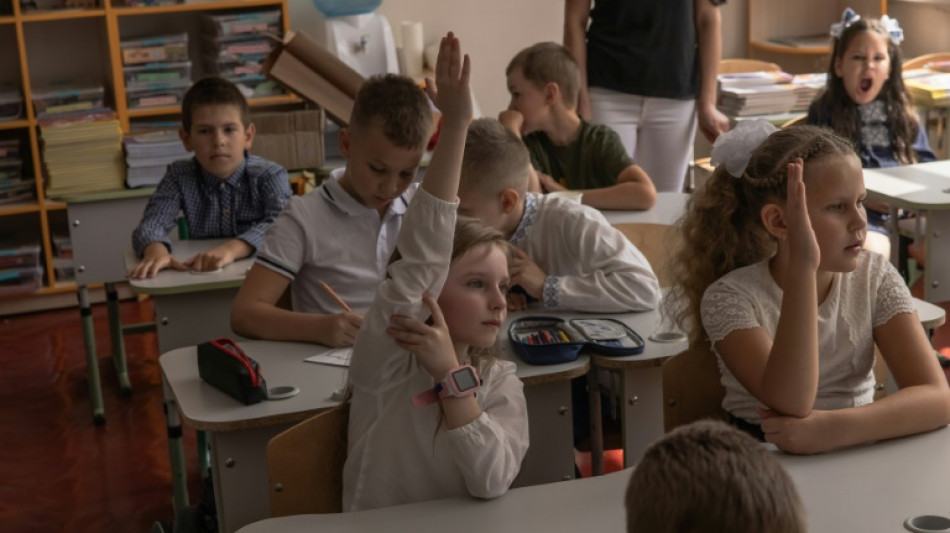
Children eager for school in Ukraine after living abroad / Photo: Roman PILIPEY - AFP

 Lights out in Laos as electricity exports surge

 Steven Strogatz weighs AI mathematics advances and their consequences for researchers
 Anthropic boss calls for AI slowdown, Altman and Musk agree

 French IT giant Capgemini sells subsidiary after row over ICE links

 Quebec Brokerage Qubit Insurance Announces New Data on Coverage Shortfalls as Rebuilding Costs Rise

 Lady Gaga welcomes first child with fiance: US media

 Bhutan business bets on hazelnuts for farming future

 'Widow's Bay' and 'The Pitt' are favorites for Emmys night

 Coastal erosion forces cancellation of California music festival

 Argentina's Dirty War rears its head in Venice film

 UK lawmakers throw out bill to legalise assisted dying

 US inflation steady in August, fueling Fed rate hike expectations

 New York marks 25th anniversary of 9/11 attacks

 Nepal flood reconstruction bill to be $4.78 bn: foreign ministry

 JUMO and Standard Bank launch Social Finance Framework to scale inclusive finance in Africa

 Doomsday tech: could AI really kill us all?

 French comedy show 'Call my agent' makes film comeback

 It's all coming back: Celine Dion fans gear up for Paris return

 Researchers eye AI revolution in natural disaster forecasts

 US braces for inflation report that may push Fed to hike rates

 Musk threatens legal action over documentary

 Latin America fact-check group asks Meta not to replace verification practice

 AI Risks to Enter 60–80% of Liability and Cyber Insurance Underwriting by 2028, ScienceSoft Predicts

 Tribal Launches Campfire, Letting Business and Technical Teams Build on Salesforce Together

 Stocks fall as fresh oil surge fans inflation fears

Makar and Nadiya Mikhailyuk chatter excitedly as they get ready for their first day back at school in Ukraine, after they and their mother moved back from Poland.
Their parents, Oleksandr and Viktoriya, decided to bring the children back to live in their hometown of Irpin outside Kyiv, which was heavily damaged by Russia's invasion but has been largely reconstructed.
Nadiya, aged 6, has never had a full school day in Ukraine, while her 8-year-old brother is keen to meet his classmates again when he joins third grade.
"I missed my class and teacher," he says, naming his favourite subjects as maths and art.
"When you study online, you can't play, when you go to school, you can play with your friends," adds Nadiya.
Both children attended Ukrainian-language school online in Poland.
More than three million children attend school in Ukraine, nearly 900,000 of whom are studying remotely, according to the presidency.
That is down from last autumn when more than 2 million were studying remotely, according to the education ministry.
For the first day back at school, Makar wears a traditional embroidered Ukrainian shirt with grey trousers and Nadiya wears a ribbon-trimmed blouse and skirt.
Their parents have also donned embroidered shirts for the occasion.
The family moved from Irpin to another Ukrainian city before going to Poland.
Their father, Oleksandr, a 39-year-old telecoms engineer, stayed behind in Ukraine due to conscription rules, while the rest of the family lived in Poland, visiting only twice.
- 'Missed our dad' -
"We really missed our dad and grandpas and grandma," says Nadiya.
"Nadiya and I kept asking: 'Mum, when will we go back?'," says Makar.
The first day back at school is marked with an elaborate ceremony, despite the war.
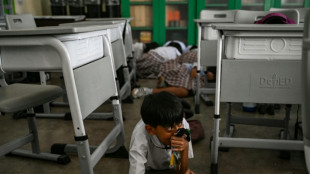
In the school playground, children perform an educational song about what to do in an air raid, complete with dance moves.
A boy wearing a bow tie acts as the host.
"All of us have one wish: for the war to end as quickly as possible with our victory," he says.
Parents are encouraged to donate to the Ukrainian army instead of giving flowers to the teachers as usual.
The school, which is called Mriya -- meaning "dream" -- was shelled five times including by Grad rockets during heavy fighting in Irpin after Russia's invasion.
A display in the entrance hall shows photos of holes in walls and windows blown out.
With help from UNICEF and the European Union, it has now been rebuilt and has a large air raid shelter that can be used for lessons during air raids.
A recreation area on the ground floor has table football and neon signs, but the windows look onto a protective wall of concrete blocks.
During her first lesson, Nadiya and 30 classmates sing along to a song called "Ukraine will live".
The teacher asks them what the word "patriot" means.
"It's someone who helps Ukraine," says one girl with blonde hair in bunches.
"Are we patriots?" asks the teacher, to enthusiastic shouts of "Yes!"
- 'Children have returned' -
The state school has had a huge influx of in-person students, said headmaster Ivan Ptashnyk, with many children returning from living abroad or studying remotely.
"We have grown because our children have returned," he says.
This year, over 300 children have joined the first grade, divided up among 12 classes.
The number of in-school pupils has now reached 2,300 and they have to attend in shifts so they can all fit.
Irpin is regularly visited by international politicians, as some its buildings stand in ruins.
Along with other towns on the outskirts of Kyiv, it was seized and occupied by Russian forces in the weeks after Moscow's offensive began last year, but was liberated by Kyiv's forces following a bloody, month-long battle.
It is now a growing neighbourhood, popular with young families, attracted by lower prices and pine woods.
For Makar and Nadiya's parents, the decision to come back to Ukraine was not easy.
Their mother Viktoriya, 41, says she enjoyed living in Warsaw and working remotely in her sales role.
She is anxious about how the school routine will work, with the children on different schedules and doing some lessons remotely.
But they say it is important for the family to reunite and their children to have opportunities to socialise.
"They just talked to each other in Poland," says Oleksandr.
"The family should be together. We decided we need to come back and continue living here together."
A.Agostinelli--CPN