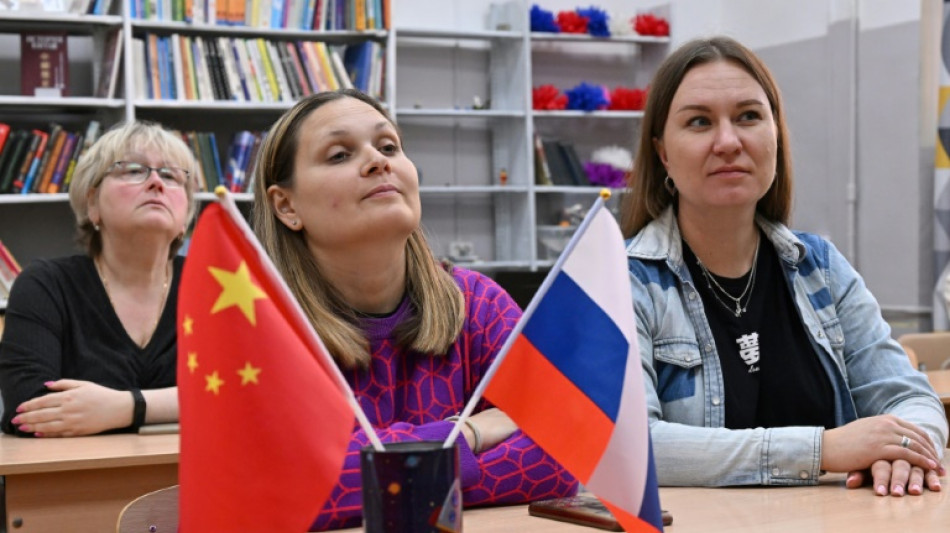
Russia's Asia pivot spurs boom in Chinese classes / Photo: Yuri KADOBNOV - AFP

 Lights out in Laos as electricity exports surge

 Steven Strogatz weighs AI mathematics advances and their consequences for researchers

 Anthropic boss calls for AI slowdown, Altman and Musk agree

 French IT giant Capgemini sells subsidiary after row over ICE links

 Quebec Brokerage Qubit Insurance Announces New Data on Coverage Shortfalls as Rebuilding Costs Rise

 Lady Gaga welcomes first child with fiance: US media

 Bhutan business bets on hazelnuts for farming future

 'Widow's Bay' and 'The Pitt' are favorites for Emmys night

 Coastal erosion forces cancellation of California music festival

 Argentina's Dirty War rears its head in Venice film

 UK lawmakers throw out bill to legalise assisted dying

 US inflation steady in August, fueling Fed rate hike expectations

 New York marks 25th anniversary of 9/11 attacks

 Nepal flood reconstruction bill to be $4.78 bn: foreign ministry

 JUMO and Standard Bank launch Social Finance Framework to scale inclusive finance in Africa

 Doomsday tech: could AI really kill us all?

 French comedy show 'Call my agent' makes film comeback

 It's all coming back: Celine Dion fans gear up for Paris return

 Researchers eye AI revolution in natural disaster forecasts

 US braces for inflation report that may push Fed to hike rates

 Musk threatens legal action over documentary

 Latin America fact-check group asks Meta not to replace verification practice

 AI Risks to Enter 60–80% of Liability and Cyber Insurance Underwriting by 2028, ScienceSoft Predicts

 Tribal Launches Campfire, Letting Business and Technical Teams Build on Salesforce Together

 Stocks fall as fresh oil surge fans inflation fears

Every Sunday, Chinese tutor Kirill Burobin begins work in the early morning and is kept busy until midnight.
As Russia seeks to tighten ties with China amid Moscow's military campaign in Ukraine, the number of Burobin's students has tripled over the past year.
"Sunday is the busiest," 20-year-old Burobin, who makes a good living with his online lessons, told AFP.
"I have 16 hours of classes virtually without a break."
The boom in demand for Chinese lessons in Russia illustrates the country's pivot towards Asia as tensions build between Moscow and the West.
Chinese President Xi Jinping's three-day visit to Russia beginning Monday aims to deepen what the two countries have called a "no-limits" relationship, which is increasingly important for Russia as its international isolation deepens.
Pummelled by multiple rounds of Western sanctions, Russia's economic and technological development is becoming more dependent on China.
Natalia Danina, a manager at HeadHunter, the country's top online recruitment company, said that last year there were nearly 11,000 vacancies requiring knowledge of the Chinese language, a 44 percent increase compared to 2021.
Over the same period, the number of jobs for Chinese speakers in Russia has doubled in sales, transport and logistics, said Danina, pointing to an "accelerated transition" to Chinese-made equipment and spare parts.
Demand for Chinese speakers in energy jobs has tripled, she added.
- 'Just the start' -
Burobin, who also studies Eastern civilisations at a top Moscow university, said that he was happy to help his students learn more about "a whole new world".
"Russians are taking up Chinese because Beijing has become our main partner for decades to come," he said.
"And this is just the beginning."
In August, Avito, Russia's leading online classified ads platform, reported a 138 percent increase in requests for Chinese lessons in Moscow in one year.
The same figure stood at 350 percent for the far eastern city of Vladivostok.
The popularity of Chinese classes might be starting to catch up with demand for English lessons in the country.
Alina Khamlova, 26, who teaches both languages, said she had only three English language students this year, compared to 12 who are learning Chinese.
One of her students is Maria, a 22-year-old designer who dreams of travelling to China to make her clothes there because it is "cheaper than in Russia".
Another student is a 25-year-old gym coach, Ivan, who wants to work in China because Europeans "are paid very well" there.
Khamlova also said that many young people in Russia hope to study in Chinese universities now that many European establishments had become "inaccessible to them".
While English still retains a dominant position, the number of high school students who chose Chinese as a foreign language during their final school exams has doubled in one year to 17,000, according to the state education watchdog Rosobrnadzor.
- 'No one will defeat us' -
Russia's growing isolation from the West has prompted many language schools to revise their curricula and invite teachers of the Chinese language.
Founded in 2017, the ChineseFirst language centre has seen twice as many registrations this year, said its co-founders, Wang Yinyu, 38, and his Russian wife Natalia, a 33-year-old Chinese speaker.
Wang's family business is booming, and he is planning to open two new branches and a kindergarten in Moscow.
In Russia, "many companies have rushed to Chinese factories to order goods that have become unavailable in Russia due to sanctions," he told AFP in Russian.
And Chinese entrepreneurs, who are interested in exporting to Russia, are looking for bilingual employees.
Wang is glad that China and Russia are becoming closer.
"China has powerful industry and Russia is rich in resources, which means that our two countries can build their own internal economy," he said.
"If we stand back-to-back, no one will defeat us."
C.Peyronnet--CPN