Dawn school trial for drowsy teens draws outcry in Indonesia / Photo: ELIAZAR BALLO - AFP

 Lights out in Laos as electricity exports surge

 Steven Strogatz weighs AI mathematics advances and their consequences for researchers

 Anthropic boss calls for AI slowdown, Altman and Musk agree

 French IT giant Capgemini sells subsidiary after row over ICE links

 Quebec Brokerage Qubit Insurance Announces New Data on Coverage Shortfalls as Rebuilding Costs Rise

 Lady Gaga welcomes first child with fiance: US media

 Bhutan business bets on hazelnuts for farming future

 'Widow's Bay' and 'The Pitt' are favorites for Emmys night

 Coastal erosion forces cancellation of California music festival

 Argentina's Dirty War rears its head in Venice film

 UK lawmakers throw out bill to legalise assisted dying

 US inflation steady in August, fueling Fed rate hike expectations

 New York marks 25th anniversary of 9/11 attacks

 Nepal flood reconstruction bill to be $4.78 bn: foreign ministry

 JUMO and Standard Bank launch Social Finance Framework to scale inclusive finance in Africa

 Doomsday tech: could AI really kill us all?

 French comedy show 'Call my agent' makes film comeback

 It's all coming back: Celine Dion fans gear up for Paris return

 Researchers eye AI revolution in natural disaster forecasts

 US braces for inflation report that may push Fed to hike rates

 Musk threatens legal action over documentary

 Latin America fact-check group asks Meta not to replace verification practice

 AI Risks to Enter 60–80% of Liability and Cyber Insurance Underwriting by 2028, ScienceSoft Predicts

 Tribal Launches Campfire, Letting Business and Technical Teams Build on Salesforce Together

 Stocks fall as fresh oil surge fans inflation fears

Every morning in a city in Indonesia's far east, sleepy teenagers can be seen trudging zombie-like through the streets on their reluctant way to school.
It is not a scene from some cheesy sci-fi offering but a controversial experiment to get the day off to a much earlier start for the sleep-deprived teens.
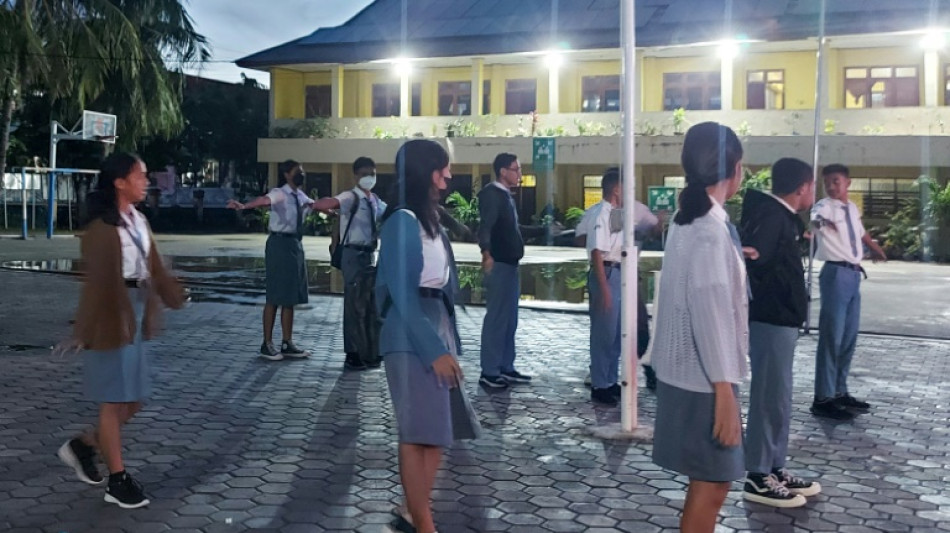
The pilot project in Kupang, the capital of East Nusa Tenggara province, has twelfth-graders at 10 high schools starting classes at 5:30 am.
Authorities say the scheme, announced last month by governor Viktor Laiskodat, is intended to strengthen children's discipline.
According to parents, though, their children are "exhausted" by the time they get home. Schools in Indonesia generally start between 7:00 and 8:00 am.
Teens in their school uniforms are now walking down dark streets or waiting for motorcycle taxis to get to school on time.
"It is extremely difficult, they now have to leave home while it's still pitch dark. I can't accept this... their safety is not guaranteed when it's dark and quiet," Rambu Ata, a mother to a 16-year-old, told AFP.
Her daughter Eureka now has to wake up at 4:00 am to get ready and ride a motorbike to school.
"Now every time she arrives home, she is exhausted and falls asleep immediately because she is so sleepy," Ata said.
At least one scholar seems to agree.
"It has no correlation with the effort to improve the quality of education," Marsel Robot, an education expert from Nusa Cendana University, told AFP.
In the long run, sleep deprivation could endanger the students' health and cause a shift in behaviour, he said.
"They will only sleep for a few hours and this is a serious risk for their health. This also will cause them stress and they will vent their stress by acting out."
- Policy extended -
A 2014 study published by the American Academy of Pediatrics recommended that middle and high schoolers start classes at 8:30 am or later to allow enough time for sleep.
The Kupang rule change was also challenged by local lawmakers, who demanded the government cancel what they called a baseless policy.
The government has maintained their experiment despite the criticism and even extended it to the local education agency, where civil servants also now start their day at 5:30 am.
Not everybody is unhappy with the policy.
Rensy Sicilia Pelokilla, a civil servant at the agency, told AFP that starting earlier made her healthier because she now has to join group exercise sessions in her office that she once slept through.
"As a civil servant I am ready to comply with the regulation and I'm going to do my best," Pelokilla said.
A.Samuel--CPN