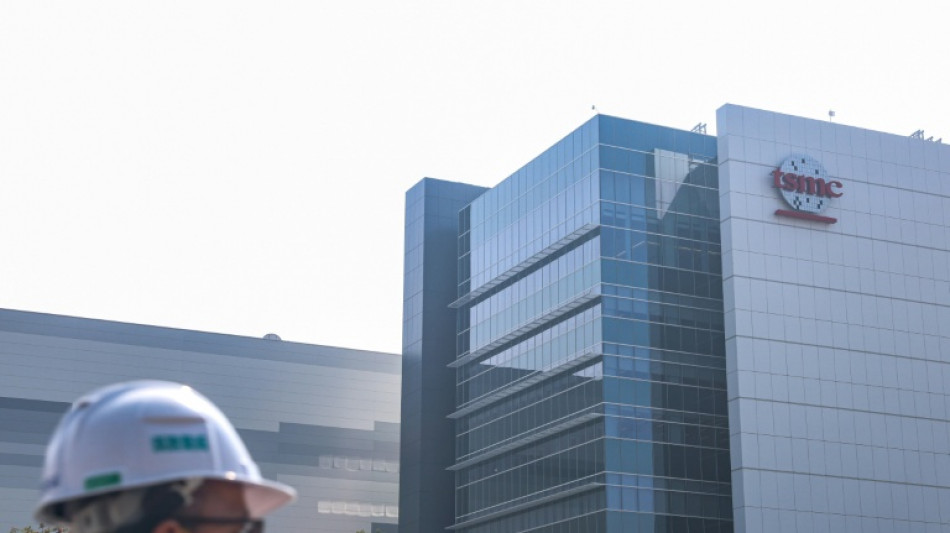
TSMC says started mass production of 'most advanced' 2nm chips / Photo: I-Hwa Cheng - AFP/File

 Multi-Asset Trading Venue Monochrome Exchange Announces IEO of Its Native Token, $MCR

 Data centre command hub keeps AI up and running

 Leo XIV, first US pope transcends his restrained style

 France's debt climbs to highest since 1978: ministry

 Thousands protest inaction over climate crisis in Switzerland

 UK actor Naomi Watts honoured at Spain film festival
 Trump signs bill authorizing sweeping Russia sanctions
 Anthropic picks Accenture for in-house AI safety evaluation

 Hushing and hedging: US companies retreat on climate

 Crisis-wracked Volkswagen warns of 10-bn-euro hit to profits

 Shakira to cap off world tour with Madrid 12-gig run

 Isolated Syrian-Druze city shortages

 UNESCO can be 'moderator' in AI debate: chief to AFP

 Russia seizes assets of Nestle, French firms

 Anthropic says AI systems moving towards building themselves

 Asian stocks boosted by falling oil, yen weakens after BoJ rate hike

 Afghan medical students in Pakistan hope court stops college expulsions

 Australia to detain tourists who overstay visa, minister says

 Asian stocks track Wall St rally as oil prices drop

 Prized Mexican relic returns on loan, two centuries on

 'In our lane': Fed's Warsh defies Trump but still fighting for credibility

 Trump admin makes major cut to endangered species protections

 GM delivers first components for US interceptor missiles

 Travis Scott and Keith Richards feature on GTA VI soundtrack

 King Charles warns tech bosses of 'existential dangers' of AI

Taiwanese tech titan TSMC has started mass producing its cutting-edge 2-nanometre semiconductor chips, the company said in a statement seen by AFP on Wednesday.
TSMC is the world's largest contract maker of chips, used in everything from smartphones to missiles, and counts Nvidia and Apple among its clients.
"TSMC's 2nm (N2) technology has started volume production in 4Q25 as planned," TSMC said in an undated statement on its website.
The chips will be the "most advanced technology in the semiconductor industry in terms of both density and energy efficiency", the company said.
"N2 technology, with leading nanosheet transistor structure, will deliver full-node performance and power benefits to address the increasing need for energy-efficient computing."
The chips will be produced at TSMC's "Fab 22" facility in the southern port city of Kaohsiung.
More than half of the world's semiconductors, and nearly all of the most advanced ones used to power artificial intelligence technology, are made in Taiwan.
TSMC has been a massive beneficiary of the frenzy in AI investment. Nvidia and Apple are among firms pouring many billions of dollars into chips, servers and data centres.
AI-related spending is soaring worldwide, and is expected to reach approximately $1.5 trillion by 2025, according to US research firm Gartner, and over $2 trillion in 2026 -- nearly two percent of global GDP.
Taiwan's dominance of the chip industry has long been seen as a "silicon shield" protecting it from an invasion or blockade by China -- which claims the island is part of its sovereign territory -- and an incentive for the United States to defend it.
But the threat of a Chinese attack has fuelled concerns about potential disruptions to global supply chains and has increased pressure for more chip production beyond Taiwan's shores.
Chinese fighter jets and warships encircled Taiwan during live-fire drills this week aimed at simulating a blockade of the democratic island's key ports and assaults on maritime targets.
Taipei, which slammed the two-day war games as "highly provocative and reckless", said the manoeuvre failed to impose a blockade on the island.
TSMC has invested in chip fabrication facilities in the United States, Japan and Germany to meet soaring demand for semiconductors, which have become the lifeblood of the global economy.
But in an interview with AFP this month, Taiwanese Deputy Foreign Minister Francois Chih-chung Wu said the island planned to keep making the "most advanced" chips on home soil and remain "indispensable" to the global semiconductor industry.
St.Ch.Baker--CPN