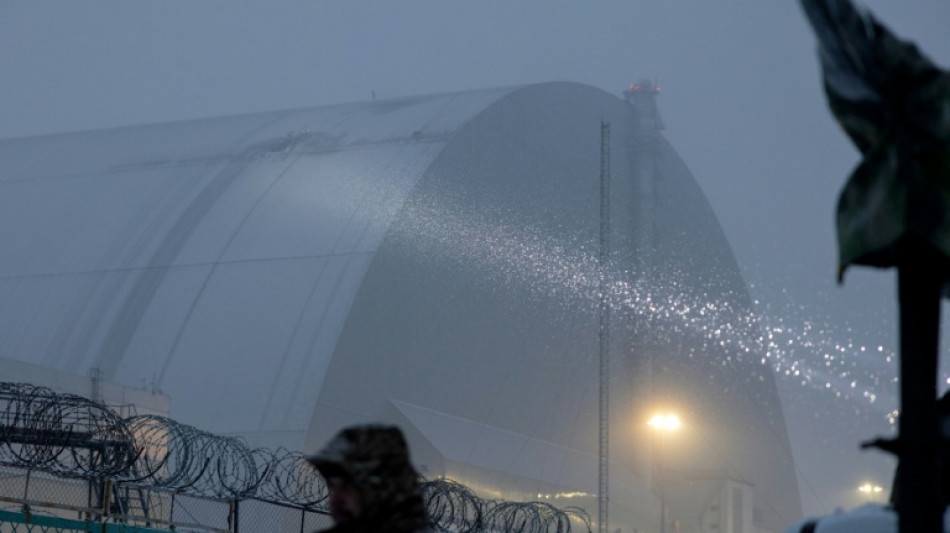
Russian strike could collapse Chernobyl shelter: plant director / Photo: Tetiana DZHAFAROVA - AFP

 Multi-Asset Trading Venue Monochrome Exchange Announces IEO of Its Native Token, $MCR

 Data centre command hub keeps AI up and running

 Leo XIV, first US pope transcends his restrained style

 France's debt climbs to highest since 1978: ministry

 Thousands protest inaction over climate crisis in Switzerland

 UK actor Naomi Watts honoured at Spain film festival
 Trump signs bill authorizing sweeping Russia sanctions

 Anthropic picks Accenture for in-house AI safety evaluation

 Hushing and hedging: US companies retreat on climate
 Crisis-wracked Volkswagen warns of 10-bn-euro hit to profits

 Shakira to cap off world tour with Madrid 12-gig run

 Isolated Syrian-Druze city shortages

 UNESCO can be 'moderator' in AI debate: chief to AFP

 Russia seizes assets of Nestle, French firms

 Anthropic says AI systems moving towards building themselves

 Asian stocks boosted by falling oil, yen weakens after BoJ rate hike

 Afghan medical students in Pakistan hope court stops college expulsions

 Australia to detain tourists who overstay visa, minister says

 Asian stocks track Wall St rally as oil prices drop

 Prized Mexican relic returns on loan, two centuries on

 'In our lane': Fed's Warsh defies Trump but still fighting for credibility

 Trump admin makes major cut to endangered species protections

 GM delivers first components for US interceptor missiles

 Travis Scott and Keith Richards feature on GTA VI soundtrack

 King Charles warns tech bosses of 'existential dangers' of AI

A Russian strike could collapse the internal radiation shelter at the defunct Chernobyl nuclear power station in Ukraine, the plant's director has told AFP.
Kyiv has accused Russia of repeatedly targeting the facility, the site of a 1986 meltdown that is still the world's worst ever nuclear disaster, since Moscow invaded in February 2022.
A hit earlier this year punched a hole in the outer radiation shell, triggering a warning from the International Atomic Energy Agency (IAEA) that it had "lost its primary safety functions."
In an interview with AFP, plant director Sergiy Tarakanov said fully restoring that shelter could take three to four years, and warned that another Russian hit could see the inner shell collapse.
"If a missile or drone hits it directly, or even falls somewhere nearby, for example, an Iskander, God forbid, it will cause a mini-earthquake in the area," Tarakanov told AFP in an interview conducted last week.
The Iskander is Russia's short-range ballistic missile system that can carry a variety of conventional warheads, including those to destroy bunkers.
"No one can guarantee that the shelter facility will remain standing after that. That is the main threat," he added.
The remnants of the nuclear power plant are covered by an inner steel-and-concrete radiation shell -- known as the Sarcophagus and built hastily after the disaster -- and a modern, high-tech outer shell, called the New Safe Confinement (NSC) structure.
The roof of the NSC was severely damaged in a Russian drone strike in February, which caused a major fire in the outer cladding of the steel structure.
"Our NSC has lost several of its main functions. And we understand that it will take us at least three or four years to restore these functions," Tarakanov added.
The IAEA said earlier this month an inspection mission found the shelter had "lost its primary safety functions, including the confinement capability, but also found that there was no permanent damage to its load-bearing structures or monitoring systems."
Director Tarakanov told AFP that radiation levels at the site remained "stable and within normal limits."
The hole caused by the drone hit has been covered with a protective screen, he said, but 300 smaller holes made by firefighters when battling the blaze still need to be filled in.
Russia's army captured the plant at the start of its 2022 invasion, before withdrawing a few weeks later.
D.Goldberg--CPN