Rome's new Colosseum station reveals ancient treasures / Photo: Filippo MONTEFORTE - AFP

 France's Macron, Canada's Carney announce closer ties
 AI 'warning shots' focus Beijing on national security risks

 Philippine tribe in limbo over US-led tech hub

 Saudi-led coalition says Houthis fired ballistic missile at Riyadh

 Cuba works to restore power after another blackout

 Brigitte Bardot widower slams sale of star's belongings

 Indonesia accepts Malaysia's help to tackle wildfires

 Nvidia, OpenAI CEOs to attend Xi dinner at White House

 Cuba hit with seventh major blackout of the year

 Nigeria miners struggled to breathe in cell before 37 died: survivors

 Warren Buffett steps down as Berkshire Hathaway chairman

 Isolated Syrian-Druze city blames Damascus for shortages

 Kerry James Marshall: American 'blackness' painter celebrated in Europe

 Infantino 'must go', says German FA vice-president

 Japan's busiest rail station tests robot bins

 Backpackers fret over Australian visa crackdown

 Bank of Japan hikes rates to 31-year high to battle inflation

 AI doomsday warnings unlikely to slow IPOs but questions linger

 In Brazil's Amazon, the hunt for oil fuels hopes and fears

 Baby orangutans in India expose 'frightening' scale of trafficking

 Oversight Board blasts 'inadequate' Meta safeguards for AI deepfakes

 Harry makes first public appearance since return to UK

 Princess Diana's brother makes new explosive claims against Charles

 Trump admin overhauls key protection for endangered species

 Mbappe draws political fire over Ceuta t-shirt controversy

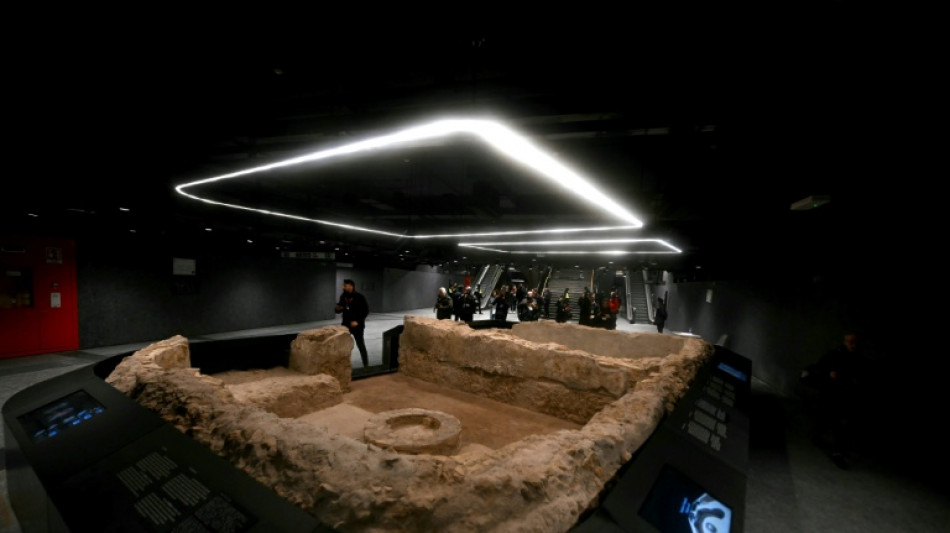
Beyond the entrance of Rome's newest metro station under the Colosseum, there are display cases filled with hundreds of ancient artefacts found during a decade-long construction project.
Spread out over four levels to a depth of 32 metres in the heart of Rome, the "Colosseo-Fori Imperiali" station on the city's C-line unveiled on Tuesday is a feat of modern engineering.
For the price of a 1.5-euro ticket, travellers can access the station's underground museum holding 350 objects -- from ceramic jugs and lamps to bronze statuettes and a wooden sword.
A little further, the remains of a bathhouse of the home of a wealthy Roman can be seen.
Ancient Rome was built in layers. Temples and forums were built on older foundations before themselves being covered over, creating a fascinating terrain for archaeologists.
At ground level, a triangular opening even offers an unusual viewpoint on the Colosseum.
"The most important thing that we have managed to do is to show an insight... into daily life," Elisa Cella, an archaeologist at the Colosseum archaeological park, said at the presentation.
- 'Extraordinary past' -
Rome mayor Roberto Gualtieri called the station opening "an extraordinary and historic event".
He also defended the costly and lengthy works, which have caused widespread disruption for residents and tourists in the area for years.
The project had to be delayed several times due to complaints and unexpected discoveries.
"These archaeological digs and finds, are not an obstacle," he said, calling them an opportunity to reveal the city's "extraordinary past".
Faced with the unique geological complexity of Rome, the excavation adopted a method of "descending archaeology" specifically developed for underground stations in the historic centre.
It involves installing intermediate slabs as excavations progress from top to bottom, thereby ensuring the stability of the structures.
Also inaugurated on Tuesday was the Porta Metronia station -- where excavations revealed a vast military complex from the 2nd century AD including a residence decorated with frescoes and mosaics.
The residence was dismantled, restored and then reinstalled in a space which metro travellers can admire from an elevated walkway.
"Rome has always built on top of itself," said Simona Morretta, head of excavations and of the Porta Metronia museum.
Launched in 2007, the construction of the C line connecting the city's northeast to the southeast has suffered significant delays.
Once completed, it will have 31 stations over a length of 29 kilometres.
A.Levy--CPN