
China's trade surplus tops $1 trillion despite plunge in US-bound exports / Photo: - - AFP

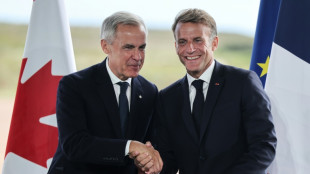 France's Macron, Canada's Carney announce closer ties

 AI 'warning shots' focus Beijing on national security risks

 Philippine tribe in limbo over US-led tech hub

 Saudi-led coalition says Houthis fired ballistic missile at Riyadh

 Cuba works to restore power after another blackout

 Brigitte Bardot widower slams sale of star's belongings

 Indonesia accepts Malaysia's help to tackle wildfires

 Nvidia, OpenAI CEOs to attend Xi dinner at White House

 Cuba hit with seventh major blackout of the year

 Nigeria miners struggled to breathe in cell before 37 died: survivors

 Warren Buffett steps down as Berkshire Hathaway chairman

 Isolated Syrian-Druze city blames Damascus for shortages

 Kerry James Marshall: American 'blackness' painter celebrated in Europe

 Infantino 'must go', says German FA vice-president

 Japan's busiest rail station tests robot bins

 Backpackers fret over Australian visa crackdown

 Bank of Japan hikes rates to 31-year high to battle inflation

 AI doomsday warnings unlikely to slow IPOs but questions linger

 In Brazil's Amazon, the hunt for oil fuels hopes and fears

 Baby orangutans in India expose 'frightening' scale of trafficking

 Oversight Board blasts 'inadequate' Meta safeguards for AI deepfakes

 Harry makes first public appearance since return to UK

 Princess Diana's brother makes new explosive claims against Charles

 Trump admin overhauls key protection for endangered species

 Mbappe draws political fire over Ceuta t-shirt controversy

China's towering annual trade surplus surpassed $1 trillion for the first time last month, data showed Monday, as a sharp drop in shipments to the United States was offset by surging exports to other major markets.
Presidents Xi Jinping and Donald Trump reached a tentative truce to their fierce trade war when they met in late October, agreeing a pause to painful measures that included lofty tit-for-tat tariffs.
Exports have served as a key economic lifeline for China as trade and relations with the United States and others have fluctuated in recent years.
That has helped temper a prolonged debt crisis in the country's vast property sector and sluggish domestic spending, which have weighed on growth and are among the most pressing issues facing Beijing.
Exports climbed 5.9 percent year-on-year in November, reversing the slight decline recorded in October, the General Administration of Customs said.
The reading was also above a Bloomberg forecast of four percent growth.
The jump came despite a continued downturn in shipments to the United States, which sank 28.6 percent to $33.8 billion in November, the data showed.
"Weakness in exports to the United States was more than offset by shipments to other markets," Zichun Huang of Capital Economics wrote in a note.
"Exports are likely to remain resilient, thanks to trade rerouting and rising price competitiveness as deflation pushes down China's real effective exchange rate," Huang said.
The surge in shipments last month added to the country's ballooning annual trade surplus for the first 11 months of the year, which the Customs data showed hit $1.08 trillion in November.
"China's trade surplus this year has already surpassed last year's level, and we expect it to widen further next year," Huang wrote.
But the imbalance has long been a sticking point for major Western trading partners.
French President Emmanuel Macron threatened in remarks published Sunday to impose tariffs on China if Beijing fails to reduce its massive trade surplus with the European Union.
Macron -- who concluded a state visit to China last week -- warned in business daily Les Echos that "Europeans will be forced to take strong measures in the coming months".
In a further sign of China's weak domestic consumption, the data showed Monday that imports rose 1.9 percent on-year in November -- slower than the three percent increase predicted by Bloomberg.
"The rebound of export growth in November helps to mitigate the weak domestic demand," Zhiwei Zhang, president and chief economist at Pinpoint Asset Management, wrote in a note.
"The economic momentum slowed in the fourth quarter partly driven by the continued weakness in the property sector," he said.
Xi and Trump agreed at the October meeting in South Korea to scale back sky-high tariffs on each other's goods and blistering export controls that had sent shockwaves across global industries.
The detente is due to expire late next year, allowing time for officials to reach a permanent deal -- though experts warn such a breakthrough will be challenging.
"There's no guarantee this uneasy truce will last that long," Lynn Song, ING chief economist for Greater China, said last week.
"A lot needs to go right for the agreement to hold for the full year," he wrote, adding that "it seems prudent to expect a softer external demand backdrop for next year."
China's leaders -- who are targeting overall growth this year of five percent -- are expected to convene a key meeting this week focused on economic planning.
P.Gonzales--CPN