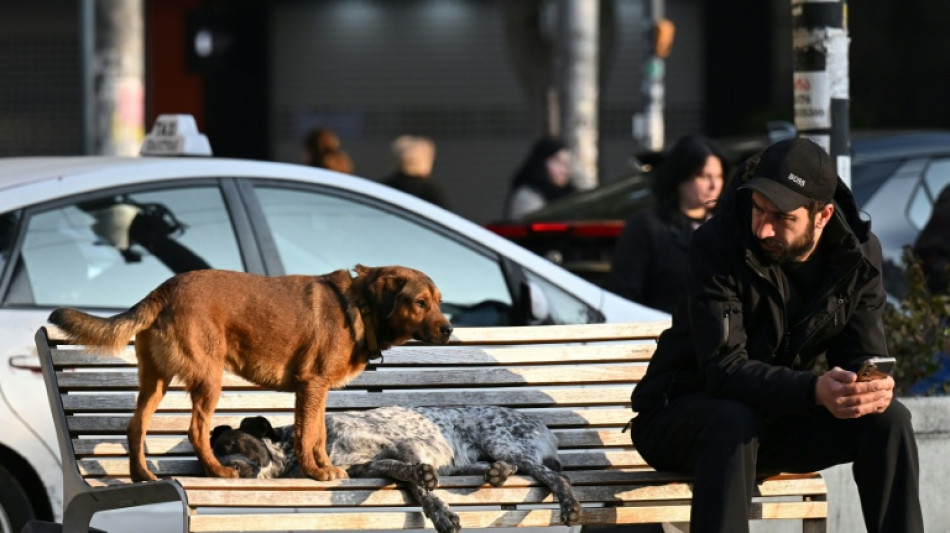
Georgia's street dogs stir affection, fear, national debate / Photo: Vano SHLAMOV - AFP

 France's Macron, Canada's Carney announce closer ties

 AI 'warning shots' focus Beijing on national security risks

 Philippine tribe in limbo over US-led tech hub

 Saudi-led coalition says Houthis fired ballistic missile at Riyadh

 Cuba works to restore power after another blackout

 Brigitte Bardot widower slams sale of star's belongings

 Indonesia accepts Malaysia's help to tackle wildfires

 Nvidia, OpenAI CEOs to attend Xi dinner at White House

 Cuba hit with seventh major blackout of the year

 Nigeria miners struggled to breathe in cell before 37 died: survivors

 Warren Buffett steps down as Berkshire Hathaway chairman

 Isolated Syrian-Druze city blames Damascus for shortages

 Kerry James Marshall: American 'blackness' painter celebrated in Europe

 Infantino 'must go', says German FA vice-president

 Japan's busiest rail station tests robot bins

 Backpackers fret over Australian visa crackdown

 Bank of Japan hikes rates to 31-year high to battle inflation

 AI doomsday warnings unlikely to slow IPOs but questions linger

 In Brazil's Amazon, the hunt for oil fuels hopes and fears

 Baby orangutans in India expose 'frightening' scale of trafficking

 Oversight Board blasts 'inadequate' Meta safeguards for AI deepfakes

 Harry makes first public appearance since return to UK

 Princess Diana's brother makes new explosive claims against Charles

 Trump admin overhauls key protection for endangered species

 Mbappe draws political fire over Ceuta t-shirt controversy

At a bus stop in central Tbilisi, two tagged dogs dozed on a bench as some commuters smiled at them and others cast angry glances.
In the streets of the Georgian capital, such scenes are part of daily life: community-fed "yard dogs", yellow municipal tags on their ears, lounge outside bakeries, metro entrances and school gates.
The free-roaming canines stir both affection and fear. What to do with their swelling numbers -- in the tens of thousands in Tbilisi alone -- has become a nationwide dilemma.
Stray animals tied the top spot for public concerns in a poll by the National Democratic Institute, with 22 percent of respondents naming it the most pressing issue.
Many welcome the dogs as a symbol of Tbilisi, a showcase of Georgian hospitality and the warm street life that draws tourists to the capital.
"Street dogs in Georgia have made a more positive impact on tourism and the image of Georgia than people and culture alone," said journalist Elena Nikoleisvili, 51, who helps street dogs.
"If anything, these adorable creatures should be the symbol of the capital -- like the cats of Istanbul."
On cafe terraces, regulars slip bones under tables as mongrels curl up between patrons' feet, while each neighbourhood and cul-de-sac has its own local canine mascot.
- 'Drop in the ocean' -
Others worry about safety.
"They bark and scare folks," said plumber Oleg Berlovi, 43.
"Two weeks ago, a dog bit my kid and we needed shots. Animals are great, but they need looking after."
According to the World Health Organization, dogs are the main vectors in human rabies cases globally.
Georgia still records a handful of human deaths from the disease each year and administers tens of thousands of post-exposure treatments, according to the Global Alliance for Rabies Control.
City officials say the answer is steady, humane population control.
"The state's policy is to manage these animals by the most humane methods possible and to reduce to a minimum the number of stray dogs on the streets," Nicoloz Aragveli, who heads Tbilisi city hall's animal monitoring agency, told AFP.
A recent count put the capital's stray dog population at about 29,000, and around 74 percent have been neutered, Aragveli said.
"We plan to do more so that we reach 100 percent," he said.
The city runs weekly school lessons and a door-to-door registration drive to raise awareness and track owned pets.
Legislative changes have also tightened penalties for abandoning animals and for violating care and ownership rules -- steps officials say will help halt the flow of pets to the streets.
But journalist Nikoleisvili said the authorities only responded after a public backlash, and "could do much more".
The number of dogs that have been neutered in Tbilisi -- around 50,000 over the last decade -- is "a drop in the ocean", she said.
- 'Guilty party' -
Volunteers, like theatre director Zacharia Dolidze, who builds kennels, also play a big role in caring for the dogs.
"There are days I make 20 kennels. I've built about 2,500 in seven years," the 40-year-old said.
He collects regular donations to help pay for materials.
Shelter operators say there are big gaps in addressing what they call one of Georgia's biggest issues.
"You can make regulations, but if you cannot enforce them, that's not going to help," said Sara Anna Modzmanashvili Kemecsei, who runs a shelter that houses about 50 dogs.
In many regions, "there are absolutely no neutering campaigns."
"I can't really see that the government is on top of the issue, so there are lots of volunteers," she said. "They are really good at managing these animals."
Politics has also injected fresh uncertainty.
Last year, the government pushed a "foreign influence" law that complicates NGOs' access to funding from foreign donors such as UK animal welfare charity Mayhew, which runs a programme to vaccinate and neuter strays in Tbilisi.
Volunteers meanwhile continue to juggle feeding, sheltering and basic care.
Nino Adeishvili, 50, is a geologist and university lecturer who looks after around 10 dogs.
Her group organises rabies shots and fundraises on Facebook for deworming, flea treatment and food.
"On the street, a dog is still unprotected," she said.
"The guilty party is the human."
Ng.A.Adebayo--CPN