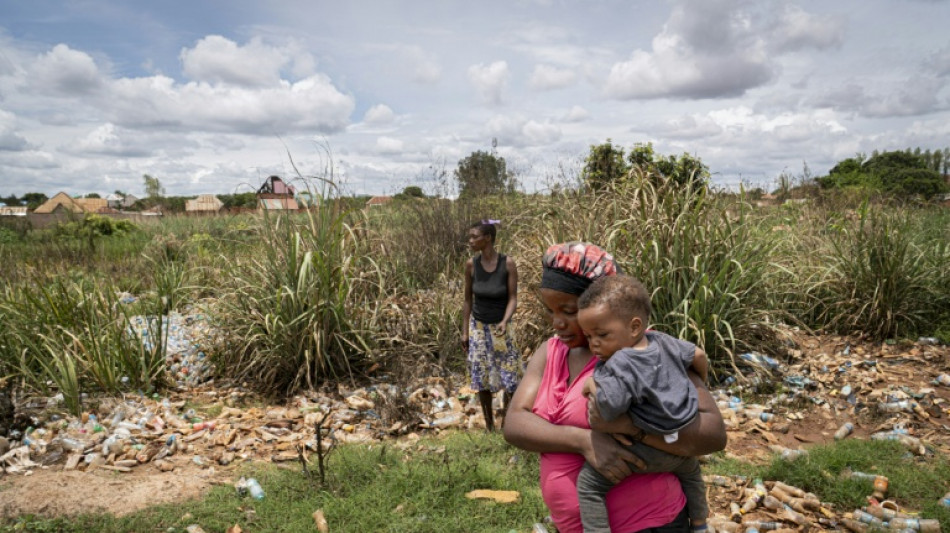
Unchecked mining waste taints DR Congo communities / Photo: Glody MURHABAZI - AFP

 France's Macron, Canada's Carney announce closer ties
 AI 'warning shots' focus Beijing on national security risks

 Philippine tribe in limbo over US-led tech hub

 Saudi-led coalition says Houthis fired ballistic missile at Riyadh

 Cuba works to restore power after another blackout
 Brigitte Bardot widower slams sale of star's belongings

 Indonesia accepts Malaysia's help to tackle wildfires
 Nvidia, OpenAI CEOs to attend Xi dinner at White House

 Cuba hit with seventh major blackout of the year

 Nigeria miners struggled to breathe in cell before 37 died: survivors

 Warren Buffett steps down as Berkshire Hathaway chairman

 Isolated Syrian-Druze city blames Damascus for shortages

 Kerry James Marshall: American 'blackness' painter celebrated in Europe

 Infantino 'must go', says German FA vice-president

 Japan's busiest rail station tests robot bins

 Backpackers fret over Australian visa crackdown

 Bank of Japan hikes rates to 31-year high to battle inflation

 AI doomsday warnings unlikely to slow IPOs but questions linger

 In Brazil's Amazon, the hunt for oil fuels hopes and fears

 Baby orangutans in India expose 'frightening' scale of trafficking

 Oversight Board blasts 'inadequate' Meta safeguards for AI deepfakes

 Harry makes first public appearance since return to UK

 Princess Diana's brother makes new explosive claims against Charles

 Trump admin overhauls key protection for endangered species

 Mbappe draws political fire over Ceuta t-shirt controversy

Carrying her sore-pocked daughter across her decaying field, Helene Mvubu says she is one of thousands to have fallen victim to the toxic waste defiling the Democratic Republic of Congo's mining capital.
Global powers, notably China and the United States, are in a race to extract strategic minerals in the DRC, which supplies more than 70 percent of the world's cobalt, essential for making electric batteries and weaponry.
But human rights groups say the mining operations are resulting in severe environmental damage in the mineral-rich African nation.
Mvubu told AFP that she has for years suffered the consequences of flooding from contaminated water discharged by Congo Dongfang International Mining (CDM), a Chinese company that processes copper and cobalt ore in the outskirts of Lubumbashi, capital of the mineral-rich Katanga province in the southeastern DRC.
"The food we prepare becomes bitter, our water sources are polluted," said the farmer as she walked across her plot, where the sugarcane has turned yellow with disease.
Mvubu's field is located directly within the path of runoff water from the CDM site, surrounded by an imposing concrete wall guarded by officers, on a mountain overlooking residential neighbourhoods.
The extent of the pollution is unknown.
But when it rains, red water can be seen gushing out from four drainage points under the enclosure.
Residents and civil society groups interviewed by AFP accused CDM of taking advantage of rainy periods to discharge mining wastewater.
At the beginning of November, thousands of cubic metres of the reddish water poured out from the Chinese company site over two days, despite no rainfall.
Outrage over the flooding forced Congolese authorities to act by suspending the site's activities and appointing an investigative commission -- a rare move in a country where mining companies generally operate with impunity, often with the complicity of local administrations.
- 'For show' -
"Everyone was surprised to see the waters flooding us even though it hadn't rained," said resident Hortance Kiluba, as she busied herself washing her laundry.
Joseph Kongolo, a member of the investigative commission and provincial coordinator of the National Human Rights Commission (CNDH), said the Chinese company "was misled by the weather and opened the valves before the rains fell" that would have otherwise hidden the flow.
CDM, however, claimed that the November flood was caused by the accidental rupture of a retention basin.
Several members of the investigative commission charge that pollution from the site dates back several years.
But no study on the toxicity of the wastewater has yet been made public.
Residents told AFP they have experienced harmful effects firsthand.
Martiny, a vendor of fruits and vegetables at the local market, showed her "damaged" hands and feet that she blamed on the exposure to "acidic" water.
The November flood, which inundated the market, also soaked her supply of dried fish, leaving it inedible.
To calm the upset, CDM employees distributed masks and bottles of water to the community.
The firm has also led the repairs of a stretch of road damaged by the waters.
"It's just for show," said a local chief, under the condition of anonymity, claiming that the firm also bribed officials to convince the public that the release of wastewater was accidental and not planned.
- 'Responsibilities are shared' -
A CDM representative denied any negligence on the company's part when contacted by AFP, asserting that "the materials are processed on site" and that "there could not have been any prior pollution" before November.
A subsidiary of Chinese multinational Zhejiang Huayou Cobalt, CDM has long been in the crosshairs of human rights organisations.
Hubert Tshiswaka, director general of the DRC's Institute for Human Rights Research (IRDH) and member of the investigating commission, has for years fought to get CDM to comply with social and financial obligations -- such as the payment of mining royalties -- required by law.
"Curiously, CDM obtained all the permits to set up on top of this hill," where rains naturally flow down to the neighbourhoods below, he said.
Although the spill pointed to CDM's "disregard for basic standards" with "serious repercussions on the environment", mining minister Louis Watum Kabamba admitted following the investigation that "responsibilities are shared".
"Our administration should have played its role," he said.
H.Meyer--CPN