French almond makers revive traditions to counter US dominance / Photo: Christophe SIMON - AFP

 France's Macron, Canada's Carney announce closer ties

 AI 'warning shots' focus Beijing on national security risks

 Philippine tribe in limbo over US-led tech hub

 Saudi-led coalition says Houthis fired ballistic missile at Riyadh

 Cuba works to restore power after another blackout

 Brigitte Bardot widower slams sale of star's belongings

 Indonesia accepts Malaysia's help to tackle wildfires

 Nvidia, OpenAI CEOs to attend Xi dinner at White House

 Cuba hit with seventh major blackout of the year

 Nigeria miners struggled to breathe in cell before 37 died: survivors

 Warren Buffett steps down as Berkshire Hathaway chairman

 Isolated Syrian-Druze city blames Damascus for shortages

 Kerry James Marshall: American 'blackness' painter celebrated in Europe

 Infantino 'must go', says German FA vice-president

 Japan's busiest rail station tests robot bins

 Backpackers fret over Australian visa crackdown

 Bank of Japan hikes rates to 31-year high to battle inflation

 AI doomsday warnings unlikely to slow IPOs but questions linger

 In Brazil's Amazon, the hunt for oil fuels hopes and fears

 Baby orangutans in India expose 'frightening' scale of trafficking

 Oversight Board blasts 'inadequate' Meta safeguards for AI deepfakes

 Harry makes first public appearance since return to UK

 Princess Diana's brother makes new explosive claims against Charles

 Trump admin overhauls key protection for endangered species

 Mbappe draws political fire over Ceuta t-shirt controversy

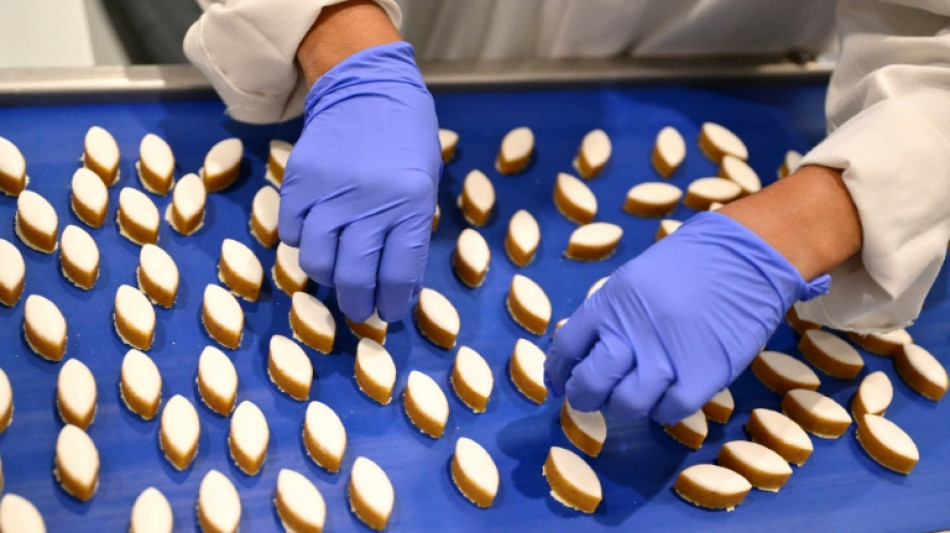
The scent of marzipan wafts through the air as confectioners from a century-old company in southern France prepare calissons, one of Provence's famed sweets made of candied melon and crushed almonds.
French producers have over the past decade sought to revive almond production, and the traditional gourmet treat first introduced in Provence under King Rene in the 15th century is now increasingly made with locally grown almonds.
Provence -- where almond blossoms famously inspired artists including Vincent Van Gogh -- was once a key almond-growing region.
But production declined in the mid-20th century, with the overnight frost of 1956 devastating orchards.
While the vast majority of almonds are grown in the United States, French producers have sought to hold their ground against US competitors, aiming to position the locally grown almonds in a premium segment and promote environmental awareness.
"I bet -- even without being Pierre Herme, the best pastry chef in the world -- that if you taste an American almond and then a Province-grown almond, you'll notice the difference in flavour immediately," said Alexis Bertucat, communications director for Le Roy Rene, a confectionery company.
Le Roy Rene, which is based in the city of Aix-en-Provence, uses around 50 tonnes of locally grown almonds a year to make treats such as calissons and nougat.
- 'Reduce our carbon footprint' -
When the company was bought in 2014 by Olivier Baussan, founder of the L'Occitane en Provence chain of cosmetics and beauty products, it imported American and Spanish almonds, said Bertucat.
But the idea to grow its own almonds and revive a tradition going back to the 15th century quickly took hold.
"The reason we make calissons in Aix-en-Provence is because there used to be almond producers all over the place," said Bertucat.
He said that thanks to the work of farmers in Provence -- "their irrigation methods, the way they treat the trees very lightly, or rather focus on creating living soil" -- the almonds they use have a high fat content.
"When it's combined with candied fruit and sugar, it produces a very distinctive flavour."
The company says it was also driven by economic and environmental concerns.
"If we use almonds that are closer to home, we reduce our carbon footprint," said Bertucat.
France now has more than 2,700 hectares of almond trees, according to official figures.
Production of shelled almonds stands at around 1,200 tonnes a year, dwarfed by the 50,000 tonnes of imported nuts.
One of producers, Francois Moulias, said that the local harvest would continue to increase but would still remain low in relation to the global market.
"We would need 50,000 hectares of almond trees to cover our needs," he said.
In 2018, he co-founded La Compagnie des Amandes with former government minister Arnaud Montebourg, which helps farmers to plant almond trees on their land.
- 'Virtuous agricultural practices' -
The company now cultivates 230 hectares of groves in southern France.
"With our more virtuous agricultural practices, we cannot achieve the same yields as the Americans," said Moulias, pointing out that French almonds use "five times less water" than those grown in California.
A processing plant was launched in October, which supplies high-end pastry makers such as Laduree and supermarkets as well as the cosmetics industry.
In 2011, cherry producer Fabien Dauphin began growing almonds to diversify crops.
He is following in the footsteps of his great-grandfather, who owned almond trees before the devastating frost of 1956.
Dauphin, who is the president of the Provence almond producers' union, owns 22 hectares of almond trees in the village of Cucuron.
Almond production accounts for half of his income, thanks in particular to online and market sales.
"It's still a niche market. Our customers are often people with high purchasing power," he said.
Dauphin is also considering branching out into pistachio production, which is still in its infancy in France.
"They're really two twin industries: we need the same equipment and, above all, we have the same customers," he said.
A.Samuel--CPN