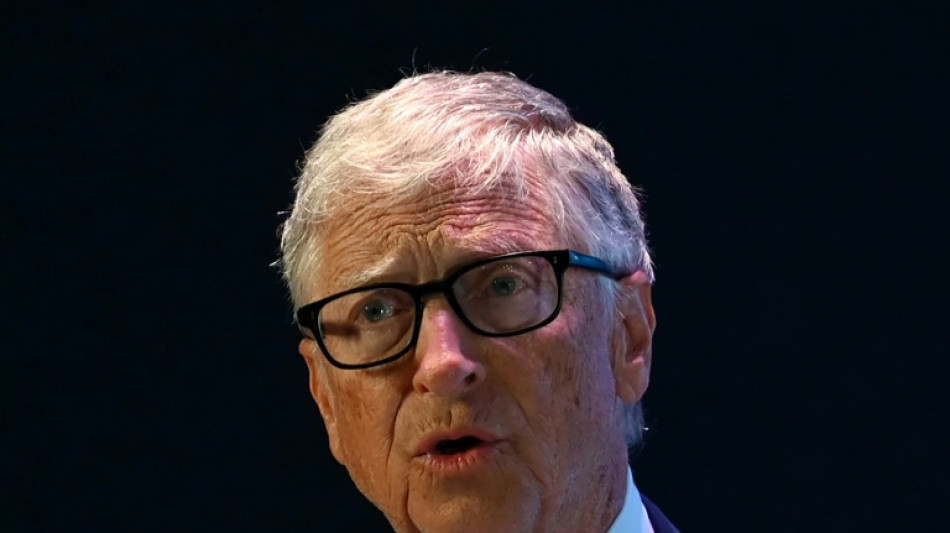
Aid cuts causing 'tragic' rise in child deaths, Bill Gates tells AFP / Photo: Arun SANKAR - AFP/File

 France's Macron, Canada's Carney announce closer ties

 AI 'warning shots' focus Beijing on national security risks

 Philippine tribe in limbo over US-led tech hub
 Saudi-led coalition says Houthis fired ballistic missile at Riyadh
 Cuba works to restore power after another blackout

 Brigitte Bardot widower slams sale of star's belongings

 Indonesia accepts Malaysia's help to tackle wildfires

 Nvidia, OpenAI CEOs to attend Xi dinner at White House

 Cuba hit with seventh major blackout of the year

 Nigeria miners struggled to breathe in cell before 37 died: survivors

 Warren Buffett steps down as Berkshire Hathaway chairman

 Isolated Syrian-Druze city blames Damascus for shortages

 Kerry James Marshall: American 'blackness' painter celebrated in Europe

 Infantino 'must go', says German FA vice-president

 Japan's busiest rail station tests robot bins

 Backpackers fret over Australian visa crackdown

 Bank of Japan hikes rates to 31-year high to battle inflation

 AI doomsday warnings unlikely to slow IPOs but questions linger

 In Brazil's Amazon, the hunt for oil fuels hopes and fears

 Baby orangutans in India expose 'frightening' scale of trafficking

 Oversight Board blasts 'inadequate' Meta safeguards for AI deepfakes

 Harry makes first public appearance since return to UK

 Princess Diana's brother makes new explosive claims against Charles

 Trump admin overhauls key protection for endangered species

 Mbappe draws political fire over Ceuta t-shirt controversy

Microsoft co-founder and philanthropist Bill Gates told AFP on Thursday it is "tragic" that child deaths will increase worldwide for the first time this century because wealthy Western countries have slashed international aid.
The United States has cut the deepest, with Gates saying fellow billionaire Elon Musk's so-called US Department of Government Efficiency (DOGE) was "responsible for a lot of deaths".
However Britain, France and Germany have also "disproportionately" slashed aid, Gates, a major funder of numerous global health programmes, said in a video interview from Seattle.
The cuts mean that the number of children dying before their fifth birthday is projected to increase to 4.8 million this year, up 200,000 since 2024, according to the Gates Foundation's annual Goalkeepers report released Thursday.
Gates said it was a "tragedy" to see child mortality rise after it had steadily fallen from around 10 million annual deaths at the turn of the millenium.
Aid for developing countries has plummeted by 27 percent this year, threatening progress against a range of diseases including malaria, HIV and polio, the report said.
If global aid cuts of around 30 percent are permanent, 16 million more children could die by 2045, according to modelling by the Gates-funded Institute for Health Metrics and Evaluation.
"That's 16 million mothers who are experiencing something that no one wants to or should have to deal with," Gates said.
- 'Chaotic' DOGE cuts -
Gates criticised the "chaotic situation" earlier this year when Musk's DOGE abruptly cut off grants from the US Agency for International Development (USAID), which has been dismantled since Donald Trump returned to the White House in January.
"I'm talking to President Trump about encouraging him to restore aid so that it is at most a modest cut -- I don't know if I'll be successful with that," the 70-year-old said.
Gates, a major donor of the Gavi alliance which distributes vaccines around the world, said he was disappointed the US did not renew its funding for the organisation in June.
US Health Secretary Robert F. Kennedy Jr also sent a video to the Gavi fund-raising event "that repeated his extremely debunked and misguided views that these childhood vaccines shouldn't be used," Gates said.
"Although the Gates Foundation works with every administration -- and we find some areas of agreement with Secretary Kennedy when it comes to vaccines -- we have essentially opposite views about the roles vaccines have played in the world."
- 'Tight' budgets -
While acknowledging that "rich world budgets are very tight," Gates regretted that international aid was being "disproportionately" targeted in European nations.
Gates said he had spoken about aid cuts with political leaders in France, where the budget has not yet been finalised.
"I talked to the prime minister and the president, among others, and said, please remember how important this is -- but it's a very tough budget situation."
Gates also expressed hope that new tools such as vaccines would bring child mortality rates back down in the next five years.
He particularly pointed to new vaccines for respiratory syncytial virus (RSV) and pneumonia, as well as a groundbreaking twice-a-year HIV-prevention injection called lenacapavir that started being rolled out in South Africa this week.
The Bill and Melinda Gates Foundation launched in 2000, with Melinda French Gates departing last year after the couple's divorce.
In May, Gates announced he would give away his more than $200 billion fortune over the next two decades, wrapping up in 2045.
Jessica Sklair, who researches elite philanthropy at the Queen Mary University of London, told AFP that Gates already wielded "an enormous influence over the world of global health".
The aid cuts would likely increase his level of influence, she said, adding that it did not appear that private philanthropy will "step in to fill the gap".
Other research by the Barcelona Institute for Global Health, exclusively reported by AFP last month, determined that more than 22 million people could die from preventable deaths by 2030 due to the US and European aid cuts.
P.Kolisnyk--CPN