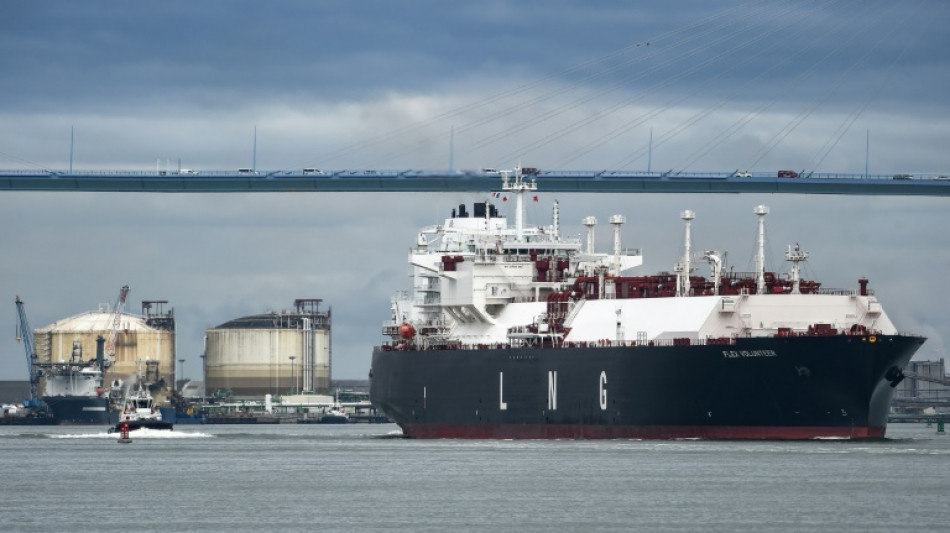
EU agrees deal to ban Russian gas by end of 2027 / Photo: Sebastien SALOM-GOMIS - AFP

 France's Macron, Canada's Carney announce closer ties
 AI 'warning shots' focus Beijing on national security risks

 Philippine tribe in limbo over US-led tech hub
 Saudi-led coalition says Houthis fired ballistic missile at Riyadh
 Cuba works to restore power after another blackout
 Brigitte Bardot widower slams sale of star's belongings

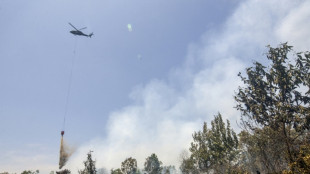 Indonesia accepts Malaysia's help to tackle wildfires

 Nvidia, OpenAI CEOs to attend Xi dinner at White House

 Cuba hit with seventh major blackout of the year

 Nigeria miners struggled to breathe in cell before 37 died: survivors

 Warren Buffett steps down as Berkshire Hathaway chairman

 Isolated Syrian-Druze city blames Damascus for shortages

 Kerry James Marshall: American 'blackness' painter celebrated in Europe

 Infantino 'must go', says German FA vice-president

 Japan's busiest rail station tests robot bins

 Backpackers fret over Australian visa crackdown

 Bank of Japan hikes rates to 31-year high to battle inflation

 AI doomsday warnings unlikely to slow IPOs but questions linger

 In Brazil's Amazon, the hunt for oil fuels hopes and fears

 Baby orangutans in India expose 'frightening' scale of trafficking

 Oversight Board blasts 'inadequate' Meta safeguards for AI deepfakes

 Harry makes first public appearance since return to UK

 Princess Diana's brother makes new explosive claims against Charles

 Trump admin overhauls key protection for endangered species

 Mbappe draws political fire over Ceuta t-shirt controversy

European Union lawmakers and member states reached a deal Wednesday to ban all imports of Russian gas before the end of 2027, as the bloc seeks to choke off key funds feeding Moscow's war chest.
"This is the dawn of a new era, the era of Europe's full energy independence from Russia," EU chief Ursula von der Leyen told reporters following the overnight deal.
Aimed at breaking a reliance the bloc has struggled to end despite the invasion of Ukraine, the accord marks a compromise between EU capitals and the European Parliament, which wanted the ban to hit sooner.
"We've made it: Europe is turning off the tap on Russian gas, forever," EU Energy Commissioner Dan Jorgensen wrote on X.
"We've chosen energy security and independence for Europe. No more blackmail. No more market manipulation by Putin. We stand strong with Ukraine."
But the Kremlin hit back, saying the move would "accelerate" a decline of the EU's economy, as it would force the bloc to resort to more expensive alternatives.
Under the deal, long-term pipeline contracts -- considered the most sensitive because they can run for decades -- will be banned from September 30, 2027, provided storage levels are sufficient, and no later than November 1, 2027.
For liquefied natural gas (LNG), long-term contracts will be prohibited from January 1, 2027, in line with a call by Commission President Ursula von der Leyen to tighten sanctions on Moscow.
Short-term contracts will be phased out earlier: from April 25, 2026 for LNG and June 17, 2026 for pipeline gas.
The move aims "to end dependency on Russian energy following Russia's weaponisation of gas supplies with significant effects on the European energy market", said a European Council statement.
The timeline must still get final approval from the European Parliament and member states.
European companies will be able to invoke "force majeure" to legally justify breaking existing contracts, citing the EU import ban.
- Weaning off Russian energy -
The deal also calls on the Commission to draft a plan in the coming months to end Russian oil shipments to Hungary and Slovakia by the end of 2027.
Hungarian Prime Minister Viktor Orban -- the EU leader closest to the Kremlin -- thumbed his nose at Brussels last month by vowing to keep importing Russian hydrocarbons during a meeting with President Vladimir Putin.
Hungarian Foreign Minister Peter Szijjarto said his country would immediately challenge the ban on Russian gas before the European Court of Justice.
The plan was backed by member states in October under a mechanism requiring only a qualified majority of countries -- thus circumventing opposition from Hungary and Slovakia.
"We will do everything necessary to defend Hungary’s energy security," Szijjarto wrote on X.
The EU moved to wean itself off Russian oil in 2022 but granted exemptions to the two landlocked countries.
Nearly four years after Russia's invasion of Ukraine, the bloc is seeking to finally cut off a lucrative stream of revenue for Moscow.
The share of Russian gas in EU imports has fallen from 45 percent in 2021 to 19 percent in 2024. But while Europe has slashed pipeline deliveries, it has partly turned to LNG -- shipped by sea, unloaded at ports, and fed back into the network.
Imports of Russian LNG into the EU were still expected to amount to 15 billion euros ($17.5 billion) this year.
A.Mykhailo--CPN