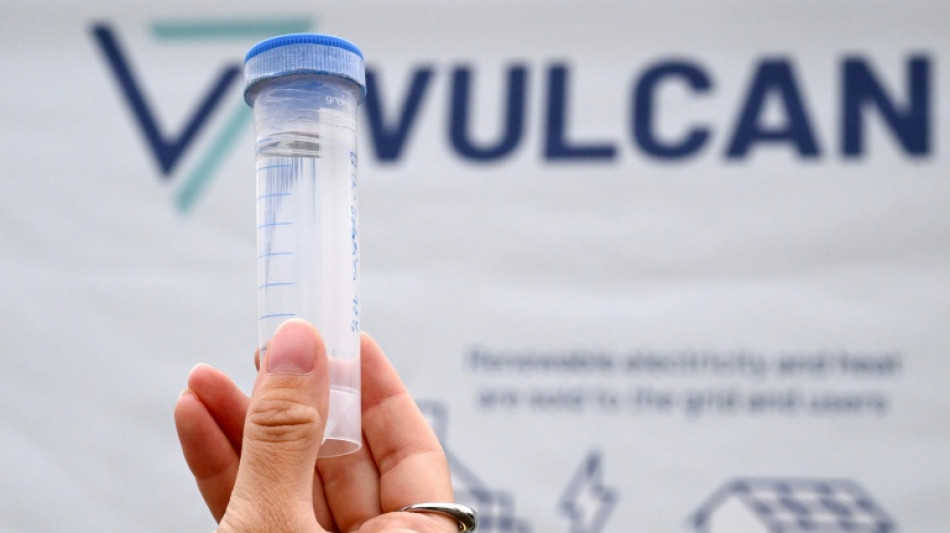
German lithium project moves ahead in boost for Europe's EV sector / Photo: Kirill KUDRYAVTSEV - AFP

 France's Macron, Canada's Carney announce closer ties
 AI 'warning shots' focus Beijing on national security risks
 Philippine tribe in limbo over US-led tech hub

 Saudi-led coalition says Houthis fired ballistic missile at Riyadh
 Cuba works to restore power after another blackout

 Brigitte Bardot widower slams sale of star's belongings

 Indonesia accepts Malaysia's help to tackle wildfires

 Nvidia, OpenAI CEOs to attend Xi dinner at White House

 Cuba hit with seventh major blackout of the year
 Nigeria miners struggled to breathe in cell before 37 died: survivors

 Warren Buffett steps down as Berkshire Hathaway chairman

 Isolated Syrian-Druze city blames Damascus for shortages

 Kerry James Marshall: American 'blackness' painter celebrated in Europe

 Infantino 'must go', says German FA vice-president

 Japan's busiest rail station tests robot bins

 Backpackers fret over Australian visa crackdown

 Bank of Japan hikes rates to 31-year high to battle inflation

 AI doomsday warnings unlikely to slow IPOs but questions linger

 In Brazil's Amazon, the hunt for oil fuels hopes and fears

 Baby orangutans in India expose 'frightening' scale of trafficking

 Oversight Board blasts 'inadequate' Meta safeguards for AI deepfakes

 Harry makes first public appearance since return to UK

 Princess Diana's brother makes new explosive claims against Charles

 Trump admin overhauls key protection for endangered species

 Mbappe draws political fire over Ceuta t-shirt controversy

Australia's Vulcan Energy said Wednesday it will soon start building a German lithium production project that will provide enough of the metal for half a million electric car batteries a year.
The group said it had secured a 2.2 billion euro ($2.5 billion) financing package that will allow it to go ahead with developing its Lionheart project, in Germany's Upper Rhine Valley.
Previously the project had been in a pilot phase but development is set to get underway in the coming days, with commercial lithium production targeted from 2028, said Vulcan.
The initiative will produce a key component in the lithium-ion batteries widely used in electric vehicles, and the news comes as Europe is racing to secure its own supplies of critical materials.
"Lionheart is set to redefine lithium production, delivering Europe's first fully domestic and sustainable lithium value chain," said Vulcan's CEO Cris Moreno.
The project involves extracting brine, or salty water, from geothermal reservoirs and then sending it for processing into lithium hydroxide, the raw material that goes into batteries.
The initiative, which also includes a renewable energy and heat plant that will supply local communities, is backed by German government grants.
"Germany and Australia are sending a strong signal for a more resilient and strategic supply of raw materials," said German Economy Minister Katherina Reiche.
The news comes as the EU was set Wednesday to release a plan to reduce its dependence on China for critical raw materials, through steps including speeding up joint purchasing and accelerating production and recycling in Europe.
China plays a huge role in the global trade for battery minerals, including lithium, and dominates production of EV batteries -- Chinese firm CATL makes over a third of all sold worldwide.
In contrast Europe's EV battery sector has been struggling -- Swedish battery marker Northvolt, long seen as the region's best hope in catching up in the sector, filed for bankruptcy earlier this year.
Demand for EVs has also moved more slowly than expected in Europe, prompting Germany and some other EU member states to press the bloc to water down a planned ban on sales of new combustion-engine cars from 2035.
J.Bondarev--CPN