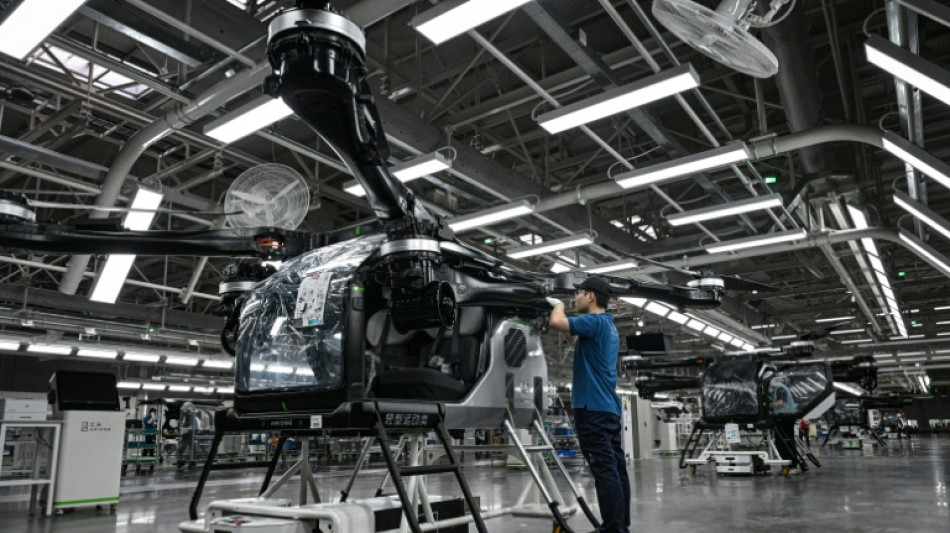
Electric vehicle prowess helps China's flying car sector take off / Photo: Jade GAO - AFP/File

 France's Macron, Canada's Carney announce closer ties

 AI 'warning shots' focus Beijing on national security risks

 Philippine tribe in limbo over US-led tech hub

 Saudi-led coalition says Houthis fired ballistic missile at Riyadh

 Cuba works to restore power after another blackout

 Brigitte Bardot widower slams sale of star's belongings

 Indonesia accepts Malaysia's help to tackle wildfires

 Nvidia, OpenAI CEOs to attend Xi dinner at White House

 Cuba hit with seventh major blackout of the year

 Nigeria miners struggled to breathe in cell before 37 died: survivors

 Warren Buffett steps down as Berkshire Hathaway chairman

 Isolated Syrian-Druze city blames Damascus for shortages

 Kerry James Marshall: American 'blackness' painter celebrated in Europe

 Infantino 'must go', says German FA vice-president

 Japan's busiest rail station tests robot bins

 Backpackers fret over Australian visa crackdown

 Bank of Japan hikes rates to 31-year high to battle inflation

 AI doomsday warnings unlikely to slow IPOs but questions linger

 In Brazil's Amazon, the hunt for oil fuels hopes and fears

 Baby orangutans in India expose 'frightening' scale of trafficking

 Oversight Board blasts 'inadequate' Meta safeguards for AI deepfakes

 Harry makes first public appearance since return to UK

 Princess Diana's brother makes new explosive claims against Charles

 Trump admin overhauls key protection for endangered species

 Mbappe draws political fire over Ceuta t-shirt controversy

A worker in white gloves inspects the propellers of a boxy two-seater aircraft fresh off the assembly line at a Chinese factory trialling the mass production of flying cars.
Globally, technical and regulatory challenges have prevented the much-hyped flying car sector from getting off the ground.
But Chinese companies are building on rapid development of drones and electric vehicles (EVs) in the world's second-largest economy, while harnessing government support for the futuristic inventions.
"China has the potential to establish a competitive edge" for flying cars, said Zhang Yangjun, a professor at Tsinghua University's School of Vehicle and Mobility.
"Future competition will increasingly hinge upon cost control and supply-chain efficiency, and these are areas where China holds clear advantages," he told AFP.
At the brightly lit factory in the southern industrial heartland of Guangzhou, logistics robots zip around ferrying unfinished parts.
The lightweight six-propeller aircraft under construction take off vertically and fit into a large car, to create the "Land Aircraft Carrier" -- a modular flying vehicle made by Aridge, an arm of Chinese EV maker XPeng.
The flying part is stored and charged in a wheeled on-land vehicle dubbed "the mothership".
At full capacity, the Aridge factory can churn out one every 30 minutes. It began its trial production phase in early November and the company plans to start deliveries next year, saying it has had more than 7,000 pre-orders.
- James Bond -
But there is a long way to go before flying cars are whizzing through the air every day.
"Regulations, the consumer's comfort with this product, and also how you manage airspaces, your supply chains, all need to catch up gradually," Michael Du, vice president of Aridge, told reporters at a recent event.
Competition is heating up among global tech giants over the future of aerial mobility, with Tesla CEO Elon Musk teasing the debut of a flying car prototype within weeks.
"If you took all the James Bond cars and combined them, it's crazier than that," Musk told the Joe Rogan Experience podcast.
American aviation pioneer Glenn Curtiss debuted the first flying car prototype in 1917.
But successful designs have only become possible in recent years as electric motors and high-performance batteries have advanced.
Major players in the sector have conducted manned test flights, including California-based companies Joby and Archer, as well as Aridge, EHang and Volant in China.
This year EHang became the world's first flying car company to be fully approved for commercial operation, something Aridge has yet to achieve.
EHang plans to introduce an air taxi service, priced similarly to a premium road taxi, within three years.
"Flying cars remain at an early developmental stage," said Zhang, who edited a white paper on China's flying car industry.
He still sees the sector as worthy of long-term endeavour, and authorities agree.
- Low-altitude economy -
Beijing has named the "low-altitude economy" -- flying cars, drones and air taxis -- as a strategic field for the next five years, seeking to accelerate their development.
Provincial governments from Guangdong to Sichuan have pledged to loosen restrictions.
A Boston Consulting Group report said China's flying car market is approaching "a critical inflection point", and predicted it will be worth $41 billion by 2040.
However, the sector has struggled to find viable business models elsewhere, with several high-profile insolvencies in Europe, and leading US players burning through cash with plans for mass production yet to materialise.
Direct comparisons between the sector in China and other international markets is tricky.
But "in terms of the EV supply chain, China is far in the lead", said Brandon Wang, a Beijing-based investor whose portfolio includes AI, robotics and flying cars.
Flying cars can use EV parts once they are certified for aviation use, which may help Chinese companies scale up.
China also has an "engineer dividend" that allows its companies to quickly solve technical issues in the production process, Wang added.
D.Goldberg--CPN