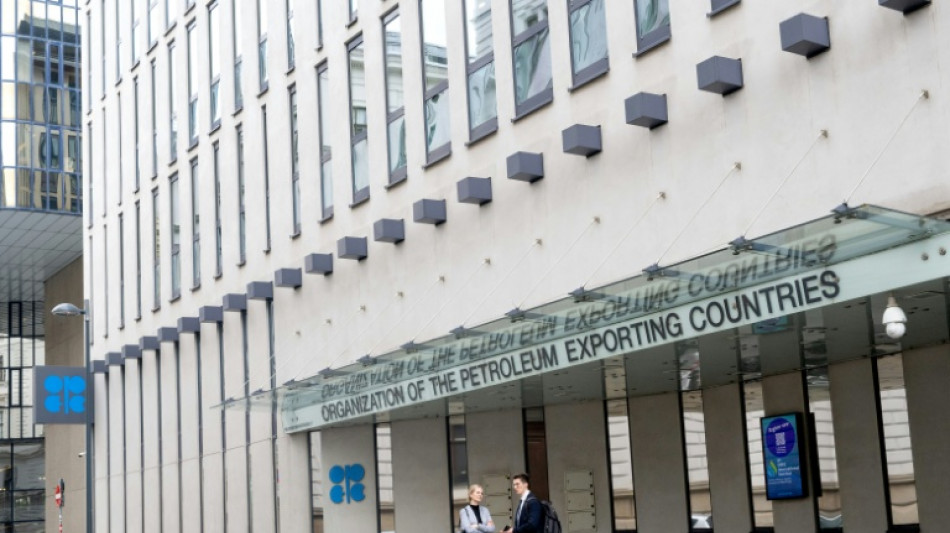
OPEC+ likely to maintain current output levels / Photo: JOE KLAMAR - AFP/File

 France's Macron, Canada's Carney announce closer ties

 AI 'warning shots' focus Beijing on national security risks

 Philippine tribe in limbo over US-led tech hub
 Saudi-led coalition says Houthis fired ballistic missile at Riyadh

 Cuba works to restore power after another blackout
 Brigitte Bardot widower slams sale of star's belongings

 Indonesia accepts Malaysia's help to tackle wildfires

 Nvidia, OpenAI CEOs to attend Xi dinner at White House

 Cuba hit with seventh major blackout of the year

 Nigeria miners struggled to breathe in cell before 37 died: survivors

 Warren Buffett steps down as Berkshire Hathaway chairman

 Isolated Syrian-Druze city blames Damascus for shortages

 Kerry James Marshall: American 'blackness' painter celebrated in Europe

 Infantino 'must go', says German FA vice-president

 Japan's busiest rail station tests robot bins

 Backpackers fret over Australian visa crackdown

 Bank of Japan hikes rates to 31-year high to battle inflation

 AI doomsday warnings unlikely to slow IPOs but questions linger

 In Brazil's Amazon, the hunt for oil fuels hopes and fears

 Baby orangutans in India expose 'frightening' scale of trafficking

 Oversight Board blasts 'inadequate' Meta safeguards for AI deepfakes

 Harry makes first public appearance since return to UK

 Princess Diana's brother makes new explosive claims against Charles

 Trump admin overhauls key protection for endangered species

 Mbappe draws political fire over Ceuta t-shirt controversy

Ministers of the Organization of the Petroleum Exporting Countries and allied nations (OPEC+) are expected to keep current output levels unchanged when they meet for online meetings on Sunday, analysts told AFP.
The biannual ministerial meeting comes as uncertainty remains over how oil prices will develop in the near future, with traders looking for signs that indicate progress in ongoing negotiations on resolving the conflict in Ukraine, which could lead to the return of Russian crude to markets.
Since April, eight key OPEC+ members led by Saudi Arabia and Russia have boosted production in an effort to regain market share amid strong competition from producers outside the group such as the United States, Canada and Guyana.
But in early November, the V8 group announced they would pause their output increases in the first quarter of 2026 due to expected lower seasonal demand, following a small increase in December.
The OPEC+ ministerial meeting is thus "unlikely to deliver any major new drivers for the market", said Commerzbank analyst Barbara Lambrecht.
"A ceasefire would likely stop mutual attacks on energy infrastructure, and sanctions might be eased or even lifted," which would reduce the risk premium that is currently driving up oil prices, she said.
A deadlock in negotiations, however, "could force (US President Donald) Trump to tighten sanctions again" against Russia's oil industry, likely pushing oil prices higher, said Arne Lohmann Rasmussen, an analyst at Global Risk Management.
Uncertainty around the future of oil prices has reinforced analysts' belief that OPEC+ will maintain group-wide current output levels as earlier predicted by the group of eight.
At its previous ministerial meeting, the group said it plans to assess the maximum sustainable production capacity for each member country, which will serve as a benchmark for quotas from 2027 onwards.
"There's some noise around how there could be some discussions around baseline production levels," said Kim Fustier, an analyst at HSBC.
However, Fustier believed it was "still too soon for them to be discussing it" and that the group would wait until 2026.
Y.Uduike--CPN