Europe secures record space budget to boost independence / Photo: FOCKE STRANGMANN - AFP

 Asia stocks rise on AI, US-China trade talks optimism
 Multi-Asset Trading Venue Monochrome Exchange Announces IEO of Its Native Token, $MCR
 Data centre command hub keeps AI up and running

 Leo XIV, first US pope transcends his restrained style
 France's debt climbs to highest since 1978: ministry

 Thousands protest inaction over climate crisis in Switzerland

 UK actor Naomi Watts honoured at Spain film festival
 Trump signs bill authorizing sweeping Russia sanctions

 Anthropic picks Accenture for in-house AI safety evaluation

 Hushing and hedging: US companies retreat on climate

 Crisis-wracked Volkswagen warns of 10-bn-euro hit to profits

 Shakira to cap off world tour with Madrid 12-gig run

 Isolated Syrian-Druze city shortages

 UNESCO can be 'moderator' in AI debate: chief to AFP

 Russia seizes assets of Nestle, French firms

 Anthropic says AI systems moving towards building themselves

 Asian stocks boosted by falling oil, yen weakens after BoJ rate hike

 Afghan medical students in Pakistan hope court stops college expulsions

 Australia to detain tourists who overstay visa, minister says

 Asian stocks track Wall St rally as oil prices drop

 Prized Mexican relic returns on loan, two centuries on

 'In our lane': Fed's Warsh defies Trump but still fighting for credibility

 Trump admin makes major cut to endangered species protections

 GM delivers first components for US interceptor missiles

 Travis Scott and Keith Richards feature on GTA VI soundtrack

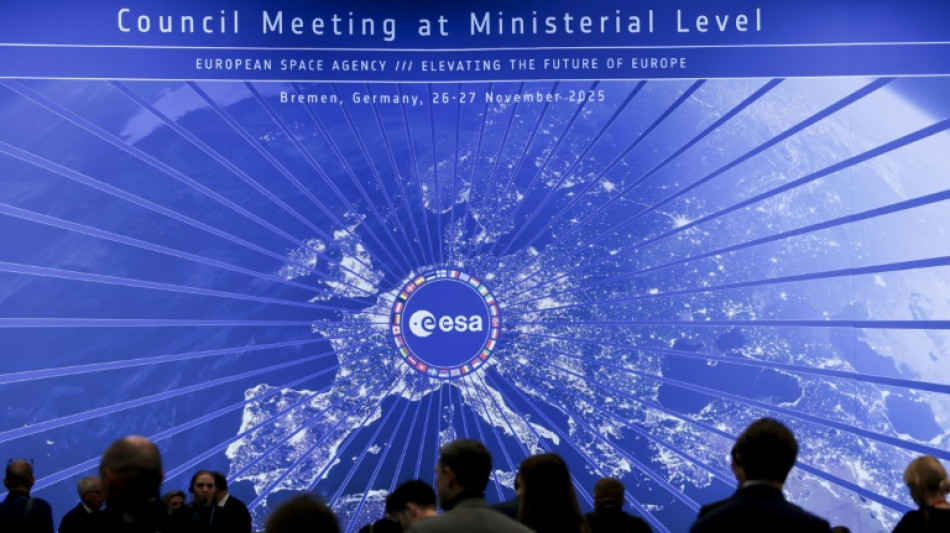
The European Space Agency announced Thursday it had secured a record budget of 22.1 billion euros to fund its programmes for the next three years, as the continent seeks greater independence in space.
The ESA also approved a plan to bolster defence cooperation and laid out plans for scientific space missions at a ministerial council meeting in the German city of Bremen.
The agency's 23 member states committed five billion euros more than 2022's budget, with the total representing almost all of the 22.2-billion-euro ($25.7 billion) funding sought by the agency.
"This has never happened before," ESA director general Josef Aschbacher told the meeting.
The amount of funding "speaks volumes -- it's a sign of confidence in the agency, Aschbacher AFP in an interview.
At the heart of the discussions in Bremen was the European Resilience from Space programme, which includes Earth observation, navigation and telecommunications.
The programme, with an estimated 1.35-billion-euro budget, has both civilian and military applications.
"Defence is always a matter of national sovereignty," said Aschbacher. "But pooling and sharing assets also has a European dimension."
One example was increasing "the number of observations and satellite images for intelligence and surveillance purposes", he said.
If the United States and China continue building huge constellations of satellites and Europe does nothing, Aschbacher feared "the same thing will happen as with Starlink: there will be a dominant US company threatening our European companies and our position".
Germany was the biggest contributor to the total budget with more than five billion euros, followed by France with 3.7 billion.
- Rockets and telescopes -
The industry has changed significantly in recent years as billionaire Elon Musk's SpaceX has risen to dominate the space launches.
Europe lost an independent way to launch its missions into space after Russia pulled its rockets following Moscow's invasion of Ukraine in 2022.
After repeated delays, Europe's new heavy lift Ariane 6 rocket finally blasted off last year. However the rocket is not reusable, unlike SpaceX's Falcon 9 workhorse.
So the ESA is planning to contract out the job of developing the continent's first reusable rocket, having named a shortlist of potential companies.
In Bremen, the European Launcher Challenge received more than 900 million euros in contributions -- twice what had been proposed, Aschbacher said.
The funding boost for ESA comes as US space agency NASA faces stiff budget cuts under President Donald Trump.
However, the ESA said this week that NASA had confirmed it would contribute to Europe's Martian rover Rosalind Franklin.
The mission is scheduled to launch in 2028 aiming to drill into the surface of Mars looking for signs of extraterrestrial life.
Among the scientific projects the ESA has proposed for the future -- but have not yet been approved -- is the first space-based laser observatory aiming to study gravitational waves, which are ripples in spacetime first predicted by Albert Einstein.
Another is the X-ray telescope NewAthena, which would study extreme events in the universe such as supermassive black holes.
There is also a plan to send a spacecraft to Saturn's moon Enceladus, which scientists suspect could have a liquid ocean under its icy shell that might be able to host life.
The ESA also has a joint proposal with Japan to send a spacecraft called Ramses to study the asteroid Apophis as it zings past Earth in 2029, hoping to learn more about how to fend off dangerous space rocks in the future.
- European astronauts to the Moon? -
Also on Thursday, the ESA announced that the first European astronauts to participate in NASA's Artemis programme -- which aims to return humans to the Moon -- will be from Germany, France and Italy.
"I can announce today that the first flight will be allocated to a German astronaut," Aschbacher said on the sidelines of the ministerial meeting.
The programme's first crewed mission to the Moon -- which will not set foot on its surface -- is planned to launch in the first half of next year.
French astronaut Thomas Pesquet, one of his country's leading candidates, said in Bremen that "it has never really been officially confirmed, so this is a positive."
"It means that Europe has its place in this adventure," he added.
O.Hansen--CPN