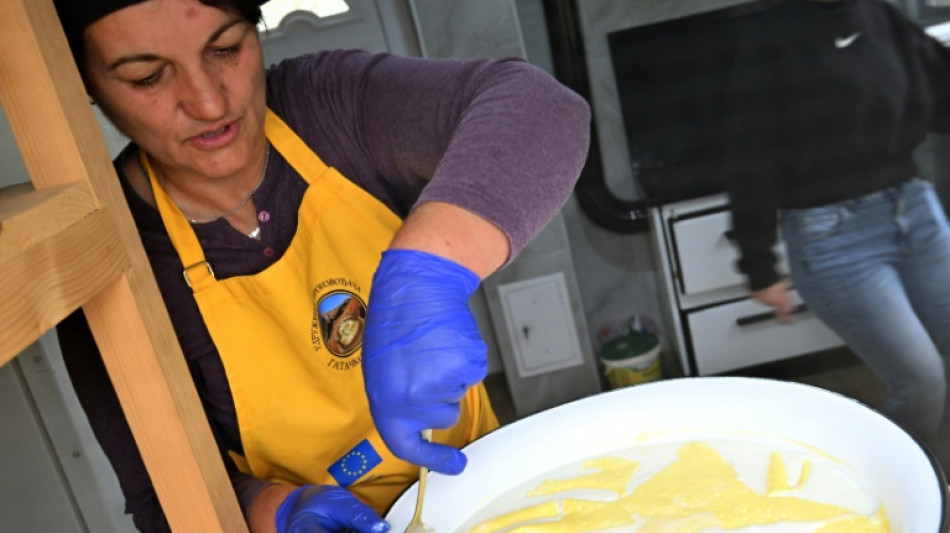
Beloved sheepskin-sack cheese Bosnia wants to protect / Photo: Elvis BARUKCIC - AFP

 Asia stocks rise on AI, US-China trade talks optimism

 Multi-Asset Trading Venue Monochrome Exchange Announces IEO of Its Native Token, $MCR

 Data centre command hub keeps AI up and running
 Leo XIV, first US pope transcends his restrained style

 France's debt climbs to highest since 1978: ministry

 Thousands protest inaction over climate crisis in Switzerland
 UK actor Naomi Watts honoured at Spain film festival
 Trump signs bill authorizing sweeping Russia sanctions

 Anthropic picks Accenture for in-house AI safety evaluation

 Hushing and hedging: US companies retreat on climate

 Crisis-wracked Volkswagen warns of 10-bn-euro hit to profits

 Shakira to cap off world tour with Madrid 12-gig run

 Isolated Syrian-Druze city shortages

 UNESCO can be 'moderator' in AI debate: chief to AFP

 Russia seizes assets of Nestle, French firms

 Anthropic says AI systems moving towards building themselves

 Asian stocks boosted by falling oil, yen weakens after BoJ rate hike

 Afghan medical students in Pakistan hope court stops college expulsions

 Australia to detain tourists who overstay visa, minister says

 Asian stocks track Wall St rally as oil prices drop

 Prized Mexican relic returns on loan, two centuries on

 'In our lane': Fed's Warsh defies Trump but still fighting for credibility

 Trump admin makes major cut to endangered species protections

 GM delivers first components for US interceptor missiles

 Travis Scott and Keith Richards feature on GTA VI soundtrack

High in the mountain meadows of southern Bosnia, farmer Branka Buha monitors her cows through a GPS signal on her husband's phone.
But when it comes to making her kajmak cheese, she sticks to the traditional method: ageing it in sheepskin sacks.
"It's a tradition passed down from my mother, from my mother-in-law. Now, I'm passing it on to my daughter-in-law," said 55-year-old Buha.
Her dairy is nestled in the hilly hamlet of Domrke, near Gacko.
At 1,200 metres (3,900 feet), and with lots of grass and wind, Buha says she has everything she needs to produce good "kajmak iz mjesine", a creamy cheese aged in animal hide -- typically sheep or lambskin around here.
Her eight cows freely wander the mountain pastures during the day, returning themselves in the evening to be milked, although one has a GPS collar in case they get lost or run into bears or wolves.
- 'Ancient preservation method' -
Her kajmak is a slightly crumblier, more flavourful cousin of the creamy "kaymak" people across the Balkans and Turkey love to spread on their bread.
After milking her cows, Buha cooks the milk in a large pot before pouring it into enamel bowls or wooden containers.
"A day or two later, depending on the ambient temperature, we skim off the milk skin that forms on the surface of the milk," she said, scooping up a thick yellow layer with a spoon.
Salted is added and then it is left to rest in a wooden barrel for around 20 days, then wrapped in animal hide.
"The longer it stays in the skin, the more it matures and acquires the specific flavour of the skin. That is what makes it unique," Buha said.
Buha also makes the sheepskin bags. Once the skin is shaved off, the hide is dried over smoke.
When dry, "we wash it carefully and stuff it with kajmak, which is then aged in the skin for up to a month. But it can even stay there for a year," she added.
"It is an ancient preservation method. When there was no electricity or other modern means of preservation, the skin was used to preserve this cheese," said Dragana Milovic, head of the Gacko Kajmak Producers Association.
Much stronger than the traditional kajmak sold in local shops and markets, the cheese has notes of smoke and lamb that set it apart.
- 'Prestige' -
With her husband, Buha produces between 500 and 600 kilos (1,100 and 1,325 pounds) of kajmak each year.
They sell their cheese at their farm or to restaurants, where it is usually served with meat dishes.
It is also eaten on toast with honey, or added to "cicvara", a traditional cornmeal dish not unlike polenta.
In 2024, kajmak was granted national Protected Designation of Origin (PDO) status, raising its price per kilo from 40 convertible marks ($24) to 50 ($30).
This means the cheese can be made only with milk from cows that graze in the Gacko region. The cows must also be fed only with locally harvested hay.
The Gacko Kajmak Producers Association recently applied for PDO status at the EU level, said Milovic.
As a formal candidate for membership of the 27-nation bloc, Bosnia-Herzegovina has the right to protect its products there.
But with only small amounts of the sheepskin-sack kajmak being produced, it is more a matter of "prestige" than as an export earner, Milovic added.
J.Bondarev--CPN