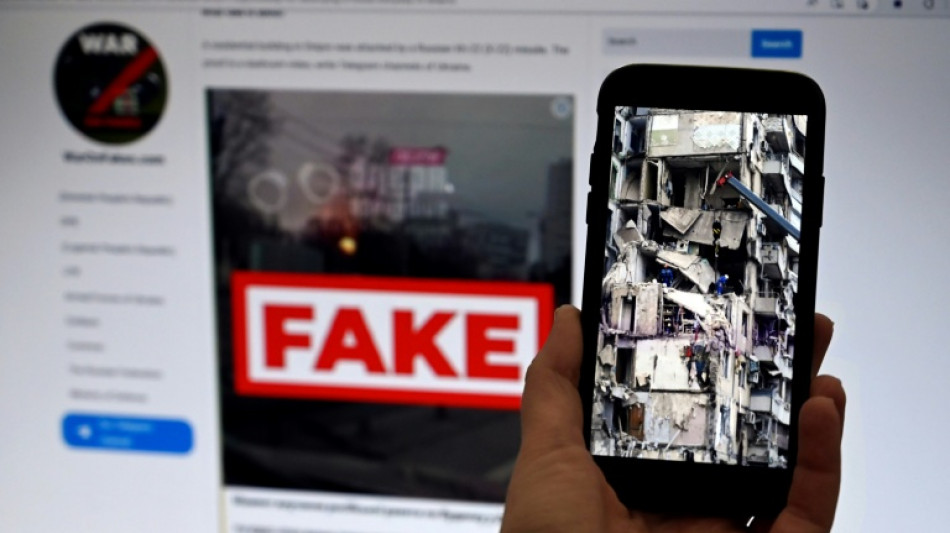
As Ukraine battles for key city, pro-Russian accounts wage AI war / Photo: OLIVIER DOULIERY - AFP

 Asia stocks rise on AI, US-China trade talks optimism
 Multi-Asset Trading Venue Monochrome Exchange Announces IEO of Its Native Token, $MCR
 Data centre command hub keeps AI up and running
 Leo XIV, first US pope transcends his restrained style
 France's debt climbs to highest since 1978: ministry
 Thousands protest inaction over climate crisis in Switzerland

 UK actor Naomi Watts honoured at Spain film festival
 Trump signs bill authorizing sweeping Russia sanctions

 Anthropic picks Accenture for in-house AI safety evaluation
 Hushing and hedging: US companies retreat on climate

 Crisis-wracked Volkswagen warns of 10-bn-euro hit to profits

 Shakira to cap off world tour with Madrid 12-gig run

 Isolated Syrian-Druze city shortages

 UNESCO can be 'moderator' in AI debate: chief to AFP

 Russia seizes assets of Nestle, French firms

 Anthropic says AI systems moving towards building themselves

 Asian stocks boosted by falling oil, yen weakens after BoJ rate hike

 Afghan medical students in Pakistan hope court stops college expulsions

 Australia to detain tourists who overstay visa, minister says

 Asian stocks track Wall St rally as oil prices drop

 Prized Mexican relic returns on loan, two centuries on

 'In our lane': Fed's Warsh defies Trump but still fighting for credibility

 Trump admin makes major cut to endangered species protections

 GM delivers first components for US interceptor missiles

 Travis Scott and Keith Richards feature on GTA VI soundtrack

Fighting for control of Pokrovsk in Ukraine's east is raging on, but in pro-Russian social media circles, Moscow has already won: viral, AI-generated videos depict a Ukrainian army in retreat, complete with fake, tearful soldiers.
Russia has been trying to capture the logistics hub in the eastern Donetsk region for more than a year, intensifying its assault in recent weeks and closing in on its outskirts in a pincer-shaped movement, according to battlefield maps published by the Institute for the Study of War.
Although the battle continues, a series of viral social media posts tell a different story: dozens of AI-generated videos of Ukrainian soldiers surrendering their weapons or weeping on their way to the front circulated on social media in November, clocking up millions of views.
The fake videos are part of a "broader narrative that we've seen since the beginning of the invasion, with (Ukrainian President Volodymyr) Zelensky sending the young and elderly to the front line against their will because they are not doing well", said Pablo Maristany de las Casas, an analyst for the Institute for Strategic Dialogue.
"There is always an event on which one can build false information," added Carole Grimaud, a researcher at France's Aix-Marseille University.
The videos "instrumentalise uncertainty to sow doubt in public opinion", she told AFP.
- Visual inconsistencies -
In one video, a Ukrainian soldier claiming to be "leaving Pokrovsk" walks without difficulty despite a cast on his leg. A stretcher appears to levitate, and disembodied legs fade in and out of the background.
These visual inconsistencies remain typical of content created by generative artificial intelligence, but they are becoming increasingly difficult to spot with the naked eye.
Other fake videos, some bearing the logo of OpenAI's Sora video creation tool, show soldiers in Ukrainian uniforms crying and begging not to be sent to the front.
Some of them appeared to use the faces of Russian online streamers.
Among those was exiled Russian YouTuber Alexei Gubanov, whose likeness appeared in a fake video of a Ukrainian soldier weeping.
"Obviously it's not me," he said in a YouTube video.
"Unfortunately, a lot of people believe this... and that plays into the hands of Russian propaganda."
- 'Chipping' at morale -
The European Digital Media Observatory, an EU-funded network of fact-checking organisations, says its community has published more than 2,000 articles related to the Ukraine war since Russia invaded in 2022, and AI has become an increasingly prevalent topic.
Ian Garner, a specialist in Russian propaganda at the Pilecki Institute, said disinformation is "an old tactic, but the technology is new".
The videos work by "chipping away at Ukrainian morale, saying: 'Look, this is somebody just like you, it could be your brother, your father'", he said.
Meanwhile, they boost Russian morale, he added.
TikTok told AFP that the accounts appearing to be behind these videos had been deleted, but not before one of them garnered more than 300,000 "likes" and several million views.
OpenAI told AFP it had conducted an investigation, without elaborating.
But this hasn't stopped the videos from circulating.
AFP found them, among other places, on Instagram, Telegram, Facebook and X in posts in Greek, Romanian, Bulgarian, Czech, Polish and French; on the website of a Russian weekly; and in a Serbian tabloid.
The impact of a fake video is difficult to measure, but "when it is repeated, it is possible that people's perceptions change", Grimaud said.
AI chatbots are also being used to promote pro-Kremlin talking points.
An Institute for Strategic Dialogue study published in October showed that among the chatbots tested, "almost one-fifth of responses cited Russian state-attributed sources".
While some companies have shown a willingness to combat the misuse of their tools, said Maristany de las Casas, "the scale and impact of information warfare outpace the companies' responses".
A.Levy--CPN