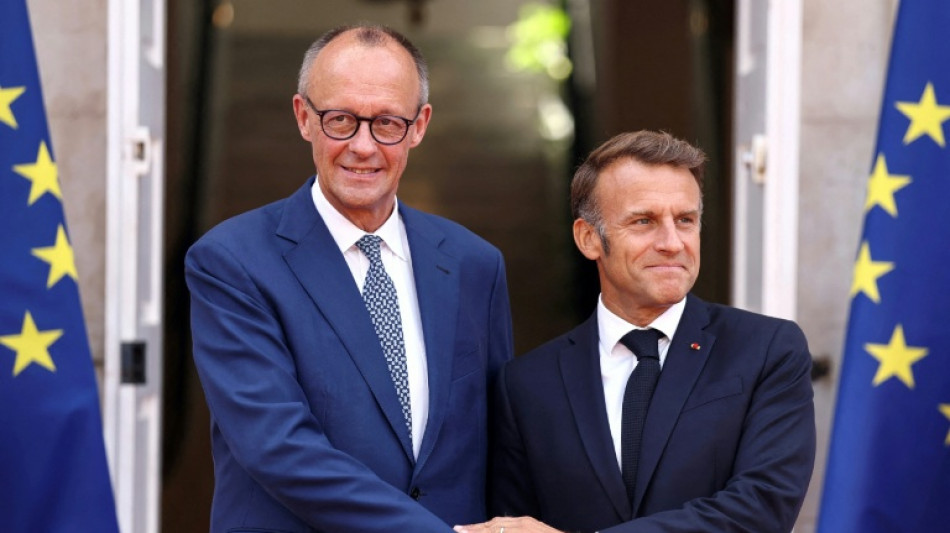
Merz, Macron to push for European digital 'sovereignty' / Photo: Manon Cruz - POOL/AFP

 Asia stocks rise on AI, US-China trade talks optimism
 Multi-Asset Trading Venue Monochrome Exchange Announces IEO of Its Native Token, $MCR
 Data centre command hub keeps AI up and running

 Leo XIV, first US pope transcends his restrained style

 France's debt climbs to highest since 1978: ministry

 Thousands protest inaction over climate crisis in Switzerland

 UK actor Naomi Watts honoured at Spain film festival

 Trump signs bill authorizing sweeping Russia sanctions
 Anthropic picks Accenture for in-house AI safety evaluation

 Hushing and hedging: US companies retreat on climate

 Crisis-wracked Volkswagen warns of 10-bn-euro hit to profits

 Shakira to cap off world tour with Madrid 12-gig run

 Isolated Syrian-Druze city shortages

 UNESCO can be 'moderator' in AI debate: chief to AFP

 Russia seizes assets of Nestle, French firms

 Anthropic says AI systems moving towards building themselves

 Asian stocks boosted by falling oil, yen weakens after BoJ rate hike

 Afghan medical students in Pakistan hope court stops college expulsions

 Australia to detain tourists who overstay visa, minister says

 Asian stocks track Wall St rally as oil prices drop

 Prized Mexican relic returns on loan, two centuries on

 'In our lane': Fed's Warsh defies Trump but still fighting for credibility

 Trump admin makes major cut to endangered species protections

 GM delivers first components for US interceptor missiles

 Travis Scott and Keith Richards feature on GTA VI soundtrack

German Chancellor Friedrich Merz and French President Emmanuel Macron will join forces Tuesday to push for greater European digital "sovereignty" and less dependence on US tech titans as the AI race gathers pace.
The leaders of Europe's biggest economies will make the call at a Berlin summit, which will also be attended by CEOs of top regional firms including French AI company Mistral and German software giant SAP.
With artificial intelligence set to play an increasingly important role in many sectors, Europe's leaders are responding to growing calls for the continent to take greater control of its own digital destiny.
Concerns about American tech dominance have also escalated since the return of US President Donald Trump, who has questioned long-standing ties between the continent and Washington in many areas.
German Digital Minister Karsten Wildberger said Monday that the summit's "core message" would be that "Europe is ready to shape its own digital future, to reduce dependence".
"We can make better progress by working together," he added while attending a ground-breaking ceremony for an 11-billion-euro ($12.8 billion) data centre outside Berlin.
The European Union in particular has been criticised for moving too slowly in the battle for AI dominance against the United States and China.
The EU will propose a rollback of rules on AI and data protection later this week, a topic that is expected to feature prominently at the summit.
Both European businesses struggling to catch up and American tech giants have complained about the regulations, although the EU now stands accused of putting competitiveness before citizens' privacy.
- Cloud computing concerns -
Another topic of discussion in Berlin will be efforts to build up "sovereign" EU cloud computing capabilities. Proponents argue such facilities would better protect Europeans' data in a sector currently dominated by US firms like Google, AWS and Microsoft.
Fostering greater competition between industry and governments as well as creating "fair and efficient" digital markets will also be on the agenda.
Merz and Macron are due to give keynote addresses in the afternoon at the summit, which will also be attended by digital ministers from across Europe. Both leaders will then have dinner with British Prime Minister Keir Starmer, a German government spokesman said, without revealing what the trio will talk about.
Several announcements related to new digital initiatives are expected.
As well as worries about US dependence, Europe has more long-standing concerns about reliance on firms from Communist Party-ruled China and other parts of Asia for hardware, from semiconductors to laptop components.
According to a survey by digital business association Bitkom, about 90 percent of German companies that import digital goods or services consider themselves dependent on them.
- 'Europe must invest' -
Bitkom President Ralf Wintergerst said that Europe needed to urgently invest more in the digital sector.
"Europe must not fall behind -- today's investments secure tomorrow's competitiveness and jobs," he told AFP. "If Europe does not want to become a museum of technology, we must ramp up investment significantly."
But Europe faces an uphill battle. The region is struggling after a period of prolonged economic weakness and its tech firms remain far smaller than their US rivals.
As of last year the continent's data centres -- crucial for AI -- had computing capacity of just 16 gigawatts, compared with 48 in the US and 38 in China, according to a recent Bitkom study.
And recent investment announcements in Germany -- billions of dollars from Google and a tie-up between US chip juggernaut Nvidia and Deutsche Telekom for an industrial AI hub -- have only highlighted the continued dependence on American tech, critics say.
Despite the US-Europe tensions, a senior official from the French presidency said the summit was not about "confrontation" with the United States or even China.
Rather it is about "how we protect our core sovereignty and what rules need to be established, especially at the European level", said the official.
D.Goldberg--CPN